US8147680B2 - Separating compositions - Google Patents
Separating compositions Download PDFInfo
- Publication number
- US8147680B2 US8147680B2 US12/952,963 US95296310A US8147680B2 US 8147680 B2 US8147680 B2 US 8147680B2 US 95296310 A US95296310 A US 95296310A US 8147680 B2 US8147680 B2 US 8147680B2
- Authority
- US
- United States
- Prior art keywords
- composition
- separating composition
- separating
- weight
- basf
- Prior art date
- Legal status (The legal status is an assumption and is not a legal conclusion. Google has not performed a legal analysis and makes no representation as to the accuracy of the status listed.)
- Active
Links
- 0 O=P(O[K])(O[K])OCCOC1=CC=CC=C1.[1*]C Chemical compound O=P(O[K])(O[K])OCCOC1=CC=CC=C1.[1*]C 0.000 description 9
Classifications
-
- C—CHEMISTRY; METALLURGY
- C10—PETROLEUM, GAS OR COKE INDUSTRIES; TECHNICAL GASES CONTAINING CARBON MONOXIDE; FUELS; LUBRICANTS; PEAT
- C10G—CRACKING HYDROCARBON OILS; PRODUCTION OF LIQUID HYDROCARBON MIXTURES, e.g. BY DESTRUCTIVE HYDROGENATION, OLIGOMERISATION, POLYMERISATION; RECOVERY OF HYDROCARBON OILS FROM OIL-SHALE, OIL-SAND, OR GASES; REFINING MIXTURES MAINLY CONSISTING OF HYDROCARBONS; REFORMING OF NAPHTHA; MINERAL WAXES
- C10G1/00—Production of liquid hydrocarbon mixtures from oil-shale, oil-sand, or non-melting solid carbonaceous or similar materials, e.g. wood, coal
- C10G1/04—Production of liquid hydrocarbon mixtures from oil-shale, oil-sand, or non-melting solid carbonaceous or similar materials, e.g. wood, coal by extraction
- C10G1/047—Hot water or cold water extraction processes
Abstract
A water-based separating composition for separating hydrocarbons from hydrocarbon-containing material includes at least about 71% by weight water, a hydrotropic agent, a dispersant having flocculating characteristics, a wetting agent, and at least one acid and at least one base in amounts sufficient to provide the separating composition with a pH of about 7 to about 8.5. The hydrotropic agent and the dispersant having flocculating characteristics are different.
Description
This application is a continuation of U.S. Non Provisional application Ser. No. 12/765,969 filed on Apr. 23, 2010, issued as U.S. Pat. No. 7,862,709 on Jan. 4, 2011, which is a continuation of U.S. Non Provisional application Ser. No. 11/868,031 filed on Oct. 5, 2007, issued as U.S. Pat. No. 7,749,379 on Jul. 6, 2010, which claims the benefit of priority from U.S. Provisional Application No. 60/828,501 filed on Oct. 6, 2006. The entire disclosures of the earlier applications are hereby incorporated by reference.
Oil sands, also known as “tar sands” and “bituminous sands,” are a mixture of bitumen (tar), sand, and water. Bitumen is a heavy, viscous crude oil, having relatively high sulfur content. When properly separated from the oil sands, bitumen may be processed to synthetic crude oil suitable for use as a feedstock for the production of liquid motor fuels, heating oil, and petrochemicals. Oil sand fields exist throughout most of the world. Particularly significant deposits exist in Canada, including the Athabasca oil sands in Alberta, the United States, including the Utah oil sands, South America, including the Orinoco oil sands in Venezuela, and Africa, including the Nigerian oil sands. A majority of all of the known oil in the world is contained in oil sands.
Bitumen is very difficult to separate from oil sands in an efficient and environmentally acceptable manner. Current efforts to separate bitumen from oil sands typically yield only about 85-92% of the available bitumen. Moreover, current efforts to separate bitumen from oil sands include the creation of emulsions, or “froth,” during processing, requiring the use of environmentally harmful organic solvents such as naphtha to “crack” the emulsions and allow for further processing. In addition, the bitumen that remains in the sand (and other particulate matter, such as clay) component of the oil sands contributes to the creation of a heavy sludge, often referred to as “tailings.” Current practice for the disposal of the tailings, which are comprised of unrecovered bitumen, sand (and other particulate matter), and water is to pump the tailings into huge tailings ponds, where the sand and other particulate matter slowly settle and stratify over the course of several years.
The present exemplary embodiments describe compositions and methods for separating bitumen from oil sands in an efficient and environmentally acceptable manner, and for recovering residual bitumen from existing tailings ponds.
According to one aspect of the present embodiments, a composition is provided, comprising a separating composition comprising a wetting agent in the amount of from about 0.001% to about 2.5% by weight of the separating composition, a hydrotropic agent, and a dispersant having flocculating characteristics, wherein the separating composition has a pH of greater than 7.5.
According to another aspect of the present embodiments, a separating composition is provided, comprising from about 0.001% to about 2.5% by weight of a wetting agent; from about 0.1% to about 4.0% by weight of a hydrotropic agent; and from about 0.25% to about 4.5% by weight of a dispersant having flocculating characteristics.
According to another aspect of the present embodiments, a separating composition for separating bitumen from oil sands or tailings is provided, comprising from about 0.001% to about 2.5% by weight of 2,5,8,11-tetramethyl-6-dodecyn-5,8-diol ethoxylate; from about 0.1% to about 4.0% by weight of an aromatic phosphate ester having the formula:

wherein R1 is a C1-C5 linear or branched alkyl group and n=1 to 8; from about 0.001% to about 4.5% by weight of sodium acid pyrophosphate; from about 0.001% to about 4.5% by weight of tetrapotassium pyrophosphate; from about 2% to about 9.5% by weight of sodium hydroxide; and from about 1.7% to about 8.6% by weight of phosphoric acid, wherein the separating composition has a pH of from about 7.0 to about 8.5.
According to another aspect of the present embodiments, a method for separating bitumen from oil sands is provided, comprising contacting a separating composition comprising a wetting agent, a hydrotropic agent, and a dispersant having flocculating characteristics with oil sands comprising bitumen and sand; heating the separating composition and the oil sands; agitating the separating composition and the oil sands; and recovering the bitumen and sand as separate products.
According to another aspect of the present embodiments, a method for separating bitumen from tailings is provided, comprising contacting a separating composition comprising a wetting agent, a hydrotropic agent, and a dispersant having flocculating characteristics with tailings comprising bitumen and sand; heating the separating composition and the tailings; agitating the separating composition and the tailings; and recovering the bitumen and sand as separate products.
As used herein, the term “about” means “approximately,” and, in any event, may indicate as much as a 10% deviation from the number being modified.
As used herein, “essentially free” means an amount less than about 0.1%.
In one embodiment, a composition is provided, comprising a separating composition comprising a wetting agent in the amount of from about 0.001% to about 2.5% by weight of the separating composition, a hydrotropic agent, and a dispersant having flocculating characteristics, wherein the separating composition has a pH of greater than 7.5.
Suitable wetting agents may include, for example, one or more of DYNOL™ 607 Surfactant (Air Products and Chemicals, Inc.), SURFYNOL® 420 (Air Products and Chemicals, Inc.), SURFYNOL® 440 (Air Products and Chemicals, Inc.), SURFYNOL® 465 (Air Products and Chemicals, Inc.), SURFYNOL® 485 (Air Products and Chemicals, Inc.), DYNOL™ 604 Surfactant (Air Products and Chemicals, Inc.), TOMADOL® 91-2.5 (Tomah Products, Inc.), TOMADOL® 91-6 (Tomah Products, Inc.), TOMADOL® 91-8 (Tomah Products, Inc.), TOMADOL® 1-3 (Tomah Products, Inc.), TOMADOL® 1-5 (Tomah Products, Inc.), TOMADOL® 1-7 (Tomah Products, Inc.), TOMADOL® 1-73B (Tomah Products, Inc.), TOMADOL® 1-9 (Tomah Products, Inc.), TOMADOL® 23-1 (Tomah Products, Inc.), TOMADOL® 23-3 (Tomah Products, Inc.), TOMADOL® 23-5 (Tomah Products, Inc.), TOMADOL® 23-6.5 (Tomah Products, Inc.), TOMADOL® 25-3 (Tomah Products, Inc.), TOMADOL® 25-7 (Tomah Products, Inc.), TOMADOL® 25-9 (Tomah Products, Inc.), TOMADOL® 25-12 (Tomah Products, Inc.), TOMADOL® 45-7 (Tomah Products, Inc.), TOMADOL® 45-13 (Tomah Products, Inc.), TRITON™ X-207 Surfactant (Dow Chemical Company), TRITON™ CA Surfactant (Dow Chemical Company), NOVEC™ Fluorosurfactant FC-4434 (3M Company), POLYFOX™ AT-1118B (Omnova Solutions, Inc.), ZONYL® 210 (Dupont), ZONYL® 225 (Dupont), ZONYL® 321 (Dupont), ZONYL® 8740 (Dupont), ZONYL® 8834L (Dupont), ZONYL® 8857A (Dupont), ZONYL® 8952 (Dupont), ZONYL® 9027 (Dupont), ZONYL® 9338 (Dupont), ZONYL® 9360 (Dupont), ZONYL® 9361 (Dupont), ZONYL® 9582 (Dupont), ZONYL® 9671 (Dupont), ZONYL® FS-300 (Dupont), ZONYL® FS-500 (Dupont), ZONYL® FS-610 (Dupont), ZONYL® 1033D (Dupont), ZONYL® FSE (DuPont), ZONYL® FSK (DuPont), ZONYL® FSH (DuPont), ZONYL® FSJ (DuPont), ZONYL® FSA (DuPont), ZONYL® FSN-100 (DuPont), LUTENSOL® OP 30-70% (BASF), LUTENSOL® A 12 N (BASF), LUTENSOL® A 3 N (BASF), LUTENSOL® A 65 N (BASF), LUTENSOL® A 9 N (BASF), LUTENSOL® AO 3 (BASF), LUTENSOL® AO 4 (BASF), LUTENSOL® AO 8 (BASF), LUTENSOL® AT 25 (BASF), LUTENSOL® AT 55 PRILL SURFACTANT (BASF), LUTENSOL® CF 10 90 SURFACTANT (BASF), LUTENSOL® DNP 10 (BASF), LUTENSOL® NP 4 (BASF), LUTENSOL® NP 10 (BASF), LUTENSOL® NP-100 PASTILLE (BASF), LUTENSOL® NP-6 (BASF), LUTENSOL® NP-70-70% (BASF), LUTENSOL® NP-50 (BASF), LUTENSOL® NP 9 (BASF), LUTENSOL® ON 40 SURFACTANT (BASF), LUTENSOL® ON 60 (BASF), LUTENSOL® OP-10 (BASF), LUTENSOL® TDA 10 SURFACTANT (BASF), LUTENSOL® TDA 3 SURFACTANT (BASF), LUTENSOL® TDA 6 SURFACTANT (BASF), LUTENSOL® TDA 9 SURFACTANT (BASF), LUTENSOL® XL 69 (BASF), LUTENSOL® XL 100 (BASF), LUTENSOL® XL 140 (BASF), LUTENSOL® XL 40 (BASF), LUTENSOL® XL 50 (BASF), LUTENSOL® XL 60 (BASF), LUTENSOL® XL 70 (BASF), LUTENSOL® XL 79 (BASF), LUTENSOL® XL 80 (BASF), LUTENSOL® XL 89 (BASF), LUTENSOL® XL 90 (BASF), LUTENSOL® XL 99 (BASF), LUTENSOL® XP 100 (BASF), LUTENSOL® XP 140 (BASF), LUTENSOL® XP 30 (BASF), LUTENSOL® XP 40 (BASF), LUTENSOL® XP 50 (BASF), LUTENSOL® XP 60 (BASF), LUTENSOL® XP 69 (BASF), LUTENSOL® XP 70 (BASF), LUTENSOL® XP 79 (BASF), LUTENSOL® XP 80 (BASF), LUTENSOL® XP 89 (BASF), LUTENSOL® XP 90 (BASF), LUTENSOL® XP 99 (BASF), MACOL® 16 SURFACTANT (BASF), MACOL® CSA 20 POLYETHER (BASF), MACOL® LA 12 SURFACTANT (BASF), MACOL® LA 4 SURFACTANT (BASF), MACOL® LF 110 SURFACTANT (BASF), MACOL® LF 125A SURFACTANT (BASF), MAZON® 1651 SURFACTANT (BASF), MAZOX® LDA Lauramine OXIDE (BASF), PLURAFAC® AO8A Surfactant (BASF), PLURAFAC® B-26 Surfactant (BASF), PLURAFAC® B25-5 Surfactant (BASF), PLURAFAC® D25 Surfactant (BASF), PLURAFAC® LF 1200 Surfactant (BASF), PLURAFAC® LF 2210 Surfactant (BASF), PLURAFAC® LF 4030 Surfactant (BASF), PLURAFAC® LF 7000 Surfactant (BASF), PLURAFAC® RA-20 Surfactant (BASF), PLURAFAC® RA 30 Surfactant (BASF), PLURAFAC® RA 40 Surfactant (BASF), PLURAFAC® RCS 43 Surfactant (BASF), PLURAFAC® RCS 48 Surfactant (BASF), PLURAFAC® S205LF Surfactant (BASF), PLURAFAC® S305LF Surfactant (BASF), PLURAFAC® S505LF Surfactant (BASF), PLURAFAC® SL 62 Surfactant (BASF), PLURAFAC® SL 92 Surfactant (BASF), PLURAFAC® SL-22 Surfactant (BASF), PLURAFAC® SL-42 Surfactant (BASF), PLURAFAC® SLF 37 Surfactant (BASF), PLURAFAC® SLF-18 Surfactant (BASF), PLURAFAC® SLF-18B-45 Surfactant (BASF), PLURAFAC® L1220 Surfactant (BASF), PLURONIC® 10R5SURFACTANT (BASF), PLURONIC® 17R2 (BASF), PLURONIC® 17R4 (BASF), PLURONIC® 25R2 (BASF), PLURONIC® 25R4 (BASF), PLURONIC® 31R1 (BASF), PLURONIC® F108 CAST SOLID SURFACTANT (BASF), PLURONIC® F108 NF CAST SOLID SURFACTANT (BASF), PLURONIC® F108 NF PRILL SURFACTANT (BASF), PLURONIC® F108 PASTILLE SURFACTANT (BASF), PLURONIC® F127 CAST SOLID SURFACTANT (BASF), PLURONIC® F127 NF PRILL Surfactant (BASF), PLURONIC® F127NF 500BHT CAST SOLID SURFACTANT (BASF), PLURONIC® F38 CAST SOLID SURFACTANT (BASF), PLURONIC® PASTILLE (BASF), PLURONIC® F68 LF PASTILLE SURFACTANT (BASF), PLURONIC® F68 CAST SOLID SURFACTANT (BASF), PLURONIC® F77 CAST SOLID SURFACTANT (BASF), PLURONIC® F-77 MICRO PASTILLE SURFACTANT (BASF), PLURONIC® F87 CAST SOLID SURFACTANT (BASF), PLURONIC® F88 CAST SOLID SURFACTANT (BASF), PLURONIC® F98 CAST SOLID SURFACTANT (BASF), PLURONIC® L10 SURFACTANT (BASF), PLURONIC® L101 SURFACTANT (BASF), PLURONIC® L121 SURFACTANT (BASF), PLURONIC® L31 SURFACTANT (BASF), PLURONIC® L92 SURFACTANT (BASF), PLURONIC® N-3 SURFACTANT (BASF), PLURONIC® P103 SURFACTANT (BASF), PLURONIC® P105 SURFACTANT (BASF), PLURONIC® P123 SURFACTANT (BASF), PLURONIC® P65 SURFACTANT (BASF), PLURONIC® P84 SURFACTANT (BASF), PLURONIC® P85 SURFACTANT (BASF), TETRONIC® 1107 micro-PASTILLE SURFACTANT (BASF), TETRONIC® 1107 SURFACTANT (BASF), TETRONIC® 1301 SURFACTANT (BASF), TETRONIC® 1304 SURFACTANT (BASF), TETRONIC® 1307 Surfactant (BASF), TETRONIC® 1307 SURFACTANT PASTILLE (BASF), TETRONIC® 150R1SURFACTANT (BASF), TETRONIC® 304 SURFACTANT (BASF), TETRONIC® 701 SURFACTANT (BASF), TETRONIC® 901 SURFACTANT (BASF), TETRONIC® 904 SURFACTANT (BASF), TETRONIC® 908 CAST SOLID SURFACTANT (BASF), and TETRONIC® 908 PASTILLE SURFACTANT (BASF), and mixtures thereof.
The wetting agent may include one or more ethoxylated acetylenic alcohols, such as, for example, 2,5,8,11-tetramethyl-6-dodecyn-5,8-diol ethoxylate.
Suitable hydrotropic agents may include, for example, one or more of TRITON® H-66 (Dow Chemical Company), TRITON® H-55 (Dow Chemical Company), TRITON® QS-44 (Dow Chemical Company), TRITON® XQS-20 (Dow Chemical Company), TRITON® X-15 (Union Carbide Corporation), TRITON® X-35 (Union Carbide Corporation), TRITON® X-45 (Union Carbide Corporation), TRITON® X-114 (Union Carbide Corporation), TRITON® X-100 (Union Carbide Corporation), TRITON® X-165 (70%) active (Union Carbide Corporation), TRITON® X-305 (70%) active (Union Carbide Corporation), TRITON® X-405 (70%) active (Union Carbide Corporation), TRITON® BG Nonionic Surfactant (Union Carbide Corporation), TERGITOL® MinFoam 1X (Dow Chemical Company), TERGITOL® L-61 (Dow Chemical Company), TERGITOL® L-64 (Dow Chemical Company), TERGITOL® L-81 (Dow Chemical Company), TERGITOL® L-101 (Dow Chemical Company), TERGITOL® NP-4 (Dow Chemical Company), TERGITOL® NP-6 (Dow Chemical Company), TERGITOL® NP-7 (Dow Chemical Company), TERGITOL® NP-8 (Dow Chemical Company), TERGITOL® NP-9 (Dow Chemical Company), TERGITOL® NP-11 (Dow Chemical Company), TERGITOL® NP-12 (Dow Chemical Company), TERGITOL® NP-13 (Dow Chemical Company), TERGITOL® NP-15 (Dow Chemical Company), TERGITOL® NP-30 (Dow Chemical Company), TERGITOL® NP-40 (Dow Chemical Company), SURFYNOL® 420 (Air Products and Chemicals, Inc.), SURFYNOL® 440 (Air Products and Chemicals, Inc.), SURFYNOL® 465 (Air Products and Chemicals, Inc.), SURFYNOL® 485 (Air Products and Chemicals, Inc.), MAPHOS® 58 ESTER (BASF), MAPHOS® 60 A Surfactant (BASF), MAPHOS® 66H ESTER (BASF), MAPHOS® 8135 ESTER (BASF), MAPHOS® M-60 ESTER (BASF), 6660 K Hydrotroping Phosphate Ester Salt (Burlington Chemical), Burcofac 7580 Aromatic Phosphate Ester (Burlington Chemical), and Burcofac 9125 (Burlington Chemical), and mixtures thereof.
The hydrotropic agent may be one or more aromatic phosphate esters, such as, for example, an aromatic phosphate ester having the formula:

wherein R1 is a C1-C5 linear or branched alkyl group and n=1 to 8.
Suitable dispersants having flocculating characteristics may include, for example, one or more of sodium acid pyrophosphate, tetrapotassium pyrophosphate, monosodium phosphate (H6NaO6P), monoammonium phosphate ((NH4)PO4), sodium acid phosphate, trisodium phosphate, sodium tripolyphosphate, sodium trimetaphosphate, sodium laurel phosphate, sodium phosphate, pentapotassium triphosphate, potassium triphosphate, tetraborate potassium tripolyphosphate, potassium phosphate-monobasic, potassium phosphate-dibasic, monopotassium phosphate, and tripotassium phosphate, and mixtures thereof.
The dispersant having flocculating characteristics may include one or more pyrophosphate salts, including, for example, one or more of sodium acid pyrophosphate and tetrapotassium pyrophosphate.
In one embodiment, the hydrotropic agent may be present in the amount of from about 0.1% to about 4.0% by weight of the separating composition. The dispersant having flocculating characteristics may be present in the amount of from about 0.25% to about 4.5% by weight of the separating composition.
In one embodiment, the separating composition may further comprise a strong base, such as, for example, hydroxides of alkali metals and alkaline earth metals, such as, for example, NaOH, KOH, Ba(OH)2, CsOH, SrOH, Ca(OH)2, LiOH, RbOH, NaH, LDA, and NaNH2. As used herein, a “strong base” is a chemical compound having a pH of greater than about 13. The strong base may be present in the amount of from about 2% to about 9.5% by weight of the separating composition.
In one embodiment, the separating composition may further comprise a heavy acid, such as, for example, phosphoric acid, nitric acid, sulfuric acid, hydronic acid, hydrobromic acid, perchloric acid, fluoromatic acid, magic acid (FSO3HSbF5), carborane super acid [H(CHB11Cl11)], triflic acid, ethanoic acid, and acetylsalicylic acid. As used herein, a “heavy” acid is an acid having a specific gravity greater than about 1.5. The heavy acid may be present in the amount of from about 1.7% to about 8.6% by weight of the separating composition.
In one embodiment, the pH of the separating composition may be greater than 7.5. The pH of the separating composition may also be from about 7.0 to about 8.5. The pH of the separating composition may also be from about 7.6 to about 7.8.
In another embodiment, the composition may be essentially free of organic solvent. As used herein, the term “organic solvent” refers to solvents that are organic compounds and contain carbon atoms such as, for example, naphtha.
In addition to the separating composition, the composition may also comprise hydrocarbon containing materials, such as oil sands, tailings, and the like. The ratio of the separating composition to the hydrocarbon containing materials may be from about 2:3 to about 3:2.
In yet another embodiment, a separating composition is provided, comprising from about 0.001% to about 2.5% by weight of a wetting agent; from about 0.1% to about 4.0% by weight of a hydrotropic agent; and from about 0.25% to about 4.5% by weight of a dispersant having flocculating characteristics. The separating composition may have a pH of greater than 7.5; from about 7.0 to about 8.5; or from about 7.6 to about 7.8. The wetting agent may be, for example, 2,5,8,11-tetramethyl-6-dodecyn-5,8-diol ethoxylate. The hydrotropic agent may be, for example, MAPHOS® 66H aromatic phosphate ester. The dispersant having flocculating characteristics may be, for example, one or more of sodium acid pyrophosphate and tetrapotassium pyrophosphate.
The separating composition may further comprise a strong base, which may be, for example, sodium hydroxide. The strong base may be present in the amount of from about 2% to about 9.5% by weight of the separating composition. The separating composition may further comprise a heavy acid, which may be, for example, phosphoric acid. The heavy acid may be present in the amount of from about 1.7% to about 8.6% by weight of the separating composition. The separating composition may also be essentially free of organic solvent.
In one embodiment, a separating composition for separating bitumen from oil sands or tailings is provided, comprising from about 0.001% to about 2.5% by weight of 2,5,8,11-tetramethyl-6-dodecyn-5,8-diol ethoxylate; from about 0.1% to about 4.0% by weight of an aromatic phosphate ester having the formula:

wherein R1 is a C1-C5 linear or branched alkyl group and n=1 to 8; from about 0% to about 4.5% by weight of sodium acid pyrophosphate; from about 0% to about 4.5% by weight of tetrapotassium pyrophosphate; from about 2.0% to about 9.5% by weight of sodium hydroxide; and from about 1.7% to about 8.6% by weight of phosphoric acid. The separating composition may have a pH of from about 7.0 to about 8.5. The separating composition may also be essentially free of organic solvent.
In one embodiment, a method for separating bitumen from oil sands is provided, comprising contacting a separating composition comprising a wetting agent, a hydrotropic agent, and a dispersant having flocculating characteristics with oil sands comprising bitumen and sand; heating the separating composition and the oil sands; agitating the separating composition and the oil sands; and recovering the bitumen and sand as separate products. The pH of the separating composition may be greater than 7.5; from about 7.0 to about 8.5; or from about 7.6 to about 7.8.
In one embodiment, the separating composition used in the exemplary method may be comprised of from about 0.001% to about 2.5% by weight of a wetting agent; from about 0.1% to about 4.0% by weight of a hydrotropic agent; and from about 0.25% to about 4.5% by weight of a dispersant having flocculating characteristics.
In another embodiment, the separating composition used in the exemplary method may be comprised of from about 0.001% to about 2.5% by weight of 2,5,8,11-tetramethyl-6-dodecyn-5,8-diol ethoxylate; from about 0.1% to about 4.0% by weight of an aromatic phosphate ester having the formula:
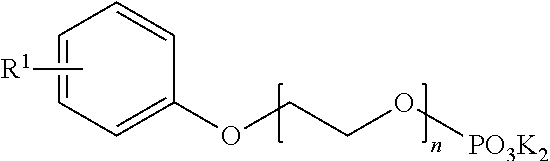
wherein R1 is a C1-C5 linear or branched alkyl group and n=1 to 8; from about 0% to about 4.5% by weight of sodium acid pyrophosphate; from about 0% to about 4.5% by weight of tetrapotassium pyrophosphate; from about 2% to about 9.5% by weight of sodium hydroxide; and from about 1.7% to about 8.6% by weight of phosphoric acid.
With respect to the process conditions under which the exemplary method may be carried out, the separating composition and the oil sands may be heated to greater than 25° C.; from about 32° C. to about 72° C.; or from about 54° C. to about 60° C. Any source of heat within the ambit of those skilled in the art may be used. Similarly, any device capable of providing sufficient agitation may be used to agitate the separating composition and the oil sands, including, for example, a high shear mixer, high speed attritor, high speed dispersers, fluidized beds, and the like, or any other device capable of providing sufficient agitation within the ambit of those skilled in the art.
In one embodiment, the ratio of the separating composition to the oil sands may be from about 2:3 to about 3:2. In another embodiment, the ratio of the separating composition to the oil sands may be about 1:1.
The recovered bitumen may be essentially emulsion-free. The exemplary method may be performed without the addition of organic solvent.
In some circumstances, it may prove desirable to subject the separated, recovered bitumen to a second or subsequent aliquot of separating composition. In such a case, the exemplary method further comprises contacting the separated, recovered bitumen with a second or subsequent aliquot of fresh separating composition; heating the fresh separating composition and the bitumen; agitating the fresh separating composition and the recovered bitumen; and recovering the resulting bitumen. Such a “rinse” cycle may be repeated until the bitumen is essentially free of any sand or other particulate matter.
In another embodiment, the separating composition may be recyclable. Thus, the exemplary method further comprises recovering the separating composition; contacting the recovered separating composition with a second or subsequent aliquot of oil sands comprising bitumen and sand; heating the recovered separating composition and the second or subsequent aliquot of oil sands; agitating the recovered separating composition and the second or subsequent aliquot of oil sands; and recovering the bitumen and sand as separate products.
In another embodiment, a method is disclosed for processing existing tailings, both to salvage remaining bitumen and to allow for redeposit of the essentially bitumen-free sand. The method may comprise contacting a separating composition comprising a wetting agent, a hydrotropic agent, and a dispersant having flocculating characteristics with tailings comprising bitumen and sand; heating the separating composition and the tailings; agitating the separating composition and the tailings; and recovering the bitumen and sand as separate products. The pH of the separating composition may be greater than 7.5; from about 7.0 to about 8.5; or from about 7.6 to about 7.8.
In one embodiment, the separating composition used in the exemplary method for processing existing tailings may be comprised of from about 0.001% to about 2.5% by weight of a wetting agent; from about 0.1% to about 4.0% by weight of a hydrotropic agent; and from about 0.25% to about 4.5% by weight of a dispersant having flocculating characteristics.
In another embodiment, the separating composition used in the exemplary method for processing existing tailings may be comprised of from about 0.001% to about 2.5% by weight of 2,5,8,11-tetramethyl-6-dodecyn-5,8-diol ethoxylate; from about 0.1% to about 4.0% by weight of an aromatic phosphate ester having the formula:

wherein R1 is a C1-C5 linear or branched alkyl group and n=1 to 8; from about 0% to about 4.5% by weight of sodium acid pyrophosphate; from about 0% to about 4.5% by weight of tetrapotassium pyrophosphate; from about 2% to about 9.5% by weight of sodium hydroxide; and from about 1.7% to about 8.6% by weight of phosphoric acid.
With respect to the process conditions under which the exemplary method for processing existing tailings may be carried out, the separating composition and the tailings may be heated to greater than 25° C.; from about 32° C. to about 72° C.; or from about 54° C. to about 60° C. Any source of heat within the ambit of those skilled in the art may be used. Similarly, any device capable of providing sufficient agitation may be used to agitate the separating composition and the tailings, including, for example, a high shear mixer, high speed attritor, high speed dispersers, fluidized beds, and the like, or any other device capable of providing sufficient agitation within the ambit of those skilled in the art.
In one embodiment, the ratio of the separating composition to the tailings may be from about 2:3 to about 3:2. In another embodiment, ratio of the separating composition to the tailings may be about 1:1.
The recovered bitumen may be essentially emulsion-free. The exemplary method may be performed without the addition of organic solvent.
In some circumstances, it may prove desirable to subject the separated, recovered bitumen from the tailings to a second or subsequent aliquot of separating composition. In such a case, the exemplary method further comprises contacting the separated, recovered bitumen with a second or subsequent aliquot of fresh separating composition; heating the fresh separating composition and the bitumen; agitating the fresh separating composition and the recovered bitumen; and recovering the resulting bitumen. Such a “rinse” cycle may be repeated until the bitumen is essentially free of any sand or other particulate matter.
In another embodiment, the separating composition may be recyclable. Thus, the exemplary method for processing existing tailings would further comprise recovering the separating composition; contacting the recovered separating composition with a second or subsequent aliquot of tailings comprising bitumen and sand; heating the recovered separating composition and the second or subsequent aliquot of tailings; agitating the recovered separating composition and the second or subsequent aliquot of tailings; and recovering the bitumen and sand as separate products.
The present embodiments have been described mainly in the context of lab-scale results. However, it should be appreciated that the results described herein are meant to embody the entire process by which oil sands are obtained, the extraction of bitumen from the oil sands, and the further processing of the extracted bitumen. By way of example, mining shovels dig oil sand ore and load it into trucks or other transportation means. The trucks take the oil sands to crushers where the oil sands are broken down in size. The broken down oil sands are added to a mixing tank and contacted with the separating composition as described herein. The separated bitumen is augered and pumped to storage, and then further refined to produce synthetic crude oil suitable for use as a feedstock for the production of liquid motor fuels, heating oil, and petrochemicals.
The following examples are provided to illustrate various embodiments and shall not be considered as limiting in scope.
300 g of the following separating composition having a pH of about 7.8 was prepared and placed in a 1 L beaker:
| 270.84 | g | H2O |
| 10.8 | g | Phosphoric acid 75% |
| 1.2 | g | Sodium acid pyrophosphate |
| 13.44 | g | Caustic soda 50% |
| 3.12 | g | Tetrapotassium pyrophosphate 60% |
| 0.6 | g | MAPHOS ® 66 H ESTER |
The beaker containing the separating composition was charged with 300 g of Athabasca oil sands. The resultant slurry was heated to between 54° C. and 60° C. A high shear lab mixer was lowered into the beaker and the slurry was stirred at 3500 rpm for 3 minutes. The mixer was removed from the beaker. Over the course of the next 5-30 minutes, complete phase separation occurred within the beaker. Four separate, distinct phases were observed. The top, first layer contained bitumen. The second layer contained the separating composition. The third layer contained clay. The bottom, fourth layer contained sand and other particulate matter.
The beaker contents were allowed to cool, at which time the bitumen was removed from the beaker. The bitumen was determined to be greater than 99% free of contaminants, including sand and clay. Approximately 45 g of bitumen was recovered, representing greater than 99% of all of the available bitumen in the sample of oil sands.
The sand was also recovered and determined to be greater than 99% free of bitumen. The sand was placed in a drying oven at 72° C. for 8 hours and, after cooling to room temperature, was able to be sifted through a 20-25 mesh sieve.
To further quantify the amount of bitumen remaining in the sand, 100.00 g of the dried sand was placed in a beaker. 100 g of toluene was added to the sand. The resultant slurry was agitated, then allowed to settle. The toluene was decanted from the sand. The decanted toluene was visually inspected and found to be clear. The sand was dried again at 72° C. for 8 hours to evaporate any remaining toluene. Thereafter, the sand was weighed. 99.86 g of sand remained.
In a separate 1 L beaker was placed a fresh 300 g aliquot of the separating composition. To the fresh separating composition was added 45 g of the separated, recovered bitumen. The separating composition and the bitumen were heated to 72° C. and were stirred at 2000 rpm for 3 minutes. The beaker contents were allowed to cool and were separated as described above. The resultant bitumen was effectively completely free of contaminants.
The original separating composition was removed from the first 1 L beaker after the bitumen was removed. 275 g of this separating composition was added to a 1 L beaker. The beaker was charged with 275 g of a new aliquot of Athabasca oil sands. The slurry was heated to 72° C. and was stirred at 3000 rpm for 3 minutes.
The beaker contents were allowed to cool, at which time the bitumen was removed from the beaker. The bitumen was determined to be greater than 99% free of contaminants, including sand and clay. Approximately 41 g of bitumen was recovered, representing greater than 99% of the available bitumen in the sample of oil sands.
The sand was also recovered and determined to be greater than 99% free of bitumen. The sand was placed in a drying oven at 72° C. for 8 hours and, after cooling to room temperature, was able to be sifted through a 20-25 mesh sieve.
To further quantify the amount of bitumen remaining in the sand, 100.00 g of the dried sand was placed in a beaker. 100 g of toluene was added to the sand. The resultant slurry was agitated, then allowed to settle. The toluene was decanted from the sand. The decanted toluene was visually inspected and found to be clear. The sand was dried again at 72° C. for 8 hours to evaporate any remaining toluene. Thereafter, the sand was weighed. 99.83 g of sand remained.
200 g of the separating composition was prepared as in Example 1. The separating composition was placed in a 1 L beaker. The beaker was charged with 300 g of tailings from an Athabasca tailings pond. The slurry was heated to 72° C. and was stirred at 3000 rpm for 2 minutes. The mixer was removed from the beaker. Over the course of the next 5-30 minutes, complete phase separation occurred within the beaker. Four separate, distinct phases were observed. The top, first layer contained bitumen. The second layer contained the separating composition. The third layer contained clay. The bottom, fourth layer contained sand and other particulate matter.
The beaker contents were allowed to cool, at which time the bitumen was removed from the beaker. The bitumen was determined to be greater than 99% free of contaminants, including sand and clay. Approximately 12 g of bitumen was recovered, representing greater than 99% of the available bitumen in the sample of tailings.
The sand was also recovered and determined to be greater than 99% free of bitumen. The sand was placed in a drying oven at 72° C. for 8 hours and, after cooling to room temperature, was able to be sifted through a 20-25 mesh sieve.
To further quantify the amount of bitumen remaining in the sand, 100.00 g of the dried sand was placed in a beaker. 100 g of toluene was added to the sand. The resultant slurry was agitated, then allowed to settle. The toluene was decanted from the sand. The decanted toluene was visually inspected and found to be clear. The sand was dried again at 72° C. for 8 hours to evaporate any remaining toluene. Thereafter, the sand was weighed. 99.76 g of sand remained.
| 270.84 | g | H2O |
| 10.8 | g | Phosphoric acid 75% |
| 1.2 | g | Sodium acid pyrophosphate |
| 13.44 | g | Caustic soda 50% |
| 3.12 | g | Tetrapotassium pyrophosphate 60% |
| 0.6 | g | MAPHOS ® 66 H ESTER |
| 263.55 | g | H2O |
| 13.55 | g | Phosphoric acid 75% |
| 1.5 | g | Sodium acid pyrophosphate |
| 16.8 | g | Caustic soda 50% |
| 3.9 | g | Tetrapotassium pyrophosphate 60% |
| 0.75 | g | MAPHOS ® 66 H ESTER |
300 g of the separating composition was prepared and was placed in a 1 L beaker. The beaker containing the separating composition was charged with 300 g of Utah oil sands. The resultant slurry was heated to between 54° C. and 60° C. A high shear lab mixer was lowered into the beaker and the slurry was stirred at 3500 rpm for 3 minutes. The mixer was removed from the beaker. Over the course of the next 5-30 minutes, complete phase separation occurred within the beaker. Four separate, distinct phases were observed. The top, first layer contained bitumen. The second layer contained the separating composition. The third layer contained clay. The bottom, fourth layer contained sand and other particulate matter.
The beaker contents were allowed to cool, at which time the bitumen was removed from the beaker. The bitumen was determined to be greater than 99% free of contaminants, including sand and clay. Approximately 40 g of bitumen was recovered, representing greater than 99% of the available bitumen in the sample of oil sands.
The sand was also recovered and determined to be greater than 99% free of bitumen. The sand was placed in a drying oven at 72° C. for 8 hours and, after cooling to room temperature, was able to be sifted through a 20-25 mesh sieve.
In a separate 1 L beaker was placed a fresh 300 g aliquot of the separating composition. To the fresh separating composition was added 40 g of the separated, recovered bitumen. The separating composition and the bitumen were heated to 72° C. and were stirred at 2000 rpm for 3 minutes. The beaker contents were allowed to cooled and separated occurred as described above. The resultant bitumen was effectively completely free of contaminants.
The original separating composition was removed from the first 1 L beaker after the bitumen was removed. 275 g of this separating composition was added to a 1 L beaker. The beaker was charged with 275 g of a new aliquot of Utah oil sands. The slurry was heated to 72° C. and was stirred at 3000 rpm for 3 minutes. The mixer was removed from the beaker. Over the course of the next 5-30 minutes, complete phase separation occurred within the beaker. Four separate, distinct phases were observed. The top, first layer contained bitumen. The second layer contained the separating composition. The third layer contained clay. The bottom, fourth layer contained sand and other particulate matter.
The beaker contents were allowed to cool, at which time the bitumen was removed from the beaker. The bitumen was determined to be greater than 99% free of contaminants, including sand and clay. Approximately 44 g of bitumen was recovered, representing greater than 99% of the available bitumen in the sample of oil sands.
The sand was also recovered and determined to be greater than 99% free of bitumen. The sand was placed in a drying oven at 72° C. for 8 hours and, after cooling to room temperature, was able to be sifted through a 20-25 mesh sieve.
To further quantify the amount of bitumen remaining in the sand, 100.00 g of the dried sand was placed in a beaker. 100 g of toluene was added to the sand. The resultant slurry was agitated, then allowed to settle. The toluene was decanted from the sand. The decanted toluene was visually inspected and found to be clear. The sand was dried again at 72° C. for 8 hours to evaporate any remaining toluene. Thereafter, the sand was weighed. 99.85 g of sand remained.
300 g of the separating composition was prepared as in Example 1. The separating composition was placed in a 1 L beaker. The beaker was charged with 300 g of tailings from a Utah tailings pond. The slurry was heated to 72° C. and was stirred at 3000 rpm for 3 minutes. The mixer was removed from the beaker. Over the course of the next 5-30 minutes, complete phase separation occurred within the beaker. Four separate, distinct phases were observed. The top, first layer contained bitumen. The second layer contained the separating composition. The third layer contained clay. The bottom, fourth layer contained sand and other particulate matter.
The beaker contents were allowed to cool, at which time the bitumen was removed from the beaker. The bitumen was determined to be greater than 99% free of contaminants, including sand and clay. Approximately 4 g of bitumen was recovered, representing greater than 99% of the available bitumen in the sample of tailings.
The sand was also recovered and determined to be greater than 99% free of bitumen. The sand was placed in a drying oven at 72° C. for 8 hours and, after cooling to room temperature, was able to be sifted through a 20-25 mesh sieve.
To further quantify the amount of bitumen remaining in the sand, 100.00 g of the dried sand was placed in a beaker. 100 g of toluene was added to the sand. The resultant slurry was agitated, then allowed to settle. The toluene was decanted from the sand. The decanted toluene was visually inspected and found to be clear. The sand was dried again at 72° C. for 8 hours to evaporate any remaining toluene. Thereafter, the sand was weighed. 99.77 g of sand remained.
Unless specifically stated to the contrary, the numerical parameters set forth in the specification, including the attached claims, are approximations that may vary depending on the desired properties sought to be obtained according to the exemplary embodiments. At the very least, and not as an attempt to limit the application of the doctrine of equivalents to the scope of the claims, each numerical parameter should at least be construed in light of the number of reported significant digits and by applying ordinary rounding techniques.
Notwithstanding that the numerical ranges and parameters setting forth the broad scope of the invention are approximations, the numerical values set forth in the specific examples are reported as precisely as possible. Any numerical value, however, inherently contains certain errors necessarily resulting from the standard deviation found in their respective testing measurements.
Furthermore, while the systems, methods, and so on have been illustrated by describing examples, and while the examples have been described in considerable detail, it is not the intention of the applicant to restrict, or in any way, limit the scope of the appended claims to such detail. It is, of course, not possible to describe every conceivable combination of components or methodologies for purposes of describing the systems, methods, and so on provided herein. Additional advantages and modifications will readily appear to those skilled in the art. Therefore, the invention, in its broader aspects, is not limited to the specific details and illustrative examples shown and described. Accordingly, departures may be made from such details without departing from the spirit or scope of the applicant's general inventive concept. Thus, this application is intended to embrace alterations, modifications, and variations that fall within the scope of the appended claims. The preceding description is not meant to limit the scope of the invention. Rather, the scope of the invention is to be determined by the appended claims and their equivalents.
Finally, to the extent that the term “includes” or “including” is employed in the detailed description or the claims, it is intended to be inclusive in a manner similar to the term “comprising,” as that term is interpreted when employed as a transitional word in a claim. Furthermore, to the extent that the term “or” is employed in the claims (e.g., A or B) it is intended to mean “A or B or both.” When the applicants intend to indicate “only A or B, but not both,” then the term “only A or B but not both” will be employed. Similarly, when the applicants intend to indicate “one and only one” of A, B, or C, the applicants will employ the phrase “one and only one.” Thus, use of the term “or” herein is the inclusive, and not the exclusive use. See Bryan A. Garner, A Dictionary of Modern Legal Usage 624 (2d. Ed. 1995).
Claims (42)
1. A water-based separating composition for separating hydrocarbons from hydrocarbon-containing material, said separating composition comprising:
at least about 71% by weight water;
a hydrotropic agent;
a dispersant having flocculating characteristics;
a wetting agent; and
at least one acid and at least one base, in amounts sufficient to provide the separating composition with a pH of about 7 to about 8.5;
wherein the hydrotropic agent and the dispersant having flocculating characteristics are different.
2. The composition of claim 1 , wherein the hydrotropic agent is present in an amount of from about 0.1% to about 4% by weight of the separating composition; and the dispersant having flocculating characteristics is present in an amount of from about 0.25% to about 4.5% by weight of the separating composition.
3. The composition of claim 1 , wherein the composition comprises at least about 89% by weight water.
4. The composition of claim 1 wherein the wetting agent comprises an alkoxylated alcohol surfactant.
5. The composition of claim 1 , wherein the wetting agent comprises 2,5,8,11-tetramethyl-6-dodecyn-5,8-diol ethoxylate.
6. The composition of claim 1 , wherein the hydrotropic agent comprises a phosphorylated nonionic surfactant.
7. The composition of claim 1 , wherein the hydrotropic agent comprises an aromatic phosphate ester having the formula:

wherein R1 is a C1-C5 linear or branched alkyl group and n=1 to 8.
8. The composition of claim 1 , wherein the dispersant having flocculating characteristics comprises a phosphate salt.
9. The composition of claim 1 , wherein the dispersant having flocculating characteristics comprises one or more of sodium acid pyrophosphate and tetrapotassium pyrophosphate.
10. The composition of claim 1 , wherein the pH of the separating composition is from about 7.6 to about 8.5.
11. The composition of claim 1 , wherein the base comprises a strong base and is present in an amount of from about 2% to about 9.5% by weight of the separating composition.
12. The composition of claim 1 , wherein the composition is essentially free of organic solvent.
13. The composition of claim 1 , further comprising hydrocarbon-containing material wherein the ratio of the separating composition to the hydrocarbon-containing material is from about 2:3 to about 3:2.
14. The separating composition of claim 1 , wherein the acid comprises a heavy acid, and is present in an amount of from about 1.7% to about 8.6% by weight.
15. The separating composition of claim 1 , wherein the acid has a specific gravity of greater than about 1.5.
16. A water-based separating composition for separating hydrocarbons from hydrocarbon-containing material, said separating composition comprising:
at least about 71% by weight water;
from about 0.1% to about 4% by weight of a hydrotropic agent; and
from about 0.25% to about 4.5% by weight of a dispersant having flocculating characteristics;
from about 0.001% to about 2.5% by weight of a wetting agent; and
at least one acid and at least one base in amounts sufficient to provide the separating composition with a pH of about 7 to about 8.5,
wherein the hydrotropic agent and the dispersant having flocculating characteristics are different.
17. The separating composition of claim 16 , wherein the separating composition has a pH of from about 7.6 to about 8.5.
18. The separating composition of claim 16 , wherein the composition comprises at least about 89% by weight water.
19. The separating composition of claim 16 , wherein the wetting agent comprises an alkoxylated alcohol surfactant.
20. The separating composition of claim 16 , wherein the wetting agent comprises 2,5,8,11-tetramethyl-6-dodecyn-5,8-diol ethoxylate.
21. The separating composition of claim 16 , wherein the hydrotropic agent comprises a phosphorylated nonionic surfactant.
22. The separating composition of claim 16 , wherein the hydrotropic agent comprises an aromatic phosphate ester having the formula:

wherein R1 is a C1-C5 linear or branched alkyl group and n=1 to 8.
23. The separating composition of claim 16 , wherein the dispersant having flocculating characteristics comprises a phosphate salt.
24. The separating composition of claim 16 , wherein the dispersant having flocculating characteristics comprises one or more of sodium acid pyrophosphate and tetrapotassium pyrophosphate.
25. The separating composition of claim 16 , wherein the acid is a heavy acid and is present in an amount of from about 1.7% to about 8.6% by weight.
26. The separating composition of claim 16 , wherein the acid has a specific gravity of greater than about 1.5 and is present in an amount of from about 1.7% to about 8.6% by weight.
27. The separating composition of claim 16 , wherein the base is a strong base and is present in an amount of from about 2% to about 9.5% by weight of the separating composition.
28. The separating composition of claim 16 , wherein the composition is essentially free of organic solvent.
29. The separating composition of claim 16 , further comprising hydrocarbon-containing material wherein the ratio of the separating composition to the hydrocarbon-containing materials is from about 2:3 to about 3:2.
30. A water-based separating composition for separating hydrocarbons from hydrocarbon-containing material, said separating composition comprising:
at least about 71% by weight water;
from about 0.1% to about 4% by weight of a hydrotropic agent; and
from about 0.25% to about 4.5% by weight of a dispersant having flocculating characteristics;
from about 0.001% to about 2.5% by weight of a wetting agent;
from about 1.7% to about 8.6% by weight of at least one acid; and
from about 2% to about 9.5% by weight of at least one base;
wherein the separating composition is utilized at a pH of about 7 to about 8.5, the separating composition is essentially free of organic solvent and the hydrotropic agent and the dispersant having flocculating characteristics are different.
31. The separating composition of claim 30 , wherein the separating composition has a pH of from about 7.6 to about 8.5.
32. The separating composition of claim 30 , wherein the composition comprises at least about 89% by weight water.
33. The separating composition of claim 30 , wherein the wetting agent comprises an alkoxylated alcohol surfactant.
34. The separating composition of claim 30 , wherein the wetting agent comprises 2,5,8,11-tetramethyl-6-dodecyn-5,8-diol ethoxylate.
35. The separating composition of claim 30 , wherein the hydrotropic agent comprises a phosphorylated nonionic surfactant.
36. The separating composition of claim 30 , wherein the hydrotropic agent comprises an aromatic phosphate ester having the formula:

wherein R1 is a C1-C5 linear or branched alkyl group and n=1 to 8.
37. The separating composition of claim 30 , wherein the dispersant having flocculating characteristics comprises a phosphate salt.
38. The separating composition of claim 30 , wherein the dispersant having flocculating characteristics comprises one or more of sodium acid pyrophosphate and tetrapotassium pyrophosphate.
39. The separating composition of claim 30 , wherein the acid is a heavy acid.
40. The separating composition of claim 30 , wherein the acid has a specific gravity of greater than about 1.5
41. The separating composition of claim 30 , wherein the base is a strong base.
42. The separating composition of claim 30 , further comprising hydrocarbon-containing material wherein the ratio of the separating composition to the hydrocarbon-containing materials is from about 2:3 to about 3:2.
Priority Applications (2)
| Application Number | Priority Date | Filing Date | Title |
|---|---|---|---|
| US12/952,963 US8147680B2 (en) | 2006-10-06 | 2010-11-23 | Separating compositions |
| US13/437,227 US8414764B2 (en) | 2006-10-06 | 2012-04-02 | Separating compositions |
Applications Claiming Priority (4)
| Application Number | Priority Date | Filing Date | Title |
|---|---|---|---|
| US82850106P | 2006-10-06 | 2006-10-06 | |
| US11/868,031 US7749379B2 (en) | 2006-10-06 | 2007-10-05 | Separating compositions and methods of use |
| US12/765,969 US7862709B2 (en) | 2006-10-06 | 2010-04-23 | Separating compositions and methods of use |
| US12/952,963 US8147680B2 (en) | 2006-10-06 | 2010-11-23 | Separating compositions |
Related Parent Applications (1)
| Application Number | Title | Priority Date | Filing Date |
|---|---|---|---|
| US12/765,969 Continuation US7862709B2 (en) | 2006-10-06 | 2010-04-23 | Separating compositions and methods of use |
Related Child Applications (1)
| Application Number | Title | Priority Date | Filing Date |
|---|---|---|---|
| US13/437,227 Continuation US8414764B2 (en) | 2006-10-06 | 2012-04-02 | Separating compositions |
Publications (2)
| Publication Number | Publication Date |
|---|---|
| US20110062382A1 US20110062382A1 (en) | 2011-03-17 |
| US8147680B2 true US8147680B2 (en) | 2012-04-03 |
Family
ID=39430409
Family Applications (4)
| Application Number | Title | Priority Date | Filing Date |
|---|---|---|---|
| US11/868,031 Active 2028-10-12 US7749379B2 (en) | 2006-10-06 | 2007-10-05 | Separating compositions and methods of use |
| US12/765,969 Active US7862709B2 (en) | 2006-10-06 | 2010-04-23 | Separating compositions and methods of use |
| US12/952,963 Active US8147680B2 (en) | 2006-10-06 | 2010-11-23 | Separating compositions |
| US13/437,227 Active US8414764B2 (en) | 2006-10-06 | 2012-04-02 | Separating compositions |
Family Applications Before (2)
| Application Number | Title | Priority Date | Filing Date |
|---|---|---|---|
| US11/868,031 Active 2028-10-12 US7749379B2 (en) | 2006-10-06 | 2007-10-05 | Separating compositions and methods of use |
| US12/765,969 Active US7862709B2 (en) | 2006-10-06 | 2010-04-23 | Separating compositions and methods of use |
Family Applications After (1)
| Application Number | Title | Priority Date | Filing Date |
|---|---|---|---|
| US13/437,227 Active US8414764B2 (en) | 2006-10-06 | 2012-04-02 | Separating compositions |
Country Status (11)
| Country | Link |
|---|---|
| US (4) | US7749379B2 (en) |
| EP (1) | EP2069467B1 (en) |
| CN (1) | CN101589135B (en) |
| CA (1) | CA2665579C (en) |
| DK (1) | DK2069467T3 (en) |
| EA (1) | EA015626B1 (en) |
| ES (1) | ES2517597T3 (en) |
| NO (1) | NO337631B1 (en) |
| PL (1) | PL2069467T3 (en) |
| UA (1) | UA102990C2 (en) |
| WO (1) | WO2008063762A2 (en) |
Cited By (1)
| Publication number | Priority date | Publication date | Assignee | Title |
|---|---|---|---|---|
| US20120193567A1 (en) * | 2006-10-06 | 2012-08-02 | Vary Petrochem, Llc | Separating compositions |
Families Citing this family (14)
| Publication number | Priority date | Publication date | Assignee | Title |
|---|---|---|---|---|
| US8062512B2 (en) * | 2006-10-06 | 2011-11-22 | Vary Petrochem, Llc | Processes for bitumen separation |
| US20080110804A1 (en) * | 2006-11-10 | 2008-05-15 | Veltri Fred J | Slurry transfer line |
| WO2009114145A2 (en) * | 2008-03-11 | 2009-09-17 | Verutek Technologies, Inc. | Ex-situ low-temperature hydrocarbon separation from tar sands |
| AU2009314391B2 (en) * | 2008-10-29 | 2012-08-30 | The Chemours Company Fc, Llc. | Treatment of tailings streams |
| CN102712848B (en) | 2009-08-17 | 2016-01-13 | 布拉克卡培都能源科技有限公司 | Oil-sand extracts |
| US9909070B2 (en) | 2009-09-15 | 2018-03-06 | Suncor Energy Inc. | Process for flocculating and dewatering oil sand mature fine tailings |
| PL3199218T3 (en) | 2009-09-15 | 2020-04-30 | Suncor Energy Inc. | Process for drying oil sand mature fine tailings |
| WO2011050440A1 (en) | 2009-10-30 | 2011-05-05 | Suncor Energy Inc. | Depositing and farming methods for drying oil sand mature fine tailings |
| CA2778964C (en) * | 2009-11-17 | 2019-02-19 | H R D Corporation | Bitumen extraction and asphaltene removal from heavy crude using high shear |
| US20110163012A1 (en) * | 2010-01-05 | 2011-07-07 | Spx Corporation | Slurry Treatment Method and Apparatus |
| ITMI20111977A1 (en) * | 2011-10-31 | 2013-05-01 | Eni Spa | PROCEDURE FOR RECOVERY OF BITUMEN FROM A BITUMINOUS SAND |
| US10574117B2 (en) * | 2014-06-24 | 2020-02-25 | Kubota Corporation | Stator of electric motor and cooling structure of electric rotating machine |
| CN106010622B (en) * | 2016-05-09 | 2018-04-03 | 天津大学 | A kind of method and system rich in carbonate oil-sand ore deposit solvent extraction and solvent recovery |
| CN110317624A (en) * | 2019-08-08 | 2019-10-11 | 平顶山东晟高科实业有限公司 | A kind of method of pitch removing QI |
Citations (371)
| Publication number | Priority date | Publication date | Assignee | Title |
|---|---|---|---|---|
| CA326747A (en) | 1932-10-11 | C. Fitzsimmons Robert | Process and apparatus for recovering bitumen | |
| CA448231A (en) | 1948-05-04 | Adolf Clark Karl | Extracting oil from bituminous sand | |
| CA488928A (en) | 1952-12-16 | Colin Ferguson James | Apparatus for the recovery of tar sands | |
| CA493081A (en) | 1953-05-26 | C. Fitzsimmons Robert | Process for recovering bitumen from tar sands | |
| CA675930A (en) | 1963-12-10 | A. Hemstock Russell | Recovery of bitumen from tar sands utilizing an evacuation step | |
| CA719690A (en) | 1965-10-12 | United States Borax And Chemical Corporation | Emulsion for preservation and fireproofing of wood | |
| US3331896A (en) | 1964-09-15 | 1967-07-18 | Gen Aniline & Film Corp | Method of preparing alkali soluble phosphate esters of hydroxylic organic compounds |
| CA778347A (en) | 1968-02-13 | S. Mclatchie Allan | Recovery of bitumen from treated emulsions and froths | |
| US3547803A (en) | 1968-09-18 | 1970-12-15 | Shell Oil Co | Recovery of oil from bituminous sands |
| US3644194A (en) | 1969-12-29 | 1972-02-22 | Marathon Oil Co | Recovery of oil from tar sands using water-external micellar dispersions |
| US3660268A (en) | 1969-12-29 | 1972-05-02 | Marathon Oil Co | Recovery of oil from tar sands using high water content oil-external micellar dispersions |
| CA914094A (en) | 1972-11-07 | Imperial Oil Limited | Recovery of bitumen from bituminous sand with control of bitumen particle size | |
| CA914092A (en) | 1972-11-07 | M. O. Cymbalisty Lubomyr | Separation of bitumen from bituminous sand using a dense slurry and controlled velocities | |
| CA915604A (en) | 1972-11-28 | Royalite Oil Company | Recovery of bitumen from bituminous sand | |
| CA915608A (en) | 1972-11-28 | Atlantic Richfield Corporation | Removal of water from bituminous emulsion | |
| CA915602A (en) | 1972-11-28 | Canada-Cities Service | Separation of bitumen from bituminous sand using a cold dense slurry | |
| CA915603A (en) | 1972-11-28 | M. O. Cymbalisty Lubomyr | Temperature control in recovery of bitumen from bituminous sand | |
| CA917585A (en) | 1972-12-26 | H. Evans George | Preparing tar sands for feed into a bitumen separation process | |
| CA917565A (en) | 1970-11-25 | 1972-12-26 | Canadian Fina Oil Limited | Method for extracting bitumen from tar sands |
| CA949482A (en) | 1971-12-22 | 1974-06-18 | Robert A. Baillie | Hot water bitumen extraction cell |
| CA975697A (en) | 1972-10-20 | 1975-10-07 | H. James Davitt | Recovery of bitumen from sludge resulting from hot water extraction of tar sands |
| CA975699A (en) | 1972-10-20 | 1975-10-07 | H. James Davitt | Recovery of bitumen from sludge resulting from hot water extraction of tar sands |
| CA975698A (en) | 1972-10-20 | 1975-10-07 | Great Canadian Oil Sands | Recovery of bitumen from sludge resulting from hot water extraction of tar sands |
| CA975696A (en) | 1972-10-20 | 1975-10-07 | Great Canadian Oil Sands | Recovery of bitumen from sludge resulting from hot water extraction of tar sands |
| US3933651A (en) | 1974-10-07 | 1976-01-20 | Great Canadian Oil Sands Limited | Recovering bitumen from large water surfaces |
| US3935076A (en) | 1973-05-29 | 1976-01-27 | Canada-Cities Service, Ltd. | Two stage separation system |
| US3948754A (en) | 1974-05-31 | 1976-04-06 | Standard Oil Company | Process for recovering and upgrading hydrocarbons from oil shale and tar sands |
| US3951749A (en) | 1974-04-19 | 1976-04-20 | Fairbanks Jr John B | Tar sand processing apparatus |
| US3951778A (en) | 1972-12-20 | 1976-04-20 | Caw Industries, Inc. | Method of separating bitumin from bituminous sands and preparing organic acids |
| US3967777A (en) | 1973-09-10 | 1976-07-06 | Exxon Research And Engineering Company | Apparatus for the treatment of tar sand froth |
| US3969220A (en) | 1974-09-16 | 1976-07-13 | Great Canadian Oil Sands Limited | Aerating tar sands-water mixture prior to settling in a gravity settling zone |
| US3978925A (en) | 1974-06-21 | 1976-09-07 | Texaco Exploration Canada Ltd. | Method for recovery of bitumens from tar sands |
| US3984920A (en) | 1975-04-03 | 1976-10-12 | Shell Oil Company | Tar sands conditioning drum |
| US3985684A (en) | 1974-02-07 | 1976-10-12 | Exxon Research And Engineering Company | Heavy crude conversion |
| US3986592A (en) | 1974-11-04 | 1976-10-19 | Great Canadian Oil Sands Limited | Hot water extraction cell containing two or more deflection baffles |
| US3986557A (en) | 1975-06-06 | 1976-10-19 | Atlantic Richfield Company | Production of bitumen from tar sands |
| US3992285A (en) | 1974-09-23 | 1976-11-16 | Universal Oil Products Company | Process for the conversion of hydrocarbonaceous black oil |
| US3994341A (en) | 1975-10-30 | 1976-11-30 | Chevron Research Company | Recovering viscous petroleum from thick tar sand |
| US3997426A (en) | 1975-04-10 | 1976-12-14 | Gulf Research & Development Company | Process for the conversion of carbonaceous materials |
| US4008765A (en) | 1975-12-22 | 1977-02-22 | Chevron Research Company | Method of recovering viscous petroleum from thick tar sand |
| US4019575A (en) | 1975-12-22 | 1977-04-26 | Chevron Research Company | System for recovering viscous petroleum from thick tar sand |
| US4019578A (en) | 1976-03-29 | 1977-04-26 | Terry Ruel C | Recovery of petroleum from tar and heavy oil sands |
| US4024915A (en) | 1974-07-31 | 1977-05-24 | Texaco Inc. | Recovery of viscous oil by unheated air injection, followed by in situ combustion |
| US4028222A (en) | 1976-02-23 | 1977-06-07 | Phillip Earl Prull | Method for extracting oil from oil shale |
| US4036732A (en) | 1975-02-06 | 1977-07-19 | Exxon Research And Engineering Company | Tar sands extraction process |
| US4046668A (en) | 1976-01-12 | 1977-09-06 | Mobil Oil Corporation | Double solvent extraction of organic constituents from tar sands |
| US4046669A (en) | 1974-12-31 | 1977-09-06 | Blaine Neal Franklin | Solvent extraction of oil from tar sands utilizing a trichloroethylene solvent |
| US4048078A (en) | 1975-07-14 | 1977-09-13 | Texaco Inc. | Oil recovery process utilizing air and superheated steam |
| US4052293A (en) | 1975-10-10 | 1977-10-04 | Cryo-Maid Inc. | Method and apparatus for extracting oil from hydrocarbonaceous solid material |
| US4054506A (en) | 1976-04-28 | 1977-10-18 | Western Oil Sands Ltd. | Method of removing bitumen from tar sand utilizing ultrasonic energy and stirring |
| US4054505A (en) | 1976-04-28 | 1977-10-18 | Western Oil Sands Ltd. | Method of removing bitumen from tar sand for subsequent recovery of the bitumen |
| US4057485A (en) | 1976-08-23 | 1977-11-08 | Blaine Neil Franklin | Solvent extraction of oil from tar sands utilizing a chlorinated ethane solvent |
| US4067796A (en) | 1975-05-27 | 1978-01-10 | Standard Oil Company | Tar sands recovery process |
| US4068716A (en) | 1975-03-20 | 1978-01-17 | Texaco Inc. | Oil recovery process utilizing aromatic solvent and steam |
| US4068717A (en) | 1976-01-05 | 1978-01-17 | Phillips Petroleum Company | Producing heavy oil from tar sands |
| US4071433A (en) | 1976-10-28 | 1978-01-31 | Phillips Petroleum Company | Recovery of oil from tar sands |
| US4098674A (en) | 1976-04-02 | 1978-07-04 | Metallgesellschaft Aktiengesellschaft | Recovery of hydrocarbonaceous material from tar sands |
| US4108760A (en) | 1974-07-25 | 1978-08-22 | Coal Industry (Patents) Limited | Extraction of oil shales and tar sands |
| US4110194A (en) | 1976-04-16 | 1978-08-29 | Intermountain Oil Research, Inc. | Process and apparatus for extracting bituminous oil from tar sands |
| US4115246A (en) | 1977-01-31 | 1978-09-19 | Continental Oil Company | Oil conversion process |
| US4120776A (en) | 1977-08-29 | 1978-10-17 | University Of Utah | Separation of bitumen from dry tar sands |
| US4120775A (en) | 1977-07-18 | 1978-10-17 | Natomas Company | Process and apparatus for separating coarse sand particles and recovering bitumen from tar sands |
| US4127475A (en) | 1976-01-13 | 1978-11-28 | Electric Power Research Institute, Inc. | Process for the isolation of chemicals from processed coals |
| US4127170A (en) | 1977-09-28 | 1978-11-28 | Texaco Exploration Canada Ltd. | Viscous oil recovery method |
| US4127172A (en) | 1977-09-28 | 1978-11-28 | Texaco Exploration Canada Ltd. | Viscous oil recovery method |
| US4133382A (en) | 1977-09-28 | 1979-01-09 | Texaco Canada Inc. | Recovery of petroleum from viscous petroleum-containing formations including tar sands |
| US4139450A (en) | 1977-10-12 | 1979-02-13 | Phillips Petroleum Company | Solvent extraction of tar sand |
| US4140182A (en) | 1977-03-24 | 1979-02-20 | Vriend Joseph A | Method of extracting oil |
| US4151073A (en) | 1978-10-31 | 1979-04-24 | Hydrocarbon Research, Inc. | Process for phase separation |
| US4161442A (en) | 1978-01-05 | 1979-07-17 | Mobil Oil Corporation | Processing of tar sands |
| US4174263A (en) | 1974-11-29 | 1979-11-13 | Standard Oil Company | Recovery of bitumen from tar sands |
| US4189376A (en) | 1977-09-14 | 1980-02-19 | Chevron Research Company | Solvent extraction process |
| US4197183A (en) | 1979-02-07 | 1980-04-08 | Mobil Oil Corporation | Processing of tar sands |
| US4213862A (en) | 1976-09-07 | 1980-07-22 | The Lummus Company | Gravity settling |
| US4224138A (en) | 1979-05-10 | 1980-09-23 | Jan Kruyer | Process for recovering bitumen from oil sand |
| US4229281A (en) | 1978-08-14 | 1980-10-21 | Phillips Petroleum Company | Process for extracting bitumen from tar sands |
| US4236995A (en) | 1976-02-10 | 1980-12-02 | Kruyer Tar Sand Development, Inc. | Process for recovering bitumen from tar sand |
| US4240377A (en) | 1978-01-19 | 1980-12-23 | Johnson William B | Fluidized-bed compact boiler and method of operation |
| US4240897A (en) | 1975-06-06 | 1980-12-23 | Clarke Thomas P | Oil sands hot water extraction process |
| US4242195A (en) | 1979-12-28 | 1980-12-30 | Mobil Oil Corporation | Extraction of tar sands or oil shale with organic sulfoxides or sulfones |
| US4249604A (en) | 1979-05-23 | 1981-02-10 | Texaco Inc. | Recovery method for high viscosity petroleum |
| US4250017A (en) | 1977-03-01 | 1981-02-10 | Reale Lucio V | Process and apparatus for separating tar from a tar sand mixture |
| US4250016A (en) | 1978-11-20 | 1981-02-10 | Texaco Inc. | Recovery of bitumen from tar sand |
| US4273191A (en) | 1980-02-25 | 1981-06-16 | Hradel Joseph R | Simultaneous oil recovery and waste disposal process |
| US4280559A (en) | 1979-10-29 | 1981-07-28 | Exxon Production Research Company | Method for producing heavy crude |
| US4284360A (en) | 1979-11-05 | 1981-08-18 | Petro-Canada Exploration Inc. | Homogenizer/subsampler for tar sand process streams |
| US4293035A (en) | 1979-06-07 | 1981-10-06 | Mobil Oil Corporation | Solvent convection technique for recovering viscous petroleum |
| US4302326A (en) | 1980-03-24 | 1981-11-24 | Texaco Canada Inc. | Tar sands emulsion-breaking process |
| US4302051A (en) | 1979-09-13 | 1981-11-24 | The United States Of America As Represented By The Secretary Of The Interior | Open surface flotation method |
| US4312761A (en) | 1980-05-28 | 1982-01-26 | Zimpro-Aec Ltd. | Treatment of clay slimes |
| US4333529A (en) | 1979-08-31 | 1982-06-08 | Wetcom Engineering Ltd. | Oil recovery process |
| US4337143A (en) | 1980-06-02 | 1982-06-29 | University Of Utah | Process for obtaining products from tar sand |
| US4338185A (en) | 1981-01-02 | 1982-07-06 | Noelle Calvin D | Recovery of oil from oil sands |
| US4341619A (en) | 1980-08-11 | 1982-07-27 | Phillips Petroleum Company | Supercritical tar sand extraction |
| US4342657A (en) | 1979-10-05 | 1982-08-03 | Magna Corporation | Method for breaking petroleum emulsions and the like using thin film spreading agents comprising a polyether polyol |
| US4342639A (en) | 1980-07-22 | 1982-08-03 | Gagon Hugh W | Process to separate bituminous material from sand (Tar Sands) |
| US4343691A (en) | 1979-11-09 | 1982-08-10 | The Lummus Company | Heat and water recovery from aqueous waste streams |
| US4344839A (en) | 1980-07-07 | 1982-08-17 | Pachkowski Michael M | Process for separating oil from a naturally occurring mixture |
| US4347126A (en) | 1981-01-29 | 1982-08-31 | Gulf & Western Manufacturing Company | Apparatus and method for flotation separation utilizing a spray nozzle |
| US4347118A (en) | 1979-10-01 | 1982-08-31 | Exxon Research & Engineering Co. | Solvent extraction process for tar sands |
| US4357230A (en) | 1980-09-25 | 1982-11-02 | Carrier Corporation | Extraction of oil using amides |
| US4358373A (en) | 1980-12-08 | 1982-11-09 | Rock Oil Corporation | Continuous apparatus for separating hydrocarbon from earth particles and sand |
| US4361476A (en) | 1981-02-23 | 1982-11-30 | Garb-Oil Corporation Of America | Process and apparatus for recovery of oil from tar sands |
| US4368111A (en) | 1980-12-17 | 1983-01-11 | Phillips Petroleum Company | Oil recovery from tar sands |
| US4383914A (en) | 1975-12-10 | 1983-05-17 | Petro-Canada Exploration Inc. | Dilution centrifuging of bitumen froth from the hot water process for tar sand |
| US4385982A (en) | 1981-05-14 | 1983-05-31 | Conoco Inc. | Process for recovery of bitumen from tar sands |
| US4387016A (en) | 1980-11-10 | 1983-06-07 | Gagon Hugh W | Method for extraction of bituminous material |
| US4396491A (en) | 1982-06-08 | 1983-08-02 | Stiller Alfred H | Solvent extraction of oil shale or tar sands |
| US4399039A (en) | 1980-10-30 | 1983-08-16 | Suncor, Inc. | Treatment of tailings pond sludge |
| US4399038A (en) | 1980-10-30 | 1983-08-16 | Suncor, Inc. | Method for dewatering the sludge layer of an industrial process tailings pond |
| US4401552A (en) | 1981-04-13 | 1983-08-30 | Suncor, Inc. | Beneficiation of froth obtained from tar sands sludge |
| US4409091A (en) | 1979-06-08 | 1983-10-11 | Research Council Of Alberta | Alkali recycle process for recovery of heavy oils and bitumens |
| US4409090A (en) | 1980-06-02 | 1983-10-11 | University Of Utah | Process for recovering products from tar sand |
| US4410417A (en) | 1980-10-06 | 1983-10-18 | University Of Utah Research Foundation | Process for separating high viscosity bitumen from tar sands |
| US4414194A (en) | 1981-05-26 | 1983-11-08 | Shell Oil Company | Extraction process |
| US4421638A (en) | 1983-03-31 | 1983-12-20 | Phillips Petroleum Company | Demetallization of heavy oils |
| US4424113A (en) | 1983-07-07 | 1984-01-03 | Mobil Oil Corporation | Processing of tar sands |
| US4425227A (en) | 1981-10-05 | 1984-01-10 | Gnc Energy Corporation | Ambient froth flotation process for the recovery of bitumen from tar sand |
| US4427066A (en) | 1981-05-08 | 1984-01-24 | Mobil Oil Corporation | Oil recovery method |
| US4427528A (en) | 1980-02-04 | 1984-01-24 | Lindoerfer Walter | Process for extracting crude oil from tar sands |
| US4428824A (en) | 1982-09-27 | 1984-01-31 | Mobil Oil Corporation | Process for visbreaking resid deasphaltenes |
| US4429745A (en) | 1981-05-08 | 1984-02-07 | Mobil Oil Corporation | Oil recovery method |
| US4429744A (en) | 1981-05-08 | 1984-02-07 | Mobil Oil Corporation | Oil recovery method |
| US4437998A (en) | 1981-05-19 | 1984-03-20 | Suncor, Inc. | Method for treating oil sands extraction plant tailings |
| US4446012A (en) | 1982-12-17 | 1984-05-01 | Allied Corporation | Process for production of light hydrocarbons by treatment of heavy hydrocarbons with water |
| US4450911A (en) | 1982-07-20 | 1984-05-29 | Mobil Oil Corporation | Viscous oil recovery method |
| US4456533A (en) | 1981-04-13 | 1984-06-26 | Suncor, Inc. | Recovery of bitumen from bituminous oil-in-water emulsions |
| US4456065A (en) | 1981-08-20 | 1984-06-26 | Elektra Energie A.G. | Heavy oil recovering |
| US4457827A (en) | 1981-03-10 | 1984-07-03 | Mobil Oil Corporation | Process for extracting bitumen from tar sands |
| US4466485A (en) | 1982-12-07 | 1984-08-21 | Mobil Oil Corporation | Viscous oil recovery method |
| US4470899A (en) | 1983-02-14 | 1984-09-11 | University Of Utah | Bitumen recovery from tar sands |
| US4473461A (en) | 1981-07-21 | 1984-09-25 | Standard Oil Company (Indiana) | Centrifugal drying and dedusting process |
| US4474616A (en) | 1983-12-13 | 1984-10-02 | Petro-Canada Exploration Inc. | Blending tar sands to provide feedstocks for hot water process |
| US4484630A (en) | 1981-01-30 | 1984-11-27 | Mobil Oil Corporation | Method for recovering heavy crudes from shallow reservoirs |
| US4486294A (en) | 1980-10-06 | 1984-12-04 | University Of Utah | Process for separating high viscosity bitumen from tar sands |
| US4489782A (en) | 1983-12-12 | 1984-12-25 | Atlantic Richfield Company | Viscous oil production using electrical current heating and lateral drain holes |
| US4489783A (en) | 1982-12-07 | 1984-12-25 | Mobil Oil Corporation | Viscous oil recovery method |
| US4498958A (en) | 1983-05-04 | 1985-02-12 | Texaco Canada Resources Ltd. | Apparatus for treating tar sands emulsion |
| US4503910A (en) | 1982-12-07 | 1985-03-12 | Mobil Oil Corporation | Viscous oil recovery method |
| US4508172A (en) | 1983-05-09 | 1985-04-02 | Texaco Inc. | Tar sand production using thermal stimulation |
| US4510257A (en) | 1983-12-08 | 1985-04-09 | Shell Oil Company | Silica-clay complexes |
| US4511479A (en) | 1981-12-21 | 1985-04-16 | Exxon Research And Engineering Company | Oil removal from water suspensions using ionic domain polymers |
| US4510997A (en) | 1981-10-05 | 1985-04-16 | Mobil Oil Corporation | Solvent flooding to recover viscous oils |
| US4511000A (en) | 1983-02-25 | 1985-04-16 | Texaco Inc. | Bitumen production and substrate stimulation |
| US4512872A (en) | 1983-05-18 | 1985-04-23 | Mobil Oil Corporation | Process for extracting bitumen from tar sands |
| US4514283A (en) | 1984-01-26 | 1985-04-30 | Shell Oil Company | Process for separating and converting heavy oil asphaltenes in a field location |
| USRE31900E (en) | 1980-12-16 | 1985-05-28 | American Cyanamid Company | Process for the flocculation of suspended solids |
| US4519894A (en) | 1983-11-02 | 1985-05-28 | Walker David G | Treatment of carbonaceous shales or sands to recover oil and pure carbon as products |
| US4521292A (en) | 1982-12-27 | 1985-06-04 | Chevron Research Company | Process for improving quality of pyrolysis oil from oil shales and tar sands |
| US4521293A (en) | 1983-01-11 | 1985-06-04 | James Scinta | Oil recovery |
| US4529496A (en) | 1979-08-15 | 1985-07-16 | Jan Kruyer | Method and apparatus for separating slurries and emulsions |
| US4532024A (en) | 1984-12-03 | 1985-07-30 | The Dow Chemical Company | Process for recovery of solvent from tar sand bitumen |
| US4533459A (en) | 1980-09-17 | 1985-08-06 | Rtr Riotinto Til Holding S.A. | Extraction process |
| US4536279A (en) | 1984-01-19 | 1985-08-20 | Mobil Oil Corporation | Enhanced recovery of hydrocarbonaceous fluids from oil shale |
| US4539096A (en) | 1984-07-16 | 1985-09-03 | Mobil Oil Corporation | Process for recovering oil and metals from oil shale |
| US4539093A (en) | 1982-12-16 | 1985-09-03 | Getty Oil Company | Extraction process and apparatus for hydrocarbon containing ores |
| US4539097A (en) | 1984-02-29 | 1985-09-03 | Standard Oil Company (Indiana) | Method for filtering solvent and tar sand mixtures |
| US4557821A (en) | 1983-08-29 | 1985-12-10 | Gulf Research & Development Company | Heavy oil hydroprocessing |
| US4561965A (en) | 1979-11-09 | 1985-12-31 | Lummus Crest Inc. | Heat and water recovery from aqueous waste streams |
| US4565249A (en) | 1983-12-14 | 1986-01-21 | Mobil Oil Corporation | Heavy oil recovery process using cyclic carbon dioxide steam stimulation |
| US4578181A (en) | 1984-06-25 | 1986-03-25 | Mobil Oil Corporation | Hydrothermal conversion of heavy oils and residua with highly dispersed catalysts |
| US4582593A (en) | 1983-05-04 | 1986-04-15 | Texaco Canada Resources Ltd. | Method for treating tar sands emulsion and apparatus therefor |
| US4587006A (en) | 1985-07-15 | 1986-05-06 | Breckinridge Minerals, Inc. | Process for recovering shale oil from raw oil shale |
| US4588476A (en) | 1981-07-13 | 1986-05-13 | Phillips Petroleum Company | Solid liquid extraction apparatus |
| US4595239A (en) | 1981-10-01 | 1986-06-17 | Oil Mining Corporation | Oil recovery mining apparatus |
| US4596651A (en) | 1980-02-20 | 1986-06-24 | Standard Oil Company (Indiana) | Two-stage tar sands extraction process |
| US4597443A (en) | 1981-11-12 | 1986-07-01 | Mobile Oil Corporation | Viscous oil recovery method |
| US4597852A (en) | 1985-09-30 | 1986-07-01 | York Earl D | Static mixer retorting of oil shale |
| US4603115A (en) | 1983-01-17 | 1986-07-29 | International Coal Refining Company | Automated process for solvent separation of organic/inorganic substance |
| US4606812A (en) | 1980-04-15 | 1986-08-19 | Chemroll Enterprises, Inc. | Hydrotreating of carbonaceous materials |
| US4607699A (en) | 1985-06-03 | 1986-08-26 | Exxon Production Research Co. | Method for treating a tar sand reservoir to enhance petroleum production by cyclic steam stimulation |
| US4615796A (en) | 1981-10-29 | 1986-10-07 | Chevron Research Company | Method for contacting solids-containing feeds in a layered bed reactor |
| US4620592A (en) | 1984-06-11 | 1986-11-04 | Atlantic Richfield Company | Progressive sequence for viscous oil recovery |
| US4620593A (en) | 1984-10-01 | 1986-11-04 | Haagensen Duane B | Oil recovery system and method |
| US4635720A (en) | 1986-01-03 | 1987-01-13 | Mobil Oil Corporation | Heavy oil recovery process using intermittent steamflooding |
| US4637992A (en) | 1984-12-17 | 1987-01-20 | Shell Oil Company | Intercalated clay compositions |
| US4651826A (en) | 1985-01-17 | 1987-03-24 | Mobil Oil Corporation | Oil recovery method |
| US4652342A (en) | 1984-05-10 | 1987-03-24 | Phillips Petroleum Company | Retorting process using an anti-bridging mechanical agitator |
| US4660645A (en) | 1983-11-25 | 1987-04-28 | Exxon Research & Engineering Co. | Method for controlled introduction of reagent into a liquid |
| US4671801A (en) | 1981-01-29 | 1987-06-09 | The Standard Oil Company | Method for the beneficiation, liquefaction and recovery of coal and other solid carbonaceous materials |
| US4675120A (en) | 1982-12-02 | 1987-06-23 | An-Son Petrochemical, Inc. | Methods of using strong acids modified with acid solutions |
| US4676314A (en) | 1985-12-06 | 1987-06-30 | Resurrection Oil Corporation | Method of recovering oil |
| US4676908A (en) | 1984-11-19 | 1987-06-30 | Hankin Management Services Ltd. | Waste water treatment |
| US4679626A (en) | 1983-12-12 | 1987-07-14 | Atlantic Richfield Company | Energy efficient process for viscous oil recovery |
| US4683029A (en) | 1985-09-20 | 1987-07-28 | Dravo Corporation | Circular solvent extractor |
| US4692238A (en) | 1986-08-12 | 1987-09-08 | Institute Of Gas Tehnology | Solvent extraction of organic oils and solvent recovery |
| US4695373A (en) | 1985-01-23 | 1987-09-22 | Union Oil Company Of California | Extraction of hydrocarbon-containing solids |
| US4699709A (en) | 1984-02-29 | 1987-10-13 | Amoco Corporation | Recovery of a carbonaceous liquid with a low fines content |
| US4704200A (en) | 1981-06-17 | 1987-11-03 | Linnola Limited | Method of separating oil or bitumen from surfaces covered with same |
| US4719008A (en) | 1985-06-28 | 1988-01-12 | Canadian Patents And Development Ltd. | Solvent extraction spherical agglomeration of oil sands |
| US4721560A (en) | 1985-09-30 | 1988-01-26 | Amoco Corporation | Static mixer retorting of oil shale |
| US4724068A (en) | 1986-07-17 | 1988-02-09 | Phillips Petroleum Company | Hydrofining of oils |
| US4730671A (en) | 1983-06-30 | 1988-03-15 | Atlantic Richfield Company | Viscous oil recovery using high electrical conductive layers |
| US4738795A (en) | 1984-10-18 | 1988-04-19 | Canadian Patents And Development Limited | Demulsification of water-in-oil emulsions |
| US4741835A (en) | 1986-09-08 | 1988-05-03 | Exxon Research And Engineering Company | Oil-in-water emulsion breaking with hydrophobically functionalized cationic polymers |
| US4747920A (en) | 1984-06-20 | 1988-05-31 | Battelle Memorial Institute | Solid-liquid separation process for fine particle suspensions by an electric and ultrasonic field |
| US4761391A (en) | 1986-06-30 | 1988-08-02 | Union Oil Company Of California | Delaminated clays and their use in hydrocarbon conversion processes |
| US4765885A (en) | 1984-12-21 | 1988-08-23 | Eneresource, Inc. | Treatment of carbonaceous materials |
| US4783268A (en) | 1987-12-28 | 1988-11-08 | Alberta Energy Company, Ltd. | Microbubble flotation process for the separation of bitumen from an oil sands slurry |
| US4786368A (en) | 1985-09-30 | 1988-11-22 | Amoco Corporation | Static mixer retorting of oil shale |
| US4812225A (en) | 1987-02-10 | 1989-03-14 | Gulf Canada Resources Limited | Method and apparatus for treatment of oil contaminated sludge |
| US4817185A (en) | 1986-07-11 | 1989-03-28 | Sumitomo Electric Industries, Ltd. | Optical character reader |
| US4818370A (en) | 1986-07-23 | 1989-04-04 | Cities Service Oil And Gas Corporation | Process for converting heavy crudes, tars, and bitumens to lighter products in the presence of brine at supercritical conditions |
| US4818373A (en) | 1984-10-19 | 1989-04-04 | Engelhard Corporation | Process for upgrading tar and bitumen |
| US4822481A (en) | 1986-08-27 | 1989-04-18 | The British Petroleum Company P.L.C. | Recovery of heavy oil |
| US4857496A (en) | 1983-08-29 | 1989-08-15 | Chevron Research Company | Heavy oil hydroprocessing with Group VI metal slurry catalyst |
| US4856587A (en) | 1988-10-27 | 1989-08-15 | Nielson Jay P | Recovery of oil from oil-bearing formation by continually flowing pressurized heated gas through channel alongside matrix |
| US4875998A (en) | 1986-11-07 | 1989-10-24 | Solv-Ex Corporation | Hot water bitumen extraction process |
| US4880528A (en) | 1988-05-04 | 1989-11-14 | The United States Of America As Represented By The United States Department Of Energy | Method and apparatus for hydrocarbon recovery from tar sands |
| US4882041A (en) | 1986-03-06 | 1989-11-21 | Delta Projects Inc. | Diluent substitution process |
| US4888108A (en) | 1986-03-05 | 1989-12-19 | Canadian Patents And Development Limited | Separation of fine solids from petroleum oils and the like |
| US4906355A (en) | 1989-03-16 | 1990-03-06 | Amoco Corporation | Tar sands extract fines removal process |
| US4912971A (en) | 1987-05-27 | 1990-04-03 | Edwards Development Corp. | System for recovery of petroleum from petroleum impregnated media |
| US4929341A (en) | 1984-07-24 | 1990-05-29 | Source Technology Earth Oils, Inc. | Process and system for recovering oil from oil bearing soil such as shale and tar sands and oil produced by such process |
| US4952306A (en) | 1989-09-22 | 1990-08-28 | Exxon Research And Engineering Company | Slurry hydroprocessing process |
| US4952544A (en) | 1987-03-05 | 1990-08-28 | Uop | Stable intercalated clays and preparation method |
| US4961467A (en) | 1989-11-16 | 1990-10-09 | Mobil Oil Corporation | Enhanced oil recovery for oil reservoir underlain by water |
| US4966685A (en) | 1988-09-23 | 1990-10-30 | Hall Jerry B | Process for extracting oil from tar sands |
| US4968412A (en) | 1989-01-17 | 1990-11-06 | Guymon E Park | Solvent and water/surfactant process for removal of bitumen from tar sands contaminated with clay |
| US4970190A (en) | 1983-08-29 | 1990-11-13 | Chevron Research Company | Heavy oil hydroprocessing with group VI metal slurry catalyst |
| US4981579A (en) | 1986-09-12 | 1991-01-01 | The Standard Oil Company | Process for separating extractable organic material from compositions comprising said extractable organic material intermixed with solids and water |
| US4988427A (en) | 1990-04-30 | 1991-01-29 | Wright William E | Liquid/solid separation unit |
| US4994175A (en) | 1988-12-14 | 1991-02-19 | Amoco Corporation | Syncrude dedusting extraction |
| US4993490A (en) | 1988-10-11 | 1991-02-19 | Exxon Production Research Company | Overburn process for recovery of heavy bitumens |
| US4994172A (en) | 1989-06-30 | 1991-02-19 | Mobil Oil Corporation | Pipelineable syncrude (synthetic crude) from heavy oil |
| US5000872A (en) | 1987-10-27 | 1991-03-19 | Canadian Occidental Petroleum, Ltd. | Surfactant requirements for the low-shear formation of water continuous emulsions from heavy crude oil |
| US5017281A (en) | 1984-12-21 | 1991-05-21 | Tar Sands Energy Ltd. | Treatment of carbonaceous materials |
| US5036917A (en) | 1989-12-06 | 1991-08-06 | Mobil Oil Corporation | Method for providing solids-free production from heavy oil reservoirs |
| US5039227A (en) | 1989-11-24 | 1991-08-13 | Alberta Energy Company Ltd. | Mixer circuit for oil sand |
| US5055212A (en) | 1988-10-31 | 1991-10-08 | Conoco Inc. | Oil compositions containing alkyl mercaptan derivatives of copolymers of an alpha olefin or an alkyl vinyl ether and an unsaturated alpha, beta-dicarboxylic compound |
| US5066388A (en) | 1990-02-27 | 1991-11-19 | Lena Ross | Process and apparatus for disengaging and separating bitumen from pulverized tar sands using selective cohesion |
| US5071807A (en) | 1989-12-29 | 1991-12-10 | Chevron Research Company | Hydrocarbon processing composition |
| US5073251A (en) | 1982-10-19 | 1991-12-17 | Daniels Ludlow S | Method of an apparatus for recovering oil from solid hydrocarbonaceous material |
| US5084079A (en) | 1990-03-09 | 1992-01-28 | Veba Oel Technologie Gmbh | High-pressure hot separator |
| US5083613A (en) | 1989-02-14 | 1992-01-28 | Canadian Occidental Petroleum, Ltd. | Process for producing bitumen |
| US5087379A (en) | 1986-07-16 | 1992-02-11 | Lewis Corporation | Ultrasonic vibrator tray processes |
| US5089052A (en) | 1989-08-10 | 1992-02-18 | Ludwig Allen C | Emulsification of rock asphalt |
| US5096567A (en) | 1989-10-16 | 1992-03-17 | The Standard Oil Company | Heavy oil upgrading under dense fluid phase conditions utilizing emulsified feed stocks |
| US5096461A (en) | 1989-03-31 | 1992-03-17 | Union Oil Company Of California | Separable coal-oil slurries having controlled sedimentation properties suitable for transport by pipeline |
| US5097903A (en) | 1989-09-22 | 1992-03-24 | Jack C. Sloan | Method for recovering intractable petroleum from subterranean formations |
| US5098481A (en) | 1990-03-06 | 1992-03-24 | Reed & Graham, Inc. | Soil remediation process and system |
| US5110443A (en) | 1989-02-14 | 1992-05-05 | Canadian Occidental Petroleum Ltd. | Converting heavy hydrocarbons into lighter hydrocarbons using ultrasonic reactor |
| US5122259A (en) | 1990-06-25 | 1992-06-16 | Nielson Jay P | Separation of oil and precious metals from mined oil-bearing rock material |
| US5124008A (en) | 1990-06-22 | 1992-06-23 | Solv-Ex Corporation | Method of extraction of valuable minerals and precious metals from oil sands ore bodies and other related ore bodies |
| US5143598A (en) | 1983-10-31 | 1992-09-01 | Amoco Corporation | Methods of tar sand bitumen recovery |
| US5145002A (en) | 1988-02-05 | 1992-09-08 | Alberta Oil Sands Technology And Research Authority | Recovery of heavy crude oil or tar sand oil or bitumen from underground formations |
| US5154831A (en) | 1988-12-22 | 1992-10-13 | Ensr Corporation | Solvent extraction process employing comminuting and dispersing surfactants |
| US5156686A (en) | 1990-11-30 | 1992-10-20 | Union Oil Company Of California | Separation of oils from solids |
| US5169518A (en) | 1991-09-09 | 1992-12-08 | The Dow Chemical Company | Recovery of petroleum from tar sands |
| US5173172A (en) | 1991-08-19 | 1992-12-22 | Exxon Research And Engineering Company | Production of hard asphalts by ultrafiltration of vacuum residua |
| US5178733A (en) | 1990-06-25 | 1993-01-12 | Nielson Jay P | Apparatus for separating oil and precious metals from mined oil-bearing rock material |
| US5198596A (en) | 1991-10-11 | 1993-03-30 | Amoco Corporation | Hydrocarbon conversion |
| US5213625A (en) | 1990-11-30 | 1993-05-25 | Union Oil Company Of California | Separation of oils from solids |
| US5215596A (en) | 1990-11-30 | 1993-06-01 | Union Oil Company Of California | Separation of oils from solids |
| US5223148A (en) | 1991-11-08 | 1993-06-29 | Oslo Alberta Limited | Process for increasing the bitumen content of oil sands froth |
| US5234577A (en) | 1990-11-30 | 1993-08-10 | Union Oil Company Of California | Separation of oils from solids |
| US5236577A (en) | 1990-07-13 | 1993-08-17 | Oslo Alberta Limited | Process for separation of hydrocarbon from tar sands froth |
| US5242580A (en) | 1990-11-13 | 1993-09-07 | Esso Resources Canada Limited | Recovery of hydrocarbons from hydrocarbon contaminated sludge |
| US5252138A (en) | 1989-01-17 | 1993-10-12 | Guymon E Park | Water/surfactant process for recovering hydrocarbons from soil in the absence of emulsifying the oil |
| US5264118A (en) | 1989-11-24 | 1993-11-23 | Alberta Energy Company, Ltd. | Pipeline conditioning process for mined oil-sand |
| US5275507A (en) | 1991-12-13 | 1994-01-04 | Gerhard Hutter | Soil decontamination method |
| US5282984A (en) | 1990-06-25 | 1994-02-01 | Texaco Inc. | Generating bitumen-in-water dispersions and emulsions |
| US5283001A (en) | 1986-11-24 | 1994-02-01 | Canadian Occidental Petroleum Ltd. | Process for preparing a water continuous emulsion from heavy crude fraction |
| US5286386A (en) | 1988-12-22 | 1994-02-15 | Ensr Corporation | Solvent extraction process for treatment of oily substrates |
| US5290959A (en) | 1985-09-10 | 1994-03-01 | Vitamins, Inc. | Mass separation of materials |
| US5297626A (en) | 1992-06-12 | 1994-03-29 | Shell Oil Company | Oil recovery process |
| US5316664A (en) | 1986-11-24 | 1994-05-31 | Canadian Occidental Petroleum, Ltd. | Process for recovery of hydrocarbons and rejection of sand |
| US5316659A (en) | 1993-04-02 | 1994-05-31 | Exxon Research & Engineering Co. | Upgrading of bitumen asphaltenes by hot water treatment |
| US5320746A (en) | 1990-11-01 | 1994-06-14 | Exxon Research And Engineering Company | Process for recovering oil from tar sands |
| US5326456A (en) | 1993-04-02 | 1994-07-05 | Exxon Research And Engineering Company | Upgrading of bitumen asphaltenes by hot water treatment containing carbonate (C-2726) |
| US5340467A (en) | 1986-11-24 | 1994-08-23 | Canadian Occidental Petroleum Ltd. | Process for recovery of hydrocarbons and rejection of sand |
| US5358917A (en) | 1991-11-01 | 1994-10-25 | Shell Oil Company | Hydrocarbon conversion catalyst |
| US5364524A (en) | 1991-07-11 | 1994-11-15 | Mobil Oil Corporation | Process for treating heavy oil |
| US5370789A (en) | 1994-02-03 | 1994-12-06 | Energy Mines & Resources Canada | Ultrapyrolytic heavy oil upgrading in an internally circulating aerated bed |
| US5374350A (en) | 1991-07-11 | 1994-12-20 | Mobil Oil Corporation | Process for treating heavy oil |
| US5392854A (en) | 1992-06-12 | 1995-02-28 | Shell Oil Company | Oil recovery process |
| US5453133A (en) | 1992-06-09 | 1995-09-26 | National Research Council Of Canada | Soil remediation |
| US5480566A (en) | 1990-11-27 | 1996-01-02 | Bitmin Corporation | Method for releasing and separating oil from oil sands |
| US5534136A (en) | 1994-12-29 | 1996-07-09 | Rosenbloom; William J. | Method and apparatus for the solvent extraction of oil from bitumen containing tar sand |
| US5564574A (en) | 1995-02-17 | 1996-10-15 | Phase Remediation Incorporated | Mineral separator |
| US5569434A (en) | 1994-10-10 | 1996-10-29 | Amoco Corporation | Hydrocarbon processing apparatus and method |
| US5626743A (en) | 1994-10-04 | 1997-05-06 | Geopetrol Equipment Ltd. | Tar sands extraction process |
| US5645714A (en) | 1994-05-06 | 1997-07-08 | Bitman Resources Inc. | Oil sand extraction process |
| US5690811A (en) | 1995-10-17 | 1997-11-25 | Mobil Oil Corporation | Method for extracting oil from oil-contaminated soil |
| US5695632A (en) | 1995-05-02 | 1997-12-09 | Exxon Research And Engineering Company | Continuous in-situ combination process for upgrading heavy oil |
| US5723042A (en) | 1994-05-06 | 1998-03-03 | Bitmin Resources Inc. | Oil sand extraction process |
| US5744065A (en) | 1995-05-12 | 1998-04-28 | Union Carbide Chemicals & Plastics Technology Corporation | Aldehyde-based surfactant and method for treating industrial, commercial, and institutional waste-water |
| US5746909A (en) | 1996-11-06 | 1998-05-05 | Witco Corp | Process for extracting tar from tarsand |
| US5762780A (en) | 1994-12-15 | 1998-06-09 | Solv-Ex Corporation | Method and apparatus for removing bituminous oil from oil sands without solvent |
| US5770049A (en) | 1996-02-05 | 1998-06-23 | Geopetrol Equipment Ltd. | Tar sands extraction process |
| US5795464A (en) | 1994-10-19 | 1998-08-18 | Exxon Research And Engineering Company | Conversion of the organic component from tar sands to lower boiling products |
| US5846314A (en) | 1996-08-14 | 1998-12-08 | Ecc International Ltd. | Process for treating a waste material resulting from an oil recovery from tar sands process |
| US5855243A (en) | 1997-05-23 | 1999-01-05 | Exxon Production Research Company | Oil recovery method using an emulsion |
| US5902554A (en) | 1995-10-31 | 1999-05-11 | Chattanooga Corporation | Apparatus for converting oil shale or tar sands to oil |
| US5911541A (en) | 1997-11-14 | 1999-06-15 | Johnson; Conrad B. | Thin layer solvent extraction |
| US5919353A (en) | 1995-11-10 | 1999-07-06 | Mitsui Engineering & Shipbuilding Co. Ltd. | Method for thermally reforming emulsion |
| US5923170A (en) | 1997-04-04 | 1999-07-13 | Vector Magnetics, Inc. | Method for near field electromagnetic proximity determination for guidance of a borehole drill |
| US5927404A (en) | 1997-05-23 | 1999-07-27 | Exxon Production Research Company | Oil recovery method using an emulsion |
| US5957202A (en) | 1997-03-13 | 1999-09-28 | Texaco Inc. | Combination production of shallow heavy crude |
| US5968370A (en) | 1998-01-14 | 1999-10-19 | Prowler Environmental Technology, Inc. | Method of removing hydrocarbons from contaminated sludge |
| US5968349A (en) | 1998-11-16 | 1999-10-19 | Bhp Minerals International Inc. | Extraction of bitumen from bitumen froth and biotreatment of bitumen froth tailings generated from tar sands |
| US5985138A (en) | 1997-06-26 | 1999-11-16 | Geopetrol Equipment Ltd. | Tar sands extraction process |
| US5998640A (en) | 1996-02-13 | 1999-12-07 | Haefele; Gary R. | Method for recovering oil from an oil-bearing solid material |
| US6004455A (en) | 1997-10-08 | 1999-12-21 | Rendall; John S. | Solvent-free method and apparatus for removing bituminous oil from oil sands |
| US6007708A (en) | 1997-10-02 | 1999-12-28 | Alberta Energy Company Ltd. | Cold dense slurrying process for extracting bitumen from oil sand |
| US6007709A (en) | 1997-12-31 | 1999-12-28 | Bhp Minerals International Inc. | Extraction of bitumen from bitumen froth generated from tar sands |
| US6019499A (en) | 1995-04-18 | 2000-02-01 | Advanced Molecular Technologies, Llc | Method of conditioning hydrocarbon liquids and an apparatus for carrying out the method |
| US6019888A (en) | 1998-02-02 | 2000-02-01 | Tetra Technologies, Inc. | Method of reducing moisture and solid content of bitumen extracted from tar sand minerals |
| US6030467A (en) | 1993-08-31 | 2000-02-29 | E. I. Du Pont De Nemours And Company | Surfactant-aided removal of organics |
| US6036844A (en) | 1998-05-06 | 2000-03-14 | Exxon Research And Engineering Co. | Three stage hydroprocessing including a vapor stage |
| US6110359A (en) | 1995-10-17 | 2000-08-29 | Mobil Oil Corporation | Method for extracting bitumen from tar sands |
| US6119870A (en) | 1998-09-09 | 2000-09-19 | Aec Oil Sands, L.P. | Cycloseparator for removal of coarse solids from conditioned oil sand slurries |
| US6139722A (en) | 1995-10-31 | 2000-10-31 | Chattanooga Corporation | Process and apparatus for converting oil shale or tar sands to oil |
| US6152356A (en) | 1999-03-23 | 2000-11-28 | Minden; Carl S. | Hydraulic mining of tar sand bitumen with aggregate material |
| US6153017A (en) | 1998-01-29 | 2000-11-28 | Petrozyme Technologies Inc. | Treatment of soil contaminated with oil or oil residues |
| US6207044B1 (en) | 1996-07-08 | 2001-03-27 | Gary C. Brimhall | Solvent extraction of hydrocarbons from inorganic materials and solvent recovery from extracted hydrocarbons |
| US6214213B1 (en) | 1995-05-18 | 2001-04-10 | Aec Oil Sands, L.P. | Solvent process for bitumen seperation from oil sands froth |
| US6258772B1 (en) | 1999-10-12 | 2001-07-10 | Bay Technologies, Inc. | Cleaning compositions comprising perfluorinated alkylphosphates |
| US6267716B1 (en) | 1998-10-23 | 2001-07-31 | Baker Hughes Incorporated | Low shear treatment for the removal of free hydrocarbons, including bitumen, from cuttings |
| US6279653B1 (en) | 1998-12-01 | 2001-08-28 | Phillips Petroleum Company | Heavy oil viscosity reduction and production |
| US6306917B1 (en) | 1998-12-16 | 2001-10-23 | Rentech, Inc. | Processes for the production of hydrocarbons, power and carbon dioxide from carbon-containing materials |
| US6319395B1 (en) | 1995-10-31 | 2001-11-20 | Chattanooga Corporation | Process and apparatus for converting oil shale or tar sands to oil |
| US6358404B1 (en) | 1999-05-13 | 2002-03-19 | Aec Oil Sands, L.P. | Method for recovery of hydrocarbon diluent from tailing |
| US6375976B1 (en) | 1999-01-19 | 2002-04-23 | Sterifx, Inc. | Multi-purpose acid compositions |
| US6402934B1 (en) | 1999-03-02 | 2002-06-11 | Rohm And Haas Company | Recovery and transportation of heavy crude oils |
| US6451885B1 (en) | 1998-07-16 | 2002-09-17 | Lafarge | Bitumen emulsions, method for obtaining them and compositions containing same |
| US6464856B1 (en) | 1998-10-13 | 2002-10-15 | Deinking/ Solvent Extraction Technologies | Separation of tars, oils and inorganic constituents from oil bearing sands or shales |
| US6494932B1 (en) | 2000-06-06 | 2002-12-17 | Birch Mountain Resources, Ltd. | Recovery of natural nanoclusters and the nanoclusters isolated thereby |
| US6527960B1 (en) | 1998-02-18 | 2003-03-04 | Canadian Environmental Equipment & Engineering Technologies, Inc. | Jet pump treatment of heavy oil production sand |
| US20030083206A1 (en) | 2001-08-08 | 2003-05-01 | Newpark Canada Inc. | Oil and gas production optimization using dynamic surface tension reducers |
| US6576145B2 (en) | 1997-02-27 | 2003-06-10 | Continuum Environmental, Llc | Method of separating hydrocarbons from mineral substrates |
| US6662872B2 (en) | 2000-11-10 | 2003-12-16 | Exxonmobil Upstream Research Company | Combined steam and vapor extraction process (SAVEX) for in situ bitumen and heavy oil production |
| US6673238B2 (en) | 2001-11-08 | 2004-01-06 | Conocophillips Company | Acidic petroleum oil treatment |
| US6709573B2 (en) | 2002-07-12 | 2004-03-23 | Anthon L. Smith | Process for the recovery of hydrocarbon fractions from hydrocarbonaceous solids |
| US6733636B1 (en) | 1999-05-07 | 2004-05-11 | Ionics, Inc. | Water treatment method for heavy oil production |
| US6743290B2 (en) | 2001-01-19 | 2004-06-01 | Chevron U.S.A. Inc. | Compositions comprising undecamantanes and processes for their separation |
| US6746599B2 (en) | 2001-06-11 | 2004-06-08 | Aec Oil Sands Limited Partnership | Staged settling process for removing water and solids from oils and extraction froth |
| US6749678B1 (en) | 1999-02-02 | 2004-06-15 | Shell Oil Company | Solid-state composition comprising solid particles and binder |
| US6758963B1 (en) | 1997-07-15 | 2004-07-06 | Exxonmobil Research And Engineering Company | Hydroprocessing using bulk group VIII/group vib catalysts |
| US6821060B2 (en) | 2003-02-18 | 2004-11-23 | Ace Oil Sands, L.P. | Jet pump system for forming an aqueous oil sand slurry |
| US6883607B2 (en) | 2001-06-21 | 2005-04-26 | N-Solv Corporation | Method and apparatus for stimulating heavy oil production |
| US6904919B2 (en) | 2001-06-11 | 2005-06-14 | Newtech Commercialization Ltd. | Apparatus and method for separating substances from particulate solids |
| US20050161372A1 (en) | 2004-01-23 | 2005-07-28 | Aquatech, Llc | Petroleum recovery and cleaning system and process |
| US6936543B2 (en) * | 2002-06-07 | 2005-08-30 | Cabot Microelectronics Corporation | CMP method utilizing amphiphilic nonionic surfactants |
| US6936178B2 (en) | 2001-11-09 | 2005-08-30 | Alcan International Limited | Apparatus for and method of settling of mineral slurries |
| US20050197267A1 (en) | 2004-03-02 | 2005-09-08 | Troxler Electronics Laboratories, Inc. | Solvent compositions for removing petroleum residue from a substrate and methods of use thereof |
| US7008528B2 (en) | 2001-03-22 | 2006-03-07 | Mitchell Allen R | Process and system for continuously extracting oil from solid or liquid oil bearing material |
| US7097255B2 (en) | 2002-01-09 | 2006-08-29 | Oil Sands Underground Mining Corp. | Method and means for processing oil sands while excavating |
| USRE39289E1 (en) | 1999-02-09 | 2006-09-19 | Ned B. Mitchell | Apparatus and process for manufacturing asphalt |
| US7141162B2 (en) | 2002-09-19 | 2006-11-28 | Suncor Energy, Inc. | Bituminous froth inclined plate separator and hydrocarbon cyclone treatment process |
| US7150320B2 (en) | 1999-05-07 | 2006-12-19 | Ge Ionics, Inc. | Water treatment method for heavy oil production |
| US7168641B2 (en) | 2004-08-31 | 2007-01-30 | Spx Corporation | Attrition scrubber apparatus and method |
| US7186673B2 (en) | 2000-04-25 | 2007-03-06 | Exxonmobil Upstream Research Company | Stability enhanced water-in-oil emulsion and method for using same |
| US7189196B2 (en) | 1997-10-14 | 2007-03-13 | Erth Technologies, Inc. | Method of separating materials with a concentric tubular centrifuge |
| US7192092B2 (en) | 2003-06-04 | 2007-03-20 | Oil Sands Underground Mining Corporation | Method and means for recovering hydrocarbons from oil sands by underground mining |
| US7201804B2 (en) | 2001-02-01 | 2007-04-10 | Labo Liquids, Llc | Cleaning of hydrocarbon-containing materials with critical and supercritical solents |
| US7256242B2 (en) | 2003-06-27 | 2007-08-14 | Chevron Oronite Company, Llc | Esterified copolymers of polyalkenes/unsaturated acidic reagents useful as lubricant and fuel additives |
| US7258788B2 (en) | 2004-03-12 | 2007-08-21 | Noram Engineering And Constructors Ltd. | Circular clarifier apparatus and method |
| US20070205141A1 (en) | 2006-03-03 | 2007-09-06 | M-I L.L.C. | Separation of tar from sand |
| US7270743B2 (en) | 2000-09-18 | 2007-09-18 | Ivanhoe Energy, Inc. | Products produced form rapid thermal processing of heavy hydrocarbon feedstocks |
| US7294156B2 (en) | 2002-09-23 | 2007-11-13 | Exxonmobil Upstream Research Company | Integrated process for bitumen recovery, separation and emulsification for steam generation |
| US7338924B2 (en) | 2002-05-02 | 2008-03-04 | Exxonmobil Upstream Research Company | Oil-in-water-in-oil emulsion |
| US7341658B2 (en) | 2002-04-18 | 2008-03-11 | Tatanium Corporation Inc. | Recovery of heavy minerals from a tar sand |
| US7399406B2 (en) | 2002-05-02 | 2008-07-15 | Suncor Energy, Inc. | Processing of oil sand ore which contains degraded bitumen |
| US7416671B2 (en) | 2004-07-21 | 2008-08-26 | Rj Oil Sands Inc. | Separation and recovery of bitumen oil from tar sands |
| US20080210602A1 (en) | 2004-10-13 | 2008-09-04 | Marathon Oil Company | System and method of separating bitumen from tar sands |
| US7428926B2 (en) | 1999-05-07 | 2008-09-30 | Ge Ionics, Inc. | Water treatment method for heavy oil production |
| US7438129B2 (en) | 1999-05-07 | 2008-10-21 | Ge Ionics, Inc. | Water treatment method for heavy oil production using calcium sulfate seed slurry evaporation |
| US7459413B2 (en) | 2006-03-10 | 2008-12-02 | State Key Laboratory Of Heavy Oil Processing | Catalyst composition for treating heavy feedstocks |
| US7553423B2 (en) | 2003-07-22 | 2009-06-30 | Stockhausen Gmbh & Co. Kg | Method for treating aqueous sludge, material so produced and the use thereof |
| US7597144B2 (en) | 2007-08-27 | 2009-10-06 | Hpd, Llc | Process for recovering heavy oil utilizing one or more membranes |
Family Cites Families (6)
| Publication number | Priority date | Publication date | Assignee | Title |
|---|---|---|---|---|
| US4421683A (en) | 1980-12-15 | 1983-12-20 | Zaidan Hojin Minsei Kagaku Kyokai | Substance effective for prevention or therapy of nephritis and method for preparation thereof |
| US4676324A (en) | 1982-11-22 | 1987-06-30 | Nl Industries, Inc. | Drill bit and cutter therefor |
| US4676312A (en) | 1986-12-04 | 1987-06-30 | Donald E. Mosing | Well casing grip assurance system |
| US5384079A (en) * | 1993-01-06 | 1995-01-24 | The United States Of America As Represented By The Secretary Of Commerce | Method for detecting thermodynamic phase transitions during polymer injection molding |
| US7758746B2 (en) * | 2006-10-06 | 2010-07-20 | Vary Petrochem, Llc | Separating compositions and methods of use |
| DK2069467T3 (en) * | 2006-10-06 | 2014-10-20 | Vary Petrochem Llc | Various compositions and methods of use |
-
2007
- 2007-10-05 DK DK07871125.6T patent/DK2069467T3/en active
- 2007-10-05 WO PCT/US2007/080563 patent/WO2008063762A2/en active Application Filing
- 2007-10-05 US US11/868,031 patent/US7749379B2/en active Active
- 2007-10-05 PL PL07871125T patent/PL2069467T3/en unknown
- 2007-10-05 ES ES07871125.6T patent/ES2517597T3/en active Active
- 2007-10-05 EP EP07871125.6A patent/EP2069467B1/en active Active
- 2007-10-05 UA UAA200904469A patent/UA102990C2/en unknown
- 2007-10-05 EA EA200970356A patent/EA015626B1/en unknown
- 2007-10-05 CN CN200780037487.9A patent/CN101589135B/en active Active
- 2007-10-05 CA CA2665579A patent/CA2665579C/en active Active
-
2009
- 2009-04-01 NO NO20091322A patent/NO337631B1/en not_active IP Right Cessation
-
2010
- 2010-04-23 US US12/765,969 patent/US7862709B2/en active Active
- 2010-11-23 US US12/952,963 patent/US8147680B2/en active Active
-
2012
- 2012-04-02 US US13/437,227 patent/US8414764B2/en active Active
Patent Citations (376)
| Publication number | Priority date | Publication date | Assignee | Title |
|---|---|---|---|---|
| CA915608A (en) | 1972-11-28 | Atlantic Richfield Corporation | Removal of water from bituminous emulsion | |
| CA915604A (en) | 1972-11-28 | Royalite Oil Company | Recovery of bitumen from bituminous sand | |
| CA488928A (en) | 1952-12-16 | Colin Ferguson James | Apparatus for the recovery of tar sands | |
| CA493081A (en) | 1953-05-26 | C. Fitzsimmons Robert | Process for recovering bitumen from tar sands | |
| CA675930A (en) | 1963-12-10 | A. Hemstock Russell | Recovery of bitumen from tar sands utilizing an evacuation step | |
| CA719690A (en) | 1965-10-12 | United States Borax And Chemical Corporation | Emulsion for preservation and fireproofing of wood | |
| CA326747A (en) | 1932-10-11 | C. Fitzsimmons Robert | Process and apparatus for recovering bitumen | |
| CA778347A (en) | 1968-02-13 | S. Mclatchie Allan | Recovery of bitumen from treated emulsions and froths | |
| CA917585A (en) | 1972-12-26 | H. Evans George | Preparing tar sands for feed into a bitumen separation process | |
| CA915603A (en) | 1972-11-28 | M. O. Cymbalisty Lubomyr | Temperature control in recovery of bitumen from bituminous sand | |
| CA915602A (en) | 1972-11-28 | Canada-Cities Service | Separation of bitumen from bituminous sand using a cold dense slurry | |
| CA914094A (en) | 1972-11-07 | Imperial Oil Limited | Recovery of bitumen from bituminous sand with control of bitumen particle size | |
| CA914092A (en) | 1972-11-07 | M. O. Cymbalisty Lubomyr | Separation of bitumen from bituminous sand using a dense slurry and controlled velocities | |
| CA448231A (en) | 1948-05-04 | Adolf Clark Karl | Extracting oil from bituminous sand | |
| US3331896A (en) | 1964-09-15 | 1967-07-18 | Gen Aniline & Film Corp | Method of preparing alkali soluble phosphate esters of hydroxylic organic compounds |
| US3547803A (en) | 1968-09-18 | 1970-12-15 | Shell Oil Co | Recovery of oil from bituminous sands |
| US3660268A (en) | 1969-12-29 | 1972-05-02 | Marathon Oil Co | Recovery of oil from tar sands using high water content oil-external micellar dispersions |
| US3644194A (en) | 1969-12-29 | 1972-02-22 | Marathon Oil Co | Recovery of oil from tar sands using water-external micellar dispersions |
| CA917565A (en) | 1970-11-25 | 1972-12-26 | Canadian Fina Oil Limited | Method for extracting bitumen from tar sands |
| CA949482A (en) | 1971-12-22 | 1974-06-18 | Robert A. Baillie | Hot water bitumen extraction cell |
| CA975697A (en) | 1972-10-20 | 1975-10-07 | H. James Davitt | Recovery of bitumen from sludge resulting from hot water extraction of tar sands |
| CA975699A (en) | 1972-10-20 | 1975-10-07 | H. James Davitt | Recovery of bitumen from sludge resulting from hot water extraction of tar sands |
| CA975698A (en) | 1972-10-20 | 1975-10-07 | Great Canadian Oil Sands | Recovery of bitumen from sludge resulting from hot water extraction of tar sands |
| CA975696A (en) | 1972-10-20 | 1975-10-07 | Great Canadian Oil Sands | Recovery of bitumen from sludge resulting from hot water extraction of tar sands |
| US3951778A (en) | 1972-12-20 | 1976-04-20 | Caw Industries, Inc. | Method of separating bitumin from bituminous sands and preparing organic acids |
| US3935076A (en) | 1973-05-29 | 1976-01-27 | Canada-Cities Service, Ltd. | Two stage separation system |
| US3967777A (en) | 1973-09-10 | 1976-07-06 | Exxon Research And Engineering Company | Apparatus for the treatment of tar sand froth |
| US3985684A (en) | 1974-02-07 | 1976-10-12 | Exxon Research And Engineering Company | Heavy crude conversion |
| US3951749A (en) | 1974-04-19 | 1976-04-20 | Fairbanks Jr John B | Tar sand processing apparatus |
| US3948754A (en) | 1974-05-31 | 1976-04-06 | Standard Oil Company | Process for recovering and upgrading hydrocarbons from oil shale and tar sands |
| US3978925A (en) | 1974-06-21 | 1976-09-07 | Texaco Exploration Canada Ltd. | Method for recovery of bitumens from tar sands |
| US4108760A (en) | 1974-07-25 | 1978-08-22 | Coal Industry (Patents) Limited | Extraction of oil shales and tar sands |
| US4024915A (en) | 1974-07-31 | 1977-05-24 | Texaco Inc. | Recovery of viscous oil by unheated air injection, followed by in situ combustion |
| US3969220A (en) | 1974-09-16 | 1976-07-13 | Great Canadian Oil Sands Limited | Aerating tar sands-water mixture prior to settling in a gravity settling zone |
| US3992285A (en) | 1974-09-23 | 1976-11-16 | Universal Oil Products Company | Process for the conversion of hydrocarbonaceous black oil |
| US3933651A (en) | 1974-10-07 | 1976-01-20 | Great Canadian Oil Sands Limited | Recovering bitumen from large water surfaces |
| US3986592A (en) | 1974-11-04 | 1976-10-19 | Great Canadian Oil Sands Limited | Hot water extraction cell containing two or more deflection baffles |
| US4174263A (en) | 1974-11-29 | 1979-11-13 | Standard Oil Company | Recovery of bitumen from tar sands |
| US4046669A (en) | 1974-12-31 | 1977-09-06 | Blaine Neal Franklin | Solvent extraction of oil from tar sands utilizing a trichloroethylene solvent |
| US4036732A (en) | 1975-02-06 | 1977-07-19 | Exxon Research And Engineering Company | Tar sands extraction process |
| US4068716A (en) | 1975-03-20 | 1978-01-17 | Texaco Inc. | Oil recovery process utilizing aromatic solvent and steam |
| US3984920A (en) | 1975-04-03 | 1976-10-12 | Shell Oil Company | Tar sands conditioning drum |
| US3997426A (en) | 1975-04-10 | 1976-12-14 | Gulf Research & Development Company | Process for the conversion of carbonaceous materials |
| US4067796A (en) | 1975-05-27 | 1978-01-10 | Standard Oil Company | Tar sands recovery process |
| US3986557A (en) | 1975-06-06 | 1976-10-19 | Atlantic Richfield Company | Production of bitumen from tar sands |
| US4240897A (en) | 1975-06-06 | 1980-12-23 | Clarke Thomas P | Oil sands hot water extraction process |
| US4048078A (en) | 1975-07-14 | 1977-09-13 | Texaco Inc. | Oil recovery process utilizing air and superheated steam |
| US4052293A (en) | 1975-10-10 | 1977-10-04 | Cryo-Maid Inc. | Method and apparatus for extracting oil from hydrocarbonaceous solid material |
| US3994341A (en) | 1975-10-30 | 1976-11-30 | Chevron Research Company | Recovering viscous petroleum from thick tar sand |
| US4383914A (en) | 1975-12-10 | 1983-05-17 | Petro-Canada Exploration Inc. | Dilution centrifuging of bitumen froth from the hot water process for tar sand |
| US4019575A (en) | 1975-12-22 | 1977-04-26 | Chevron Research Company | System for recovering viscous petroleum from thick tar sand |
| US4008765A (en) | 1975-12-22 | 1977-02-22 | Chevron Research Company | Method of recovering viscous petroleum from thick tar sand |
| US4068717A (en) | 1976-01-05 | 1978-01-17 | Phillips Petroleum Company | Producing heavy oil from tar sands |
| US4046668A (en) | 1976-01-12 | 1977-09-06 | Mobil Oil Corporation | Double solvent extraction of organic constituents from tar sands |
| US4127475A (en) | 1976-01-13 | 1978-11-28 | Electric Power Research Institute, Inc. | Process for the isolation of chemicals from processed coals |
| US4236995A (en) | 1976-02-10 | 1980-12-02 | Kruyer Tar Sand Development, Inc. | Process for recovering bitumen from tar sand |
| US4028222A (en) | 1976-02-23 | 1977-06-07 | Phillip Earl Prull | Method for extracting oil from oil shale |
| US4019578A (en) | 1976-03-29 | 1977-04-26 | Terry Ruel C | Recovery of petroleum from tar and heavy oil sands |
| US4098674A (en) | 1976-04-02 | 1978-07-04 | Metallgesellschaft Aktiengesellschaft | Recovery of hydrocarbonaceous material from tar sands |
| US4110194A (en) | 1976-04-16 | 1978-08-29 | Intermountain Oil Research, Inc. | Process and apparatus for extracting bituminous oil from tar sands |
| US4054505A (en) | 1976-04-28 | 1977-10-18 | Western Oil Sands Ltd. | Method of removing bitumen from tar sand for subsequent recovery of the bitumen |
| US4054506A (en) | 1976-04-28 | 1977-10-18 | Western Oil Sands Ltd. | Method of removing bitumen from tar sand utilizing ultrasonic energy and stirring |
| US4057485A (en) | 1976-08-23 | 1977-11-08 | Blaine Neil Franklin | Solvent extraction of oil from tar sands utilizing a chlorinated ethane solvent |
| US4213862A (en) | 1976-09-07 | 1980-07-22 | The Lummus Company | Gravity settling |
| US4071433A (en) | 1976-10-28 | 1978-01-31 | Phillips Petroleum Company | Recovery of oil from tar sands |
| US4115246A (en) | 1977-01-31 | 1978-09-19 | Continental Oil Company | Oil conversion process |
| US4250017A (en) | 1977-03-01 | 1981-02-10 | Reale Lucio V | Process and apparatus for separating tar from a tar sand mixture |
| US4140182A (en) | 1977-03-24 | 1979-02-20 | Vriend Joseph A | Method of extracting oil |
| US4120775A (en) | 1977-07-18 | 1978-10-17 | Natomas Company | Process and apparatus for separating coarse sand particles and recovering bitumen from tar sands |
| US4120776A (en) | 1977-08-29 | 1978-10-17 | University Of Utah | Separation of bitumen from dry tar sands |
| US4189376A (en) | 1977-09-14 | 1980-02-19 | Chevron Research Company | Solvent extraction process |
| US4127170A (en) | 1977-09-28 | 1978-11-28 | Texaco Exploration Canada Ltd. | Viscous oil recovery method |
| US4127172A (en) | 1977-09-28 | 1978-11-28 | Texaco Exploration Canada Ltd. | Viscous oil recovery method |
| US4133382A (en) | 1977-09-28 | 1979-01-09 | Texaco Canada Inc. | Recovery of petroleum from viscous petroleum-containing formations including tar sands |
| US4139450A (en) | 1977-10-12 | 1979-02-13 | Phillips Petroleum Company | Solvent extraction of tar sand |
| US4161442A (en) | 1978-01-05 | 1979-07-17 | Mobil Oil Corporation | Processing of tar sands |
| US4240377A (en) | 1978-01-19 | 1980-12-23 | Johnson William B | Fluidized-bed compact boiler and method of operation |
| US4229281A (en) | 1978-08-14 | 1980-10-21 | Phillips Petroleum Company | Process for extracting bitumen from tar sands |
| US4151073A (en) | 1978-10-31 | 1979-04-24 | Hydrocarbon Research, Inc. | Process for phase separation |
| US4250016A (en) | 1978-11-20 | 1981-02-10 | Texaco Inc. | Recovery of bitumen from tar sand |
| US4197183A (en) | 1979-02-07 | 1980-04-08 | Mobil Oil Corporation | Processing of tar sands |
| US4224138A (en) | 1979-05-10 | 1980-09-23 | Jan Kruyer | Process for recovering bitumen from oil sand |
| US4249604A (en) | 1979-05-23 | 1981-02-10 | Texaco Inc. | Recovery method for high viscosity petroleum |
| US4293035A (en) | 1979-06-07 | 1981-10-06 | Mobil Oil Corporation | Solvent convection technique for recovering viscous petroleum |
| US4409091A (en) | 1979-06-08 | 1983-10-11 | Research Council Of Alberta | Alkali recycle process for recovery of heavy oils and bitumens |
| US4529496A (en) | 1979-08-15 | 1985-07-16 | Jan Kruyer | Method and apparatus for separating slurries and emulsions |
| US4333529A (en) | 1979-08-31 | 1982-06-08 | Wetcom Engineering Ltd. | Oil recovery process |
| US4302051A (en) | 1979-09-13 | 1981-11-24 | The United States Of America As Represented By The Secretary Of The Interior | Open surface flotation method |
| US4347118A (en) | 1979-10-01 | 1982-08-31 | Exxon Research & Engineering Co. | Solvent extraction process for tar sands |
| US4342657A (en) | 1979-10-05 | 1982-08-03 | Magna Corporation | Method for breaking petroleum emulsions and the like using thin film spreading agents comprising a polyether polyol |
| US4280559A (en) | 1979-10-29 | 1981-07-28 | Exxon Production Research Company | Method for producing heavy crude |
| US4284360A (en) | 1979-11-05 | 1981-08-18 | Petro-Canada Exploration Inc. | Homogenizer/subsampler for tar sand process streams |
| US4561965A (en) | 1979-11-09 | 1985-12-31 | Lummus Crest Inc. | Heat and water recovery from aqueous waste streams |
| US4343691A (en) | 1979-11-09 | 1982-08-10 | The Lummus Company | Heat and water recovery from aqueous waste streams |
| US4242195A (en) | 1979-12-28 | 1980-12-30 | Mobil Oil Corporation | Extraction of tar sands or oil shale with organic sulfoxides or sulfones |
| US4427528A (en) | 1980-02-04 | 1984-01-24 | Lindoerfer Walter | Process for extracting crude oil from tar sands |
| US4596651A (en) | 1980-02-20 | 1986-06-24 | Standard Oil Company (Indiana) | Two-stage tar sands extraction process |
| US4273191A (en) | 1980-02-25 | 1981-06-16 | Hradel Joseph R | Simultaneous oil recovery and waste disposal process |
| US4302326A (en) | 1980-03-24 | 1981-11-24 | Texaco Canada Inc. | Tar sands emulsion-breaking process |
| US4606812A (en) | 1980-04-15 | 1986-08-19 | Chemroll Enterprises, Inc. | Hydrotreating of carbonaceous materials |
| US4312761A (en) | 1980-05-28 | 1982-01-26 | Zimpro-Aec Ltd. | Treatment of clay slimes |
| US4337143A (en) | 1980-06-02 | 1982-06-29 | University Of Utah | Process for obtaining products from tar sand |
| US4409090A (en) | 1980-06-02 | 1983-10-11 | University Of Utah | Process for recovering products from tar sand |
| US4344839A (en) | 1980-07-07 | 1982-08-17 | Pachkowski Michael M | Process for separating oil from a naturally occurring mixture |
| US4342639A (en) | 1980-07-22 | 1982-08-03 | Gagon Hugh W | Process to separate bituminous material from sand (Tar Sands) |
| US4341619A (en) | 1980-08-11 | 1982-07-27 | Phillips Petroleum Company | Supercritical tar sand extraction |
| US4533459A (en) | 1980-09-17 | 1985-08-06 | Rtr Riotinto Til Holding S.A. | Extraction process |
| US4357230A (en) | 1980-09-25 | 1982-11-02 | Carrier Corporation | Extraction of oil using amides |
| US4410417A (en) | 1980-10-06 | 1983-10-18 | University Of Utah Research Foundation | Process for separating high viscosity bitumen from tar sands |
| US4486294A (en) | 1980-10-06 | 1984-12-04 | University Of Utah | Process for separating high viscosity bitumen from tar sands |
| US4399038A (en) | 1980-10-30 | 1983-08-16 | Suncor, Inc. | Method for dewatering the sludge layer of an industrial process tailings pond |
| US4399039A (en) | 1980-10-30 | 1983-08-16 | Suncor, Inc. | Treatment of tailings pond sludge |
| US4387016A (en) | 1980-11-10 | 1983-06-07 | Gagon Hugh W | Method for extraction of bituminous material |
| US4358373A (en) | 1980-12-08 | 1982-11-09 | Rock Oil Corporation | Continuous apparatus for separating hydrocarbon from earth particles and sand |
| USRE31900E (en) | 1980-12-16 | 1985-05-28 | American Cyanamid Company | Process for the flocculation of suspended solids |
| US4368111A (en) | 1980-12-17 | 1983-01-11 | Phillips Petroleum Company | Oil recovery from tar sands |
| US4338185A (en) | 1981-01-02 | 1982-07-06 | Noelle Calvin D | Recovery of oil from oil sands |
| US4671801A (en) | 1981-01-29 | 1987-06-09 | The Standard Oil Company | Method for the beneficiation, liquefaction and recovery of coal and other solid carbonaceous materials |
| US4347126A (en) | 1981-01-29 | 1982-08-31 | Gulf & Western Manufacturing Company | Apparatus and method for flotation separation utilizing a spray nozzle |
| US4484630A (en) | 1981-01-30 | 1984-11-27 | Mobil Oil Corporation | Method for recovering heavy crudes from shallow reservoirs |
| US4361476A (en) | 1981-02-23 | 1982-11-30 | Garb-Oil Corporation Of America | Process and apparatus for recovery of oil from tar sands |
| US4457827A (en) | 1981-03-10 | 1984-07-03 | Mobil Oil Corporation | Process for extracting bitumen from tar sands |
| US4456533A (en) | 1981-04-13 | 1984-06-26 | Suncor, Inc. | Recovery of bitumen from bituminous oil-in-water emulsions |
| US4401552A (en) | 1981-04-13 | 1983-08-30 | Suncor, Inc. | Beneficiation of froth obtained from tar sands sludge |
| US4429745A (en) | 1981-05-08 | 1984-02-07 | Mobil Oil Corporation | Oil recovery method |
| US4429744A (en) | 1981-05-08 | 1984-02-07 | Mobil Oil Corporation | Oil recovery method |
| US4427066A (en) | 1981-05-08 | 1984-01-24 | Mobil Oil Corporation | Oil recovery method |
| US4385982A (en) | 1981-05-14 | 1983-05-31 | Conoco Inc. | Process for recovery of bitumen from tar sands |
| US4437998A (en) | 1981-05-19 | 1984-03-20 | Suncor, Inc. | Method for treating oil sands extraction plant tailings |
| US4414194A (en) | 1981-05-26 | 1983-11-08 | Shell Oil Company | Extraction process |
| US4704200A (en) | 1981-06-17 | 1987-11-03 | Linnola Limited | Method of separating oil or bitumen from surfaces covered with same |
| US4588476A (en) | 1981-07-13 | 1986-05-13 | Phillips Petroleum Company | Solid liquid extraction apparatus |
| US4473461A (en) | 1981-07-21 | 1984-09-25 | Standard Oil Company (Indiana) | Centrifugal drying and dedusting process |
| US4456065A (en) | 1981-08-20 | 1984-06-26 | Elektra Energie A.G. | Heavy oil recovering |
| US4595239A (en) | 1981-10-01 | 1986-06-17 | Oil Mining Corporation | Oil recovery mining apparatus |
| US4510997A (en) | 1981-10-05 | 1985-04-16 | Mobil Oil Corporation | Solvent flooding to recover viscous oils |
| US4425227A (en) | 1981-10-05 | 1984-01-10 | Gnc Energy Corporation | Ambient froth flotation process for the recovery of bitumen from tar sand |
| US4615796A (en) | 1981-10-29 | 1986-10-07 | Chevron Research Company | Method for contacting solids-containing feeds in a layered bed reactor |
| US4597443A (en) | 1981-11-12 | 1986-07-01 | Mobile Oil Corporation | Viscous oil recovery method |
| US4511479A (en) | 1981-12-21 | 1985-04-16 | Exxon Research And Engineering Company | Oil removal from water suspensions using ionic domain polymers |
| US4396491A (en) | 1982-06-08 | 1983-08-02 | Stiller Alfred H | Solvent extraction of oil shale or tar sands |
| US4450911A (en) | 1982-07-20 | 1984-05-29 | Mobil Oil Corporation | Viscous oil recovery method |
| US4428824A (en) | 1982-09-27 | 1984-01-31 | Mobil Oil Corporation | Process for visbreaking resid deasphaltenes |
| US5073251A (en) | 1982-10-19 | 1991-12-17 | Daniels Ludlow S | Method of an apparatus for recovering oil from solid hydrocarbonaceous material |
| US4675120A (en) | 1982-12-02 | 1987-06-23 | An-Son Petrochemical, Inc. | Methods of using strong acids modified with acid solutions |
| US4503910A (en) | 1982-12-07 | 1985-03-12 | Mobil Oil Corporation | Viscous oil recovery method |
| US4466485A (en) | 1982-12-07 | 1984-08-21 | Mobil Oil Corporation | Viscous oil recovery method |
| US4489783A (en) | 1982-12-07 | 1984-12-25 | Mobil Oil Corporation | Viscous oil recovery method |
| US4539093A (en) | 1982-12-16 | 1985-09-03 | Getty Oil Company | Extraction process and apparatus for hydrocarbon containing ores |
| US4446012A (en) | 1982-12-17 | 1984-05-01 | Allied Corporation | Process for production of light hydrocarbons by treatment of heavy hydrocarbons with water |
| US4521292A (en) | 1982-12-27 | 1985-06-04 | Chevron Research Company | Process for improving quality of pyrolysis oil from oil shales and tar sands |
| US4521293A (en) | 1983-01-11 | 1985-06-04 | James Scinta | Oil recovery |
| US4603115A (en) | 1983-01-17 | 1986-07-29 | International Coal Refining Company | Automated process for solvent separation of organic/inorganic substance |
| US4470899A (en) | 1983-02-14 | 1984-09-11 | University Of Utah | Bitumen recovery from tar sands |
| US4511000A (en) | 1983-02-25 | 1985-04-16 | Texaco Inc. | Bitumen production and substrate stimulation |
| US4421638A (en) | 1983-03-31 | 1983-12-20 | Phillips Petroleum Company | Demetallization of heavy oils |
| US4498958A (en) | 1983-05-04 | 1985-02-12 | Texaco Canada Resources Ltd. | Apparatus for treating tar sands emulsion |
| US4582593A (en) | 1983-05-04 | 1986-04-15 | Texaco Canada Resources Ltd. | Method for treating tar sands emulsion and apparatus therefor |
| US4508172A (en) | 1983-05-09 | 1985-04-02 | Texaco Inc. | Tar sand production using thermal stimulation |
| US4512872A (en) | 1983-05-18 | 1985-04-23 | Mobil Oil Corporation | Process for extracting bitumen from tar sands |
| US4730671A (en) | 1983-06-30 | 1988-03-15 | Atlantic Richfield Company | Viscous oil recovery using high electrical conductive layers |
| US4424113A (en) | 1983-07-07 | 1984-01-03 | Mobil Oil Corporation | Processing of tar sands |
| US4857496A (en) | 1983-08-29 | 1989-08-15 | Chevron Research Company | Heavy oil hydroprocessing with Group VI metal slurry catalyst |
| US4557821A (en) | 1983-08-29 | 1985-12-10 | Gulf Research & Development Company | Heavy oil hydroprocessing |
| US4970190A (en) | 1983-08-29 | 1990-11-13 | Chevron Research Company | Heavy oil hydroprocessing with group VI metal slurry catalyst |
| US5143598A (en) | 1983-10-31 | 1992-09-01 | Amoco Corporation | Methods of tar sand bitumen recovery |
| US4519894A (en) | 1983-11-02 | 1985-05-28 | Walker David G | Treatment of carbonaceous shales or sands to recover oil and pure carbon as products |
| US4660645A (en) | 1983-11-25 | 1987-04-28 | Exxon Research & Engineering Co. | Method for controlled introduction of reagent into a liquid |
| US4510257A (en) | 1983-12-08 | 1985-04-09 | Shell Oil Company | Silica-clay complexes |
| US4679626A (en) | 1983-12-12 | 1987-07-14 | Atlantic Richfield Company | Energy efficient process for viscous oil recovery |
| US4489782A (en) | 1983-12-12 | 1984-12-25 | Atlantic Richfield Company | Viscous oil production using electrical current heating and lateral drain holes |
| US4474616A (en) | 1983-12-13 | 1984-10-02 | Petro-Canada Exploration Inc. | Blending tar sands to provide feedstocks for hot water process |
| US4565249A (en) | 1983-12-14 | 1986-01-21 | Mobil Oil Corporation | Heavy oil recovery process using cyclic carbon dioxide steam stimulation |
| US4536279A (en) | 1984-01-19 | 1985-08-20 | Mobil Oil Corporation | Enhanced recovery of hydrocarbonaceous fluids from oil shale |
| US4514283A (en) | 1984-01-26 | 1985-04-30 | Shell Oil Company | Process for separating and converting heavy oil asphaltenes in a field location |
| US4699709A (en) | 1984-02-29 | 1987-10-13 | Amoco Corporation | Recovery of a carbonaceous liquid with a low fines content |
| US4539097A (en) | 1984-02-29 | 1985-09-03 | Standard Oil Company (Indiana) | Method for filtering solvent and tar sand mixtures |
| US4652342A (en) | 1984-05-10 | 1987-03-24 | Phillips Petroleum Company | Retorting process using an anti-bridging mechanical agitator |
| US4620592A (en) | 1984-06-11 | 1986-11-04 | Atlantic Richfield Company | Progressive sequence for viscous oil recovery |
| US4747920A (en) | 1984-06-20 | 1988-05-31 | Battelle Memorial Institute | Solid-liquid separation process for fine particle suspensions by an electric and ultrasonic field |
| US4578181A (en) | 1984-06-25 | 1986-03-25 | Mobil Oil Corporation | Hydrothermal conversion of heavy oils and residua with highly dispersed catalysts |
| US4539096A (en) | 1984-07-16 | 1985-09-03 | Mobil Oil Corporation | Process for recovering oil and metals from oil shale |
| US4929341A (en) | 1984-07-24 | 1990-05-29 | Source Technology Earth Oils, Inc. | Process and system for recovering oil from oil bearing soil such as shale and tar sands and oil produced by such process |
| US4620593A (en) | 1984-10-01 | 1986-11-04 | Haagensen Duane B | Oil recovery system and method |
| US4738795A (en) | 1984-10-18 | 1988-04-19 | Canadian Patents And Development Limited | Demulsification of water-in-oil emulsions |
| US4818373A (en) | 1984-10-19 | 1989-04-04 | Engelhard Corporation | Process for upgrading tar and bitumen |
| US4676908A (en) | 1984-11-19 | 1987-06-30 | Hankin Management Services Ltd. | Waste water treatment |
| US4532024A (en) | 1984-12-03 | 1985-07-30 | The Dow Chemical Company | Process for recovery of solvent from tar sand bitumen |
| US4637992A (en) | 1984-12-17 | 1987-01-20 | Shell Oil Company | Intercalated clay compositions |
| US5017281A (en) | 1984-12-21 | 1991-05-21 | Tar Sands Energy Ltd. | Treatment of carbonaceous materials |
| US4765885A (en) | 1984-12-21 | 1988-08-23 | Eneresource, Inc. | Treatment of carbonaceous materials |
| US4651826A (en) | 1985-01-17 | 1987-03-24 | Mobil Oil Corporation | Oil recovery method |
| US4695373A (en) | 1985-01-23 | 1987-09-22 | Union Oil Company Of California | Extraction of hydrocarbon-containing solids |
| US4607699A (en) | 1985-06-03 | 1986-08-26 | Exxon Production Research Co. | Method for treating a tar sand reservoir to enhance petroleum production by cyclic steam stimulation |
| US4719008A (en) | 1985-06-28 | 1988-01-12 | Canadian Patents And Development Ltd. | Solvent extraction spherical agglomeration of oil sands |
| US4587006A (en) | 1985-07-15 | 1986-05-06 | Breckinridge Minerals, Inc. | Process for recovering shale oil from raw oil shale |
| US5290959A (en) | 1985-09-10 | 1994-03-01 | Vitamins, Inc. | Mass separation of materials |
| US4683029A (en) | 1985-09-20 | 1987-07-28 | Dravo Corporation | Circular solvent extractor |
| US4721560A (en) | 1985-09-30 | 1988-01-26 | Amoco Corporation | Static mixer retorting of oil shale |
| US4786368A (en) | 1985-09-30 | 1988-11-22 | Amoco Corporation | Static mixer retorting of oil shale |
| US4597852A (en) | 1985-09-30 | 1986-07-01 | York Earl D | Static mixer retorting of oil shale |
| US4676314A (en) | 1985-12-06 | 1987-06-30 | Resurrection Oil Corporation | Method of recovering oil |
| US4635720A (en) | 1986-01-03 | 1987-01-13 | Mobil Oil Corporation | Heavy oil recovery process using intermittent steamflooding |
| US4888108A (en) | 1986-03-05 | 1989-12-19 | Canadian Patents And Development Limited | Separation of fine solids from petroleum oils and the like |
| US4882041A (en) | 1986-03-06 | 1989-11-21 | Delta Projects Inc. | Diluent substitution process |
| US4761391A (en) | 1986-06-30 | 1988-08-02 | Union Oil Company Of California | Delaminated clays and their use in hydrocarbon conversion processes |
| US4817185A (en) | 1986-07-11 | 1989-03-28 | Sumitomo Electric Industries, Ltd. | Optical character reader |
| US5087379A (en) | 1986-07-16 | 1992-02-11 | Lewis Corporation | Ultrasonic vibrator tray processes |
| US4724068A (en) | 1986-07-17 | 1988-02-09 | Phillips Petroleum Company | Hydrofining of oils |
| US4818370A (en) | 1986-07-23 | 1989-04-04 | Cities Service Oil And Gas Corporation | Process for converting heavy crudes, tars, and bitumens to lighter products in the presence of brine at supercritical conditions |
| US4692238A (en) | 1986-08-12 | 1987-09-08 | Institute Of Gas Tehnology | Solvent extraction of organic oils and solvent recovery |
| US4822481A (en) | 1986-08-27 | 1989-04-18 | The British Petroleum Company P.L.C. | Recovery of heavy oil |
| US4741835A (en) | 1986-09-08 | 1988-05-03 | Exxon Research And Engineering Company | Oil-in-water emulsion breaking with hydrophobically functionalized cationic polymers |
| US4981579A (en) | 1986-09-12 | 1991-01-01 | The Standard Oil Company | Process for separating extractable organic material from compositions comprising said extractable organic material intermixed with solids and water |
| US4875998A (en) | 1986-11-07 | 1989-10-24 | Solv-Ex Corporation | Hot water bitumen extraction process |
| US5316664A (en) | 1986-11-24 | 1994-05-31 | Canadian Occidental Petroleum, Ltd. | Process for recovery of hydrocarbons and rejection of sand |
| US5283001A (en) | 1986-11-24 | 1994-02-01 | Canadian Occidental Petroleum Ltd. | Process for preparing a water continuous emulsion from heavy crude fraction |
| US5340467A (en) | 1986-11-24 | 1994-08-23 | Canadian Occidental Petroleum Ltd. | Process for recovery of hydrocarbons and rejection of sand |
| US4812225A (en) | 1987-02-10 | 1989-03-14 | Gulf Canada Resources Limited | Method and apparatus for treatment of oil contaminated sludge |
| US4952544A (en) | 1987-03-05 | 1990-08-28 | Uop | Stable intercalated clays and preparation method |
| US4912971A (en) | 1987-05-27 | 1990-04-03 | Edwards Development Corp. | System for recovery of petroleum from petroleum impregnated media |
| US5000872A (en) | 1987-10-27 | 1991-03-19 | Canadian Occidental Petroleum, Ltd. | Surfactant requirements for the low-shear formation of water continuous emulsions from heavy crude oil |
| US4783268A (en) | 1987-12-28 | 1988-11-08 | Alberta Energy Company, Ltd. | Microbubble flotation process for the separation of bitumen from an oil sands slurry |
| US5145002A (en) | 1988-02-05 | 1992-09-08 | Alberta Oil Sands Technology And Research Authority | Recovery of heavy crude oil or tar sand oil or bitumen from underground formations |
| US4880528A (en) | 1988-05-04 | 1989-11-14 | The United States Of America As Represented By The United States Department Of Energy | Method and apparatus for hydrocarbon recovery from tar sands |
| US4966685A (en) | 1988-09-23 | 1990-10-30 | Hall Jerry B | Process for extracting oil from tar sands |
| US4993490A (en) | 1988-10-11 | 1991-02-19 | Exxon Production Research Company | Overburn process for recovery of heavy bitumens |
| US4856587A (en) | 1988-10-27 | 1989-08-15 | Nielson Jay P | Recovery of oil from oil-bearing formation by continually flowing pressurized heated gas through channel alongside matrix |
| US5055212A (en) | 1988-10-31 | 1991-10-08 | Conoco Inc. | Oil compositions containing alkyl mercaptan derivatives of copolymers of an alpha olefin or an alkyl vinyl ether and an unsaturated alpha, beta-dicarboxylic compound |
| US4994175A (en) | 1988-12-14 | 1991-02-19 | Amoco Corporation | Syncrude dedusting extraction |
| US5154831A (en) | 1988-12-22 | 1992-10-13 | Ensr Corporation | Solvent extraction process employing comminuting and dispersing surfactants |
| US5286386A (en) | 1988-12-22 | 1994-02-15 | Ensr Corporation | Solvent extraction process for treatment of oily substrates |
| US4968412A (en) | 1989-01-17 | 1990-11-06 | Guymon E Park | Solvent and water/surfactant process for removal of bitumen from tar sands contaminated with clay |
| US5252138A (en) | 1989-01-17 | 1993-10-12 | Guymon E Park | Water/surfactant process for recovering hydrocarbons from soil in the absence of emulsifying the oil |
| US5110443A (en) | 1989-02-14 | 1992-05-05 | Canadian Occidental Petroleum Ltd. | Converting heavy hydrocarbons into lighter hydrocarbons using ultrasonic reactor |
| US5083613A (en) | 1989-02-14 | 1992-01-28 | Canadian Occidental Petroleum, Ltd. | Process for producing bitumen |
| US4906355A (en) | 1989-03-16 | 1990-03-06 | Amoco Corporation | Tar sands extract fines removal process |
| US5096461A (en) | 1989-03-31 | 1992-03-17 | Union Oil Company Of California | Separable coal-oil slurries having controlled sedimentation properties suitable for transport by pipeline |
| US4994172A (en) | 1989-06-30 | 1991-02-19 | Mobil Oil Corporation | Pipelineable syncrude (synthetic crude) from heavy oil |
| US5089052A (en) | 1989-08-10 | 1992-02-18 | Ludwig Allen C | Emulsification of rock asphalt |
| US4952306A (en) | 1989-09-22 | 1990-08-28 | Exxon Research And Engineering Company | Slurry hydroprocessing process |
| US5097903A (en) | 1989-09-22 | 1992-03-24 | Jack C. Sloan | Method for recovering intractable petroleum from subterranean formations |
| US5096567A (en) | 1989-10-16 | 1992-03-17 | The Standard Oil Company | Heavy oil upgrading under dense fluid phase conditions utilizing emulsified feed stocks |
| US4961467A (en) | 1989-11-16 | 1990-10-09 | Mobil Oil Corporation | Enhanced oil recovery for oil reservoir underlain by water |
| US5039227A (en) | 1989-11-24 | 1991-08-13 | Alberta Energy Company Ltd. | Mixer circuit for oil sand |
| US5264118A (en) | 1989-11-24 | 1993-11-23 | Alberta Energy Company, Ltd. | Pipeline conditioning process for mined oil-sand |
| US5036917A (en) | 1989-12-06 | 1991-08-06 | Mobil Oil Corporation | Method for providing solids-free production from heavy oil reservoirs |
| US5071807A (en) | 1989-12-29 | 1991-12-10 | Chevron Research Company | Hydrocarbon processing composition |
| US5066388A (en) | 1990-02-27 | 1991-11-19 | Lena Ross | Process and apparatus for disengaging and separating bitumen from pulverized tar sands using selective cohesion |
| US5098481A (en) | 1990-03-06 | 1992-03-24 | Reed & Graham, Inc. | Soil remediation process and system |
| US5084079A (en) | 1990-03-09 | 1992-01-28 | Veba Oel Technologie Gmbh | High-pressure hot separator |
| US4988427A (en) | 1990-04-30 | 1991-01-29 | Wright William E | Liquid/solid separation unit |
| US5124008A (en) | 1990-06-22 | 1992-06-23 | Solv-Ex Corporation | Method of extraction of valuable minerals and precious metals from oil sands ore bodies and other related ore bodies |
| US5282984A (en) | 1990-06-25 | 1994-02-01 | Texaco Inc. | Generating bitumen-in-water dispersions and emulsions |
| US5122259A (en) | 1990-06-25 | 1992-06-16 | Nielson Jay P | Separation of oil and precious metals from mined oil-bearing rock material |
| US5178733A (en) | 1990-06-25 | 1993-01-12 | Nielson Jay P | Apparatus for separating oil and precious metals from mined oil-bearing rock material |
| US5236577A (en) | 1990-07-13 | 1993-08-17 | Oslo Alberta Limited | Process for separation of hydrocarbon from tar sands froth |
| US5320746A (en) | 1990-11-01 | 1994-06-14 | Exxon Research And Engineering Company | Process for recovering oil from tar sands |
| US5242580A (en) | 1990-11-13 | 1993-09-07 | Esso Resources Canada Limited | Recovery of hydrocarbons from hydrocarbon contaminated sludge |
| US5480566A (en) | 1990-11-27 | 1996-01-02 | Bitmin Corporation | Method for releasing and separating oil from oil sands |
| US5234577A (en) | 1990-11-30 | 1993-08-10 | Union Oil Company Of California | Separation of oils from solids |
| US5156686A (en) | 1990-11-30 | 1992-10-20 | Union Oil Company Of California | Separation of oils from solids |
| US5213625A (en) | 1990-11-30 | 1993-05-25 | Union Oil Company Of California | Separation of oils from solids |
| US5215596A (en) | 1990-11-30 | 1993-06-01 | Union Oil Company Of California | Separation of oils from solids |
| US5374350A (en) | 1991-07-11 | 1994-12-20 | Mobil Oil Corporation | Process for treating heavy oil |
| US5364524A (en) | 1991-07-11 | 1994-11-15 | Mobil Oil Corporation | Process for treating heavy oil |
| US5173172A (en) | 1991-08-19 | 1992-12-22 | Exxon Research And Engineering Company | Production of hard asphalts by ultrafiltration of vacuum residua |
| US5169518A (en) | 1991-09-09 | 1992-12-08 | The Dow Chemical Company | Recovery of petroleum from tar sands |
| US5198596A (en) | 1991-10-11 | 1993-03-30 | Amoco Corporation | Hydrocarbon conversion |
| US5358917A (en) | 1991-11-01 | 1994-10-25 | Shell Oil Company | Hydrocarbon conversion catalyst |
| US5223148A (en) | 1991-11-08 | 1993-06-29 | Oslo Alberta Limited | Process for increasing the bitumen content of oil sands froth |
| US5275507A (en) | 1991-12-13 | 1994-01-04 | Gerhard Hutter | Soil decontamination method |
| US5453133A (en) | 1992-06-09 | 1995-09-26 | National Research Council Of Canada | Soil remediation |
| US5392854A (en) | 1992-06-12 | 1995-02-28 | Shell Oil Company | Oil recovery process |
| US5297626A (en) | 1992-06-12 | 1994-03-29 | Shell Oil Company | Oil recovery process |
| US5326456A (en) | 1993-04-02 | 1994-07-05 | Exxon Research And Engineering Company | Upgrading of bitumen asphaltenes by hot water treatment containing carbonate (C-2726) |
| US5316659A (en) | 1993-04-02 | 1994-05-31 | Exxon Research & Engineering Co. | Upgrading of bitumen asphaltenes by hot water treatment |
| US6030467A (en) | 1993-08-31 | 2000-02-29 | E. I. Du Pont De Nemours And Company | Surfactant-aided removal of organics |
| US5370789A (en) | 1994-02-03 | 1994-12-06 | Energy Mines & Resources Canada | Ultrapyrolytic heavy oil upgrading in an internally circulating aerated bed |
| US5723042A (en) | 1994-05-06 | 1998-03-03 | Bitmin Resources Inc. | Oil sand extraction process |
| US5645714A (en) | 1994-05-06 | 1997-07-08 | Bitman Resources Inc. | Oil sand extraction process |
| US5626743A (en) | 1994-10-04 | 1997-05-06 | Geopetrol Equipment Ltd. | Tar sands extraction process |
| US5569434A (en) | 1994-10-10 | 1996-10-29 | Amoco Corporation | Hydrocarbon processing apparatus and method |
| US5795464A (en) | 1994-10-19 | 1998-08-18 | Exxon Research And Engineering Company | Conversion of the organic component from tar sands to lower boiling products |
| US5795444A (en) | 1994-12-15 | 1998-08-18 | Solv-Ex Corporation | Method and apparatus for removing bituminous oil from oil sands without solvent |
| US5762780A (en) | 1994-12-15 | 1998-06-09 | Solv-Ex Corporation | Method and apparatus for removing bituminous oil from oil sands without solvent |
| US5534136A (en) | 1994-12-29 | 1996-07-09 | Rosenbloom; William J. | Method and apparatus for the solvent extraction of oil from bitumen containing tar sand |
| US5564574A (en) | 1995-02-17 | 1996-10-15 | Phase Remediation Incorporated | Mineral separator |
| US6019499A (en) | 1995-04-18 | 2000-02-01 | Advanced Molecular Technologies, Llc | Method of conditioning hydrocarbon liquids and an apparatus for carrying out the method |
| US5695632A (en) | 1995-05-02 | 1997-12-09 | Exxon Research And Engineering Company | Continuous in-situ combination process for upgrading heavy oil |
| US5744065A (en) | 1995-05-12 | 1998-04-28 | Union Carbide Chemicals & Plastics Technology Corporation | Aldehyde-based surfactant and method for treating industrial, commercial, and institutional waste-water |
| US6214213B1 (en) | 1995-05-18 | 2001-04-10 | Aec Oil Sands, L.P. | Solvent process for bitumen seperation from oil sands froth |
| US5690811A (en) | 1995-10-17 | 1997-11-25 | Mobil Oil Corporation | Method for extracting oil from oil-contaminated soil |
| US6110359A (en) | 1995-10-17 | 2000-08-29 | Mobil Oil Corporation | Method for extracting bitumen from tar sands |
| US6139722A (en) | 1995-10-31 | 2000-10-31 | Chattanooga Corporation | Process and apparatus for converting oil shale or tar sands to oil |
| US5902554A (en) | 1995-10-31 | 1999-05-11 | Chattanooga Corporation | Apparatus for converting oil shale or tar sands to oil |
| US6319395B1 (en) | 1995-10-31 | 2001-11-20 | Chattanooga Corporation | Process and apparatus for converting oil shale or tar sands to oil |
| US5919353A (en) | 1995-11-10 | 1999-07-06 | Mitsui Engineering & Shipbuilding Co. Ltd. | Method for thermally reforming emulsion |
| US5770049A (en) | 1996-02-05 | 1998-06-23 | Geopetrol Equipment Ltd. | Tar sands extraction process |
| US5998640A (en) | 1996-02-13 | 1999-12-07 | Haefele; Gary R. | Method for recovering oil from an oil-bearing solid material |
| US6207044B1 (en) | 1996-07-08 | 2001-03-27 | Gary C. Brimhall | Solvent extraction of hydrocarbons from inorganic materials and solvent recovery from extracted hydrocarbons |
| US5846314A (en) | 1996-08-14 | 1998-12-08 | Ecc International Ltd. | Process for treating a waste material resulting from an oil recovery from tar sands process |
| US5746909A (en) | 1996-11-06 | 1998-05-05 | Witco Corp | Process for extracting tar from tarsand |
| US6576145B2 (en) | 1997-02-27 | 2003-06-10 | Continuum Environmental, Llc | Method of separating hydrocarbons from mineral substrates |
| US5957202A (en) | 1997-03-13 | 1999-09-28 | Texaco Inc. | Combination production of shallow heavy crude |
| US5923170A (en) | 1997-04-04 | 1999-07-13 | Vector Magnetics, Inc. | Method for near field electromagnetic proximity determination for guidance of a borehole drill |
| US5927404A (en) | 1997-05-23 | 1999-07-27 | Exxon Production Research Company | Oil recovery method using an emulsion |
| US6068054A (en) | 1997-05-23 | 2000-05-30 | Exxon Production Research Company | Oil recovery method using an emulsion |
| US5855243A (en) | 1997-05-23 | 1999-01-05 | Exxon Production Research Company | Oil recovery method using an emulsion |
| US5985138A (en) | 1997-06-26 | 1999-11-16 | Geopetrol Equipment Ltd. | Tar sands extraction process |
| US6758963B1 (en) | 1997-07-15 | 2004-07-06 | Exxonmobil Research And Engineering Company | Hydroprocessing using bulk group VIII/group vib catalysts |
| US6007708A (en) | 1997-10-02 | 1999-12-28 | Alberta Energy Company Ltd. | Cold dense slurrying process for extracting bitumen from oil sand |
| US6004455A (en) | 1997-10-08 | 1999-12-21 | Rendall; John S. | Solvent-free method and apparatus for removing bituminous oil from oil sands |
| US7189196B2 (en) | 1997-10-14 | 2007-03-13 | Erth Technologies, Inc. | Method of separating materials with a concentric tubular centrifuge |
| US5911541A (en) | 1997-11-14 | 1999-06-15 | Johnson; Conrad B. | Thin layer solvent extraction |
| US6007709A (en) | 1997-12-31 | 1999-12-28 | Bhp Minerals International Inc. | Extraction of bitumen from bitumen froth generated from tar sands |
| US5968370A (en) | 1998-01-14 | 1999-10-19 | Prowler Environmental Technology, Inc. | Method of removing hydrocarbons from contaminated sludge |
| US6153017A (en) | 1998-01-29 | 2000-11-28 | Petrozyme Technologies Inc. | Treatment of soil contaminated with oil or oil residues |
| US6019888A (en) | 1998-02-02 | 2000-02-01 | Tetra Technologies, Inc. | Method of reducing moisture and solid content of bitumen extracted from tar sand minerals |
| US6527960B1 (en) | 1998-02-18 | 2003-03-04 | Canadian Environmental Equipment & Engineering Technologies, Inc. | Jet pump treatment of heavy oil production sand |
| US6036844A (en) | 1998-05-06 | 2000-03-14 | Exxon Research And Engineering Co. | Three stage hydroprocessing including a vapor stage |
| US6451885B1 (en) | 1998-07-16 | 2002-09-17 | Lafarge | Bitumen emulsions, method for obtaining them and compositions containing same |
| US6119870A (en) | 1998-09-09 | 2000-09-19 | Aec Oil Sands, L.P. | Cycloseparator for removal of coarse solids from conditioned oil sand slurries |
| US6464856B1 (en) | 1998-10-13 | 2002-10-15 | Deinking/ Solvent Extraction Technologies | Separation of tars, oils and inorganic constituents from oil bearing sands or shales |
| US6267716B1 (en) | 1998-10-23 | 2001-07-31 | Baker Hughes Incorporated | Low shear treatment for the removal of free hydrocarbons, including bitumen, from cuttings |
| US5968349A (en) | 1998-11-16 | 1999-10-19 | Bhp Minerals International Inc. | Extraction of bitumen from bitumen froth and biotreatment of bitumen froth tailings generated from tar sands |
| US6279653B1 (en) | 1998-12-01 | 2001-08-28 | Phillips Petroleum Company | Heavy oil viscosity reduction and production |
| US6306917B1 (en) | 1998-12-16 | 2001-10-23 | Rentech, Inc. | Processes for the production of hydrocarbons, power and carbon dioxide from carbon-containing materials |
| US6375976B1 (en) | 1999-01-19 | 2002-04-23 | Sterifx, Inc. | Multi-purpose acid compositions |
| US6749678B1 (en) | 1999-02-02 | 2004-06-15 | Shell Oil Company | Solid-state composition comprising solid particles and binder |
| USRE39289E1 (en) | 1999-02-09 | 2006-09-19 | Ned B. Mitchell | Apparatus and process for manufacturing asphalt |
| US6402934B1 (en) | 1999-03-02 | 2002-06-11 | Rohm And Haas Company | Recovery and transportation of heavy crude oils |
| US6152356A (en) | 1999-03-23 | 2000-11-28 | Minden; Carl S. | Hydraulic mining of tar sand bitumen with aggregate material |
| US7438129B2 (en) | 1999-05-07 | 2008-10-21 | Ge Ionics, Inc. | Water treatment method for heavy oil production using calcium sulfate seed slurry evaporation |
| US7428926B2 (en) | 1999-05-07 | 2008-09-30 | Ge Ionics, Inc. | Water treatment method for heavy oil production |
| US7150320B2 (en) | 1999-05-07 | 2006-12-19 | Ge Ionics, Inc. | Water treatment method for heavy oil production |
| US6733636B1 (en) | 1999-05-07 | 2004-05-11 | Ionics, Inc. | Water treatment method for heavy oil production |
| US6358404B1 (en) | 1999-05-13 | 2002-03-19 | Aec Oil Sands, L.P. | Method for recovery of hydrocarbon diluent from tailing |
| US6258772B1 (en) | 1999-10-12 | 2001-07-10 | Bay Technologies, Inc. | Cleaning compositions comprising perfluorinated alkylphosphates |
| US7186673B2 (en) | 2000-04-25 | 2007-03-06 | Exxonmobil Upstream Research Company | Stability enhanced water-in-oil emulsion and method for using same |
| US6494932B1 (en) | 2000-06-06 | 2002-12-17 | Birch Mountain Resources, Ltd. | Recovery of natural nanoclusters and the nanoclusters isolated thereby |
| US7270743B2 (en) | 2000-09-18 | 2007-09-18 | Ivanhoe Energy, Inc. | Products produced form rapid thermal processing of heavy hydrocarbon feedstocks |
| US6662872B2 (en) | 2000-11-10 | 2003-12-16 | Exxonmobil Upstream Research Company | Combined steam and vapor extraction process (SAVEX) for in situ bitumen and heavy oil production |
| US6743290B2 (en) | 2001-01-19 | 2004-06-01 | Chevron U.S.A. Inc. | Compositions comprising undecamantanes and processes for their separation |
| US7201804B2 (en) | 2001-02-01 | 2007-04-10 | Labo Liquids, Llc | Cleaning of hydrocarbon-containing materials with critical and supercritical solents |
| US7008528B2 (en) | 2001-03-22 | 2006-03-07 | Mitchell Allen R | Process and system for continuously extracting oil from solid or liquid oil bearing material |
| US6904919B2 (en) | 2001-06-11 | 2005-06-14 | Newtech Commercialization Ltd. | Apparatus and method for separating substances from particulate solids |
| US6746599B2 (en) | 2001-06-11 | 2004-06-08 | Aec Oil Sands Limited Partnership | Staged settling process for removing water and solids from oils and extraction froth |
| US7363973B2 (en) | 2001-06-21 | 2008-04-29 | N Solv Corp | Method and apparatus for stimulating heavy oil production |
| US6883607B2 (en) | 2001-06-21 | 2005-04-26 | N-Solv Corporation | Method and apparatus for stimulating heavy oil production |
| US20030083206A1 (en) | 2001-08-08 | 2003-05-01 | Newpark Canada Inc. | Oil and gas production optimization using dynamic surface tension reducers |
| US6673238B2 (en) | 2001-11-08 | 2004-01-06 | Conocophillips Company | Acidic petroleum oil treatment |
| US6936178B2 (en) | 2001-11-09 | 2005-08-30 | Alcan International Limited | Apparatus for and method of settling of mineral slurries |
| US7097255B2 (en) | 2002-01-09 | 2006-08-29 | Oil Sands Underground Mining Corp. | Method and means for processing oil sands while excavating |
| US7448692B2 (en) | 2002-01-09 | 2008-11-11 | Osum Oil Sands.Corp | Method and means for processing oil sands while excavating |
| US7341658B2 (en) | 2002-04-18 | 2008-03-11 | Tatanium Corporation Inc. | Recovery of heavy minerals from a tar sand |
| US7338924B2 (en) | 2002-05-02 | 2008-03-04 | Exxonmobil Upstream Research Company | Oil-in-water-in-oil emulsion |
| US7399406B2 (en) | 2002-05-02 | 2008-07-15 | Suncor Energy, Inc. | Processing of oil sand ore which contains degraded bitumen |
| US6936543B2 (en) * | 2002-06-07 | 2005-08-30 | Cabot Microelectronics Corporation | CMP method utilizing amphiphilic nonionic surfactants |
| US6709573B2 (en) | 2002-07-12 | 2004-03-23 | Anthon L. Smith | Process for the recovery of hydrocarbon fractions from hydrocarbonaceous solids |
| US7141162B2 (en) | 2002-09-19 | 2006-11-28 | Suncor Energy, Inc. | Bituminous froth inclined plate separator and hydrocarbon cyclone treatment process |
| US7438807B2 (en) | 2002-09-19 | 2008-10-21 | Suncor Energy, Inc. | Bituminous froth inclined plate separator and hydrocarbon cyclone treatment process |
| US7294156B2 (en) | 2002-09-23 | 2007-11-13 | Exxonmobil Upstream Research Company | Integrated process for bitumen recovery, separation and emulsification for steam generation |
| US6821060B2 (en) | 2003-02-18 | 2004-11-23 | Ace Oil Sands, L.P. | Jet pump system for forming an aqueous oil sand slurry |
| US7192092B2 (en) | 2003-06-04 | 2007-03-20 | Oil Sands Underground Mining Corporation | Method and means for recovering hydrocarbons from oil sands by underground mining |
| US7256242B2 (en) | 2003-06-27 | 2007-08-14 | Chevron Oronite Company, Llc | Esterified copolymers of polyalkenes/unsaturated acidic reagents useful as lubricant and fuel additives |
| US7553423B2 (en) | 2003-07-22 | 2009-06-30 | Stockhausen Gmbh & Co. Kg | Method for treating aqueous sludge, material so produced and the use thereof |
| US20050161372A1 (en) | 2004-01-23 | 2005-07-28 | Aquatech, Llc | Petroleum recovery and cleaning system and process |
| US20050197267A1 (en) | 2004-03-02 | 2005-09-08 | Troxler Electronics Laboratories, Inc. | Solvent compositions for removing petroleum residue from a substrate and methods of use thereof |
| US7258788B2 (en) | 2004-03-12 | 2007-08-21 | Noram Engineering And Constructors Ltd. | Circular clarifier apparatus and method |
| US7416671B2 (en) | 2004-07-21 | 2008-08-26 | Rj Oil Sands Inc. | Separation and recovery of bitumen oil from tar sands |
| US7168641B2 (en) | 2004-08-31 | 2007-01-30 | Spx Corporation | Attrition scrubber apparatus and method |
| US20080210602A1 (en) | 2004-10-13 | 2008-09-04 | Marathon Oil Company | System and method of separating bitumen from tar sands |
| US20070205141A1 (en) | 2006-03-03 | 2007-09-06 | M-I L.L.C. | Separation of tar from sand |
| US7459413B2 (en) | 2006-03-10 | 2008-12-02 | State Key Laboratory Of Heavy Oil Processing | Catalyst composition for treating heavy feedstocks |
| US7597144B2 (en) | 2007-08-27 | 2009-10-06 | Hpd, Llc | Process for recovering heavy oil utilizing one or more membranes |
Non-Patent Citations (23)
| Title |
|---|
| European Patent Office Communication pursuant to Article 94(3) EPC, regarding Application No. 07871125.6-2104, dated Mar. 18, 2010. |
| International Preliminary Report on Patentability from related PCT Application No. PCT/US2007/080563; Apr. 16, 2009 (2 pages). |
| International Search Report from related PCT Application No. PCT/US2007/080563; Jul. 25, 2008 (2 pages). |
| Notice of Allowance from related U.S. Appl. No. 11/868,031; May 24, 2010. |
| Notice of Allowance from related U.S. Appl. No. 12/556,878; Jun. 3, 2010 (14 pages). |
| Notice of Allowance from related U.S. Appl. No. 12/650,621; Nov. 26, 2010 (13 pages). |
| Notice of Allowance from related U.S. Appl. No. 12/761,845; Jun. 22, 2010 (6 pages). |
| Notice of Allowance from related U.S. Appl. No. 12/765,969; Aug. 25, 2010 (14 pages). |
| Notice of Allowance from related U.S. Appl. No. 12/765,982 (along with Interview Summary); Aug. 24, 2010. |
| Notice of Allowance-corresponding U.S. Appl. No. 12/650,621, filed Dec. 31, 2009; Dated Mar. 29, 2011 (5 pages). |
| Notice of Allowance—corresponding U.S. Appl. No. 12/650,621, filed Dec. 31, 2009; Dated Mar. 29, 2011 (5 pages). |
| Office Action from related U.S. Appl. No. 12/605,621; Jun. 25, 2010 (8 pages). |
| Office Action from related U.S. Appl. No. 12/765,969; Jun. 7, 2010. |
| Office Action from related U.S. Appl. No. 12/765,982; Jun. 7, 2010. |
| Online Technical Bulletin XP-002555082 of BASF Corporation, entitled MAPHOS 66 H Aromatic Phosphate Ester, 2002 (1 page). |
| Supplementary Partial European Search Report for Application No. EP 07 87 1125, dated Dec. 2, 2009 (8 pages). |
| U.S. Office Action-corresponding U.S. Appl. No. 12/952,037, filed Nov. 23, 2010; Dated May 11, 2011 (5 pages). |
| U.S. Office Action—corresponding U.S. Appl. No. 12/952,037, filed Nov. 23, 2010; Dated May 11, 2011 (5 pages). |
| Web page from www.nanochemtechnologies.net, "Products-Petro-Chemical", dated Jul. 7, 2006 (1 page). |
| Web page from www.nanochemtechnologies.net, "Products—Petro-Chemical", dated Jul. 7, 2006 (1 page). |
| Web pages from www.nanochemtechnologies.net, "ChemExtract(tm) History of Development", dated Jul. 7, 2006 (2 pages). |
| Web pages from www.nanochemtechnologies.net, "ChemExtract(tm) Material Safety Data Sheet", dated Jul. 7, 2006 (2 pages). |
| Written Opinion from related PCT Application No. PCT/US2007/080563; Jul. 25, 2008 (5 pages). |
Cited By (2)
| Publication number | Priority date | Publication date | Assignee | Title |
|---|---|---|---|---|
| US20120193567A1 (en) * | 2006-10-06 | 2012-08-02 | Vary Petrochem, Llc | Separating compositions |
| US8414764B2 (en) * | 2006-10-06 | 2013-04-09 | Vary Petrochem Llc | Separating compositions |
Also Published As
| Publication number | Publication date |
|---|---|
| EP2069467B1 (en) | 2014-07-16 |
| ES2517597T3 (en) | 2014-11-03 |
| PL2069467T3 (en) | 2015-02-27 |
| EA015626B1 (en) | 2011-10-31 |
| NO337631B1 (en) | 2016-05-18 |
| EP2069467A4 (en) | 2009-12-30 |
| US7862709B2 (en) | 2011-01-04 |
| US20080085851A1 (en) | 2008-04-10 |
| US20120193567A1 (en) | 2012-08-02 |
| US20100200469A1 (en) | 2010-08-12 |
| DK2069467T3 (en) | 2014-10-20 |
| CA2665579A1 (en) | 2008-05-29 |
| US20110062382A1 (en) | 2011-03-17 |
| CN101589135B (en) | 2014-04-02 |
| CA2665579C (en) | 2015-06-30 |
| WO2008063762A3 (en) | 2008-11-06 |
| US7749379B2 (en) | 2010-07-06 |
| UA102990C2 (en) | 2013-09-10 |
| EP2069467A2 (en) | 2009-06-17 |
| WO2008063762A2 (en) | 2008-05-29 |
| EA200970356A1 (en) | 2009-10-30 |
| CN101589135A (en) | 2009-11-25 |
| NO20091322L (en) | 2009-04-06 |
| US8414764B2 (en) | 2013-04-09 |
Similar Documents
| Publication | Publication Date | Title |
|---|---|---|
| US8147680B2 (en) | Separating compositions | |
| US8372272B2 (en) | Separating compositions | |
| US8268165B2 (en) | Processes for bitumen separation | |
| US20130062258A1 (en) | Removal of hydrocarbons from particulate solids | |
| CA2786316C (en) | Slurry treatment method and apparatus | |
| CN114702977B (en) | Method for treating difficult-to-treat oil sludge in petrochemical enterprise electric desalting tank | |
| US4405825A (en) | Pour point reduction of syncrude | |
| US20150083645A1 (en) | Composition for Recovering Bitumen from Oil Sands | |
| US20190055475A1 (en) | Method for processing weathered oil sand ore | |
| Zhu | Understanding the role of caustic addition in oil sands processing | |
| US1651688A (en) | Process of reclaiming waste lubricating mineral oil containing soaps | |
| US20140151270A1 (en) | Sodium triphosphate and caustic as process aids for the extraction of bitumen from mined oil sands |
Legal Events
| Date | Code | Title | Description |
|---|---|---|---|
| STCF | Information on status: patent grant |
Free format text: PATENTED CASE |
|
| FPAY | Fee payment |
Year of fee payment: 4 |
|
| MAFP | Maintenance fee payment |
Free format text: PAYMENT OF MAINTENANCE FEE, 8TH YR, SMALL ENTITY (ORIGINAL EVENT CODE: M2552); ENTITY STATUS OF PATENT OWNER: SMALL ENTITY Year of fee payment: 8 |
|
| MAFP | Maintenance fee payment |
Free format text: PAYMENT OF MAINTENANCE FEE, 12TH YR, SMALL ENTITY (ORIGINAL EVENT CODE: M2553); ENTITY STATUS OF PATENT OWNER: SMALL ENTITY Year of fee payment: 12 |