US8084265B2 - Method and Pd/V2 O5 device for H2 detection - Google Patents
Method and Pd/V2 O5 device for H2 detection Download PDFInfo
- Publication number
- US8084265B2 US8084265B2 US12/059,356 US5935608A US8084265B2 US 8084265 B2 US8084265 B2 US 8084265B2 US 5935608 A US5935608 A US 5935608A US 8084265 B2 US8084265 B2 US 8084265B2
- Authority
- US
- United States
- Prior art keywords
- hydrogen
- layer
- sensor
- detection
- hydrogen gas
- Prior art date
- Legal status (The legal status is an assumption and is not a legal conclusion. Google has not performed a legal analysis and makes no representation as to the accuracy of the status listed.)
- Expired - Fee Related, expires
Links
- 238000000034 method Methods 0.000 title claims abstract description 21
- 238000001514 detection method Methods 0.000 title claims abstract description 16
- 239000001257 hydrogen Substances 0.000 claims abstract description 43
- 229910052739 hydrogen Inorganic materials 0.000 claims abstract description 43
- UFHFLCQGNIYNRP-UHFFFAOYSA-N Hydrogen Chemical compound [H][H] UFHFLCQGNIYNRP-UHFFFAOYSA-N 0.000 claims abstract description 42
- 230000004044 response Effects 0.000 claims abstract description 15
- 238000004040 coloring Methods 0.000 claims abstract description 11
- 238000004061 bleaching Methods 0.000 claims abstract description 10
- 238000003780 insertion Methods 0.000 claims abstract description 10
- 230000037431 insertion Effects 0.000 claims abstract description 10
- 230000003287 optical effect Effects 0.000 claims abstract description 10
- 239000000758 substrate Substances 0.000 claims abstract description 9
- KDLHZDBZIXYQEI-UHFFFAOYSA-N Palladium Chemical compound [Pd] KDLHZDBZIXYQEI-UHFFFAOYSA-N 0.000 claims description 66
- 229910052763 palladium Inorganic materials 0.000 claims description 14
- -1 V2O5 hydrogen Chemical class 0.000 claims description 8
- 229920006395 saturated elastomer Polymers 0.000 claims description 3
- 238000006243 chemical reaction Methods 0.000 claims description 2
- 238000001704 evaporation Methods 0.000 claims 1
- 230000008020 evaporation Effects 0.000 claims 1
- 150000002431 hydrogen Chemical class 0.000 abstract description 7
- 238000000151 deposition Methods 0.000 abstract 2
- VYPSYNLAJGMNEJ-UHFFFAOYSA-N Silicium dioxide Chemical compound O=[Si]=O VYPSYNLAJGMNEJ-UHFFFAOYSA-N 0.000 description 18
- 230000001351 cycling effect Effects 0.000 description 12
- 229910052681 coesite Inorganic materials 0.000 description 9
- 229910052906 cristobalite Inorganic materials 0.000 description 9
- 239000000377 silicon dioxide Substances 0.000 description 9
- 229910052682 stishovite Inorganic materials 0.000 description 9
- 229910052905 tridymite Inorganic materials 0.000 description 9
- 229910001935 vanadium oxide Inorganic materials 0.000 description 8
- 230000008569 process Effects 0.000 description 7
- XHCLAFWTIXFWPH-UHFFFAOYSA-N [O-2].[O-2].[O-2].[O-2].[O-2].[V+5].[V+5] Chemical compound [O-2].[O-2].[O-2].[O-2].[O-2].[V+5].[V+5] XHCLAFWTIXFWPH-UHFFFAOYSA-N 0.000 description 5
- 239000011521 glass Substances 0.000 description 5
- 150000002500 ions Chemical class 0.000 description 5
- 239000010409 thin film Substances 0.000 description 5
- 230000005540 biological transmission Effects 0.000 description 4
- 239000003054 catalyst Substances 0.000 description 3
- 230000008859 change Effects 0.000 description 3
- 239000010408 film Substances 0.000 description 3
- 150000004678 hydrides Chemical class 0.000 description 3
- 239000000463 material Substances 0.000 description 3
- 238000002474 experimental method Methods 0.000 description 2
- 239000000446 fuel Substances 0.000 description 2
- 239000007789 gas Substances 0.000 description 2
- 125000004435 hydrogen atom Chemical group [H]* 0.000 description 2
- 238000005259 measurement Methods 0.000 description 2
- FXVIUOOYXNDBDN-UHFFFAOYSA-N palladium vanadium Chemical compound [V].[Pd].[Pd].[Pd].[Pd].[Pd].[Pd].[Pd].[Pd] FXVIUOOYXNDBDN-UHFFFAOYSA-N 0.000 description 2
- 238000002834 transmittance Methods 0.000 description 2
- NXNHEWQCAYDCJK-UHFFFAOYSA-N CC.O=[V](=O)(=O)(=O)(=O)[V] Chemical compound CC.O=[V](=O)(=O)(=O)(=O)[V] NXNHEWQCAYDCJK-UHFFFAOYSA-N 0.000 description 1
- VKTADKJHAPUOPA-UHFFFAOYSA-N O=[V](=O)(=O)(=O)(=O)[V] Chemical compound O=[V](=O)(=O)(=O)(=O)[V] VKTADKJHAPUOPA-UHFFFAOYSA-N 0.000 description 1
- 238000002485 combustion reaction Methods 0.000 description 1
- 230000006378 damage Effects 0.000 description 1
- 239000002360 explosive Substances 0.000 description 1
- 238000012544 monitoring process Methods 0.000 description 1
- 229910003445 palladium oxide Inorganic materials 0.000 description 1
- 238000011160 research Methods 0.000 description 1
- 230000000087 stabilizing effect Effects 0.000 description 1
- 238000002207 thermal evaporation Methods 0.000 description 1
- 230000007704 transition Effects 0.000 description 1
Images


Classifications
-
- G—PHYSICS
- G01—MEASURING; TESTING
- G01N—INVESTIGATING OR ANALYSING MATERIALS BY DETERMINING THEIR CHEMICAL OR PHYSICAL PROPERTIES
- G01N31/00—Investigating or analysing non-biological materials by the use of the chemical methods specified in the subgroup; Apparatus specially adapted for such methods
- G01N31/22—Investigating or analysing non-biological materials by the use of the chemical methods specified in the subgroup; Apparatus specially adapted for such methods using chemical indicators
-
- G—PHYSICS
- G01—MEASURING; TESTING
- G01N—INVESTIGATING OR ANALYSING MATERIALS BY DETERMINING THEIR CHEMICAL OR PHYSICAL PROPERTIES
- G01N33/00—Investigating or analysing materials by specific methods not covered by groups G01N1/00 - G01N31/00
- G01N33/0004—Gaseous mixtures, e.g. polluted air
- G01N33/0009—General constructional details of gas analysers, e.g. portable test equipment
- G01N33/0027—General constructional details of gas analysers, e.g. portable test equipment concerning the detector
- G01N33/0036—Specially adapted to detect a particular component
- G01N33/005—Specially adapted to detect a particular component for H2
-
- G—PHYSICS
- G01—MEASURING; TESTING
- G01N—INVESTIGATING OR ANALYSING MATERIALS BY DETERMINING THEIR CHEMICAL OR PHYSICAL PROPERTIES
- G01N21/00—Investigating or analysing materials by the use of optical means, i.e. using sub-millimetre waves, infrared, visible or ultraviolet light
- G01N21/75—Systems in which material is subjected to a chemical reaction, the progress or the result of the reaction being investigated
- G01N21/77—Systems in which material is subjected to a chemical reaction, the progress or the result of the reaction being investigated by observing the effect on a chemical indicator
- G01N21/78—Systems in which material is subjected to a chemical reaction, the progress or the result of the reaction being investigated by observing the effect on a chemical indicator producing a change of colour
- G01N21/783—Systems in which material is subjected to a chemical reaction, the progress or the result of the reaction being investigated by observing the effect on a chemical indicator producing a change of colour for analysing gases
-
- Y—GENERAL TAGGING OF NEW TECHNOLOGICAL DEVELOPMENTS; GENERAL TAGGING OF CROSS-SECTIONAL TECHNOLOGIES SPANNING OVER SEVERAL SECTIONS OF THE IPC; TECHNICAL SUBJECTS COVERED BY FORMER USPC CROSS-REFERENCE ART COLLECTIONS [XRACs] AND DIGESTS
- Y10—TECHNICAL SUBJECTS COVERED BY FORMER USPC
- Y10T—TECHNICAL SUBJECTS COVERED BY FORMER US CLASSIFICATION
- Y10T436/00—Chemistry: analytical and immunological testing
- Y10T436/22—Hydrogen, per se
Definitions
- the preferred embodiment relates to an ultra-stable vanadium oxide thin film structure for the detection of hydrogen gas.
- the hydrogen gas is dissociated on the Pd catalyst into H atoms, and the V 2 O 5 layer on which the Pd is coated functions as a H + insertion host.
- the Pd layer is thus stabilized, which upon combination with hydrogen is chemochromically changed.
- Hydrogen is a plentiful, clean, non-polluting fuel. Hydrogen is currently used in many industries, and the US demand for hydrogen is approximately 140 billion cubic feet per year and growing. However, hydrogen is explosive at 4% in air. Therefore, it is critical to measure, monitor, and control hydrogen wherever it is used.
- sensors and measurement instrumentation for hydrogen gases detect and/or measure hydrogen
- a portable sensing device typically there is required a portable sensing device, a kit (where hydrogen gas detection and/or measurement is required in existing equipment), and sensor heads installed at points where hydrogen leaks are possible, or where monitoring is necessary (i.e. in internal combustion engines which operate using hydrogen as a fuel).
- H 2 detection devices do not exhibit stable cycling during repeated coloring/bleaching processes and are encumbered by a narrow response range for detecting H 2 .
- H 2 detection may be accomplished through the use of various and sundry devices, including thin film Pd oxide devices.
- various and sundry devices including thin film Pd oxide devices.
- problems or drawbacks are associated with the use of these hydrogen detecting devices. These problems are: they do not exhibit stable cycling during repeated coloring/bleaching processes; and, they are encumbered by a narrow response range for detecting hydrogen.
- One aspect of the preferred embodiment is to provide an ultra-stable palladium vanadium oxide film structure and method for chemochromic detection of hydrogen.
- Another aspect of the preferred exemplary method is to provide an ultra-stable palladium vanadium oxide structure for chemochromic detection of hydrogen that exhibits stable cycling during repeated coloring/bleaching processes.
- a further aspect of the preferred exemplary method is to provide an ultra-stable vanadium oxide film structure for chemochromic detection of hydrogen in which the proton insertion material contributes to stabilize the palladium layer, and exhibits a wider response range for detecting H 2 .
- the preferred exemplary method is accomplished by providing a palladium/vanadium oxide layer sensor device in which, a V 2 O 5 thin film is coated on a transparent or glass substrate. Thereafter, a palladium layer is evaporated onto the V 2 O 5 thin film.
- the palladium layer serves as a catalyst material that facilitates reaction with hydrogen gas. That is, the hydrogen gas is dissociated on the Pd catalyst into H atoms, which diffuse into the V 2 O 5 film.
- the vanadium oxide layer acts as a hydrogen insertion host while the palladium layer is responsible for optical modulation.
- the presence of an ion storage host is vital to the stability of the palladium layer, and the sensor formed therefrom exhibits a wide response range for detecting hydrogen and shows very stable cycling during repeated coloring/bleaching processes.
- FIG. 1A shows a hydrogen sensor comprising SiO 2 deposited on a glass substrate, with Pd in turn deposited on the SiO 2 layer in which the interface between the SiO 2 /Pd layer blocks the H 2 .
- FIG. 1B shows a hydrogen sensor in which V 2 O 5 is deposited on a glass substrate, with Pd in turn coated on the V 2 O 5 layer in which the Pd/V 2 O 5 interface does not block H 2 .
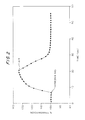
- FIG. 2 is a graph showing percent relative transmission versus time for a 20 nm VO x /30 nmPd sensor in the presence of 4% hydrogen.
- FIG. 3 is a graph showing percent transmission versus cycle number as a measure of cycling stability for a 20 nm VO x /30 nmPd sensor in an environment of 4% H 2 .
- the Pd/V 2 O 5 hydrogen sensor is capable of providing a response above the narrow range of 2% hydrogen because, unlike WO 3 , the V 2 O 5 is not saturated as 2% H 2 or higher.
- the Pd/V 2 O 5 sensor While not wishing to be bound by any theory as to why the Pd/V 2 O 5 sensor is capable of functioning beyond the H 2 saturation point compared to a Pd/WO 3 sensor, it is nevertheless believed that, the Pd/V 2 O 5 sensor structure does not change the thermodynamics of the system, i.e., if fully equilibrated, the Pd still forms a hydride; however, when a kinetically steady state is achieved, the sensor still has the capacity to detect high concentrations of hydrogen even in a higher than normal atmospheric pressurized hydrogen atmosphere.
- FIG. 1A a sensor comprising a glass substrate 10 on which is coated SiO 2 , 11 .
- a Pd layer 12 is coated onto the SiO 2 .
- H 2 13 is blocked at the interface, because SiO 2 cannot react with hydrogen.
- Pd hydride is formed that undergoes phase transition at hydrogen concentration higher than 4%, resulting in substantial volume change and failure of the sensor.
- FIG. 1B in which a glass substrate 20 is coated with a V 2 O 5 layer 21 , which in turn is coated by a Pd layer 22 , H 2 23 is not blocked at the interface between V 2 O 5 and Pd. Accordingly, the vanadium oxide layer acts as a hydrogen insertion host in the Pd/V 2 O 5 hydrogen sensor, while the palladium layer is responsible for the optical modulation.
- the presence of an ion storage host is vital is vital to the stability of the palladium layer, and, unlike the case, when SiO 2 is used in conjunction with a Pd layer, the Pd layer does not peel off and is not degraded in the presence of 2% H 2 (but actually starts forming hydride at room temperature in the presence of about 4% H 2 ).
- FIG. 2 is a graph depicting percent relative transmission versus time for a 20 nm VO/30 nrn Pd hydrogen sensor when exposed to a 4% hydrogen environment, and subsequently exposed to air.
- the cycling stability of a 20 nm VO/30 nrn Pd hydrogen sensor at 4% hydrogen is shown in the graph of transmission relative percent versus cycle number in FIG. 3 , where excellent cycling stability is exhibited during repeated coloring/bleaching cycles. The difference of transmittance between bleached and colored curves does not decrease with cycling.
- the Pd/V 2 O 5 hydrogen sensor results show that: a proton insertion material is vital to stabilizing the palladium layer, although it does not contribute to the optical response; that the Pd/V 2 O 5 hydrogen sensor is easy to make via thermal evaporation processes; and that a wide response range of between 1 to 100% H 2 concentration is available for detecting hydrogen.
Abstract
Description

(Pd+XH2)=PdH2x
(Less Transmissive)=(More Transmissive)
Claims (4)

Pd+XH2=PdH2x;
Priority Applications (1)
| Application Number | Priority Date | Filing Date | Title |
|---|---|---|---|
| US12/059,356 US8084265B2 (en) | 2001-05-05 | 2008-03-31 | Method and Pd/V2 O5 device for H2 detection |
Applications Claiming Priority (5)
| Application Number | Priority Date | Filing Date | Title |
|---|---|---|---|
| US10/239,977 US7419635B2 (en) | 2000-05-05 | 2001-05-05 | Pd/V2O5 device for colorimetric H2 detection |
| WOPCT/US01/14411 | 2001-05-05 | ||
| PCT/US2001/014411 WO2001086266A2 (en) | 2000-05-05 | 2001-05-05 | Pd/v2 05 device for colorimetric h2 detection |
| USPCT/US01/14411 | 2001-05-05 | ||
| US12/059,356 US8084265B2 (en) | 2001-05-05 | 2008-03-31 | Method and Pd/V2 O5 device for H2 detection |
Related Parent Applications (1)
| Application Number | Title | Priority Date | Filing Date |
|---|---|---|---|
| US10/239,977 Division US7419635B2 (en) | 2000-05-05 | 2001-05-05 | Pd/V2O5 device for colorimetric H2 detection |
Publications (2)
| Publication Number | Publication Date |
|---|---|
| US20090053822A1 US20090053822A1 (en) | 2009-02-26 |
| US8084265B2 true US8084265B2 (en) | 2011-12-27 |
Family
ID=40382561
Family Applications (1)
| Application Number | Title | Priority Date | Filing Date |
|---|---|---|---|
| US12/059,356 Expired - Fee Related US8084265B2 (en) | 2001-05-05 | 2008-03-31 | Method and Pd/V2 O5 device for H2 detection |
Country Status (1)
| Country | Link |
|---|---|
| US (1) | US8084265B2 (en) |
Cited By (1)
| Publication number | Priority date | Publication date | Assignee | Title |
|---|---|---|---|---|
| US20130236975A1 (en) * | 2010-04-19 | 2013-09-12 | Total Raffinage Marketing | Tracking of the rate of corrosion of a metal conduit traversed by a corrosive fluid |
Families Citing this family (2)
| Publication number | Priority date | Publication date | Assignee | Title |
|---|---|---|---|---|
| US8048384B1 (en) * | 2010-08-31 | 2011-11-01 | University Of Central Florida Research Foundation, Inc. | Chemochromic hydrogen sensors |
| CN110988046A (en) * | 2019-10-30 | 2020-04-10 | 广州钰芯传感科技有限公司 | V capable of detecting ethanol gas2O5Preparation method of nano material and application of nano material in gas sensor |
Citations (27)
| Publication number | Priority date | Publication date | Assignee | Title |
|---|---|---|---|---|
| US4282272A (en) | 1978-06-09 | 1981-08-04 | Asahi Glass Company, Limited | Method for forming electrochromic film |
| US4365870A (en) | 1979-10-29 | 1982-12-28 | Tokyo Shibaura Denki Kabushiki Kaisha | Electrochromic display device |
| JPS59180526A (en) | 1983-03-30 | 1984-10-13 | Fujitsu Ltd | Electrochromic display element |
| US4661320A (en) | 1983-08-12 | 1987-04-28 | Hochiki Corporation | Gas sensor |
| JPS62257047A (en) | 1986-04-30 | 1987-11-09 | Hochiki Corp | Hydrogen sensor |
| JPS62257046A (en) | 1986-04-30 | 1987-11-09 | Hochiki Corp | Hydrogen sensor |
| US4706493A (en) | 1985-12-13 | 1987-11-17 | General Motors Corporation | Semiconductor gas sensor having thermally isolated site |
| US4832468A (en) | 1985-04-13 | 1989-05-23 | Toyoda Gosei Co., Ltd. | Dimming window |
| US4889414A (en) | 1984-08-21 | 1989-12-26 | Eic Laboratories, Inc. | Light modulating device |
| US5105303A (en) | 1988-03-30 | 1992-04-14 | Saab Automobile Aktiebolag | Arrangement for a transparent covering element with an electrochromatic layer |
| US5252142A (en) | 1990-11-22 | 1993-10-12 | Canon Kabushiki Kaisha | Pin junction photovoltaic element having an I-type semiconductor layer with a plurality of regions having different graded band gaps |
| USRE34469E (en) | 1987-06-18 | 1993-12-07 | Eic Laboratories, Inc. | Solid state electrochromic light modulator |
| WO1996006203A1 (en) | 1994-08-19 | 1996-02-29 | Optical Coating Laboratory, Inc. | Electrochromic materials and devices, and method |
| EP0730189A1 (en) | 1995-03-03 | 1996-09-04 | Canon Kabushiki Kaisha | Electrochromic device and method for manufacturing the same |
| US5708735A (en) | 1996-03-29 | 1998-01-13 | Benson; David K. | Fiber optic device for sensing the presence of a gas |
| US5724187A (en) | 1994-05-05 | 1998-03-03 | Donnelly Corporation | Electrochromic mirrors and devices |
| US5777780A (en) | 1995-08-30 | 1998-07-07 | Canon Kabushiki Kaisha | Electrochromic device and method for manufacturing the same |
| US5864994A (en) * | 1994-11-14 | 1999-02-02 | Fraunhofer Gesellschaft Zur Foerderung Der Angewandten Forschung E.V. | Glazing element, in particular for facing building facades |
| US6020987A (en) | 1997-04-02 | 2000-02-01 | Gentex Corporation | Electrochromic medium capable of producing a pre-selected color |
| US6080998A (en) | 1997-02-27 | 2000-06-27 | Sanyo Electric Co., Ltd. | Amorphous silicon germanium thin film and photovoltaic element |
| US6111684A (en) | 1997-04-02 | 2000-08-29 | Gentex Corporation | Electrochromic rearview mirror incorporating a third surface metal reflector and a display/signal light |
| US6277589B1 (en) | 1998-05-12 | 2001-08-21 | Midwest Research Institute | Method and apparatus for rapid biohydrogen phenotypic screening of microorganisms using a chemochromic sensor |
| US6293847B1 (en) | 1999-10-14 | 2001-09-25 | Agere Systems Guardian Corp. | Apparatus for chemical mechanical polishing endpoint detection using a hydrogen sensor |
| US20030227664A1 (en) | 2000-05-24 | 2003-12-11 | Anoop Agrawal | Electrochromic devices |
| US20040023595A1 (en) | 2000-05-05 | 2004-02-05 | Liu Ping | H2 doped w03, ultra-fast, high-sensitivity hydrogen sensors |
| US6723566B2 (en) | 2000-05-05 | 2004-04-20 | Midwest Research Institute | Pd/Ni-WO3 anodic double layer gasochromic device |
| US6859297B2 (en) | 2001-08-07 | 2005-02-22 | Midwest Research Institute | Electrochromic counter electrode |
Family Cites Families (2)
| Publication number | Priority date | Publication date | Assignee | Title |
|---|---|---|---|---|
| US34469A (en) * | 1862-02-18 | Improved evaporating-pans for saccharine juices | ||
| JPS63119196U (en) * | 1987-01-28 | 1988-08-02 |
-
2008
- 2008-03-31 US US12/059,356 patent/US8084265B2/en not_active Expired - Fee Related
Patent Citations (30)
| Publication number | Priority date | Publication date | Assignee | Title |
|---|---|---|---|---|
| US4282272A (en) | 1978-06-09 | 1981-08-04 | Asahi Glass Company, Limited | Method for forming electrochromic film |
| US4365870A (en) | 1979-10-29 | 1982-12-28 | Tokyo Shibaura Denki Kabushiki Kaisha | Electrochromic display device |
| JPS59180526A (en) | 1983-03-30 | 1984-10-13 | Fujitsu Ltd | Electrochromic display element |
| US4661320A (en) | 1983-08-12 | 1987-04-28 | Hochiki Corporation | Gas sensor |
| US4889414A (en) | 1984-08-21 | 1989-12-26 | Eic Laboratories, Inc. | Light modulating device |
| US4832468A (en) | 1985-04-13 | 1989-05-23 | Toyoda Gosei Co., Ltd. | Dimming window |
| US4706493A (en) | 1985-12-13 | 1987-11-17 | General Motors Corporation | Semiconductor gas sensor having thermally isolated site |
| JPS62257047A (en) | 1986-04-30 | 1987-11-09 | Hochiki Corp | Hydrogen sensor |
| JPS62257046A (en) | 1986-04-30 | 1987-11-09 | Hochiki Corp | Hydrogen sensor |
| USRE34469E (en) | 1987-06-18 | 1993-12-07 | Eic Laboratories, Inc. | Solid state electrochromic light modulator |
| US5105303A (en) | 1988-03-30 | 1992-04-14 | Saab Automobile Aktiebolag | Arrangement for a transparent covering element with an electrochromatic layer |
| US5252142A (en) | 1990-11-22 | 1993-10-12 | Canon Kabushiki Kaisha | Pin junction photovoltaic element having an I-type semiconductor layer with a plurality of regions having different graded band gaps |
| US5724187A (en) | 1994-05-05 | 1998-03-03 | Donnelly Corporation | Electrochromic mirrors and devices |
| WO1996006203A1 (en) | 1994-08-19 | 1996-02-29 | Optical Coating Laboratory, Inc. | Electrochromic materials and devices, and method |
| US5864994A (en) * | 1994-11-14 | 1999-02-02 | Fraunhofer Gesellschaft Zur Foerderung Der Angewandten Forschung E.V. | Glazing element, in particular for facing building facades |
| EP0730189A1 (en) | 1995-03-03 | 1996-09-04 | Canon Kabushiki Kaisha | Electrochromic device and method for manufacturing the same |
| US5831760A (en) | 1995-03-03 | 1998-11-03 | Canon Kabushiki Kaisha | Electrochromic device |
| US5777780A (en) | 1995-08-30 | 1998-07-07 | Canon Kabushiki Kaisha | Electrochromic device and method for manufacturing the same |
| US5708735A (en) | 1996-03-29 | 1998-01-13 | Benson; David K. | Fiber optic device for sensing the presence of a gas |
| US6080998A (en) | 1997-02-27 | 2000-06-27 | Sanyo Electric Co., Ltd. | Amorphous silicon germanium thin film and photovoltaic element |
| US6020987A (en) | 1997-04-02 | 2000-02-01 | Gentex Corporation | Electrochromic medium capable of producing a pre-selected color |
| US6111684A (en) | 1997-04-02 | 2000-08-29 | Gentex Corporation | Electrochromic rearview mirror incorporating a third surface metal reflector and a display/signal light |
| US6277589B1 (en) | 1998-05-12 | 2001-08-21 | Midwest Research Institute | Method and apparatus for rapid biohydrogen phenotypic screening of microorganisms using a chemochromic sensor |
| US6448068B2 (en) | 1998-05-12 | 2002-09-10 | Midwest Research Institute | System for rapid biohydrogen phenotypic screening of microorganisms using a chemochromic sensor |
| US6293847B1 (en) | 1999-10-14 | 2001-09-25 | Agere Systems Guardian Corp. | Apparatus for chemical mechanical polishing endpoint detection using a hydrogen sensor |
| US20040023595A1 (en) | 2000-05-05 | 2004-02-05 | Liu Ping | H2 doped w03, ultra-fast, high-sensitivity hydrogen sensors |
| US6723566B2 (en) | 2000-05-05 | 2004-04-20 | Midwest Research Institute | Pd/Ni-WO3 anodic double layer gasochromic device |
| US7910373B2 (en) | 2000-05-05 | 2011-03-22 | Alliance For Sustainable Energy, Llc | H2O doped WO3, ultra-fast, high-sensitivity hydrogen sensors |
| US20030227664A1 (en) | 2000-05-24 | 2003-12-11 | Anoop Agrawal | Electrochromic devices |
| US6859297B2 (en) | 2001-08-07 | 2005-02-22 | Midwest Research Institute | Electrochromic counter electrode |
Non-Patent Citations (31)
| Title |
|---|
| Beni, "Ion-Insertion Electochomic Displays", Advances in Image Pickup and Display,1982, vol. 5, pp. 83-136. |
| Decker et al., "The Electrochromic Process in Non-Stoichiometric Nickel Oxide Thin Film Electrodes", Electrochima Acta, 1992, vol. 37, No. 6, pp. 1033-1038. |
| Definition of "lag time" and "rise time"; http://www.nwgIde.org/glossary.html. |
| Definition of "response time"; http://www.pc-education.mcmaster.ca/Instrumentation/terminology. |
| Faughnan et al., "Electrochromic Displays Based on WO3", Display Devices, 1980, Chapter 5, pp. 181-211, Edited by PANKOVE, Springer-Verlag. |
| International Preliminary Examination Report, dated Jun. 5, 2003, for International Application No. PCT/US2001/24699. |
| International Preliminary Examination Report, dated Sep. 17, 2002, for International Application No. PCT/US2001/14411. |
| International Search Report, dated Dec. 19, 2001, for International Application No. PCT/US2001/14411. |
| International Search Report, dated Jan. 10, 2001, for International Application No. PCT/US2001/24699. |
| International Search Report, dated Jan. 21, 2002, for International Application No. PCT/US2001/14375. |
| Ito, "Hydrogen Detection Based on Coloration of Anodic Tungsten Oxide Film", Appl. Phys. Lett. vol. 60, Feb. 1992, 938-940. |
| Judeinstein, "Role of the Water Content on the Electrochromic Properties of WO3 n H2O Thin Films", Materials Science & Engineering, 1989, 129-132. |
| Judeinstein, "Role of the Water Content on the Electrochromic Properties of WO3nH2O Thin Films", Materials Science & Engineering, 1989, 120-132. |
| Kim, "A Study on the Hydrogen Intercalation into rf-magnetron Sputtered Amorphous WO3 Film Using Cyclic Voltammetry Combined with Electrochemical Quartz Crystal Microbalance Technique", Solid State Ionics, North Holland Pub. Co. vol. 109, No. 1-2, Jun. 1, 1998, 81-87. |
| Lampert, "Electrochromic Materials and Devices for Energy Efficient Windows", Solar Energy Materials, 1984, vol. 11, pp. 1-27. |
| Lee et al, "Electrochromic Behavior of Ni-W Oxide Electrodes", Solar Energy Materials and Solar Cells, 1995, vol. 39, pp. 155-166. |
| Lee et al. "Characterization of Ni-W Oxide Thin Film Electrodes", Solid State Ionics, 1998, vol. 109, pp. 303-310. |
| Lee, "Microstructure Study of Amorphous Vanadium Oxide Thin Films Using Raman Spectroscopy", Journal of Applied Physics, vol. 92, No. 4, Aug. 15, 2002. |
| Liu, "Electrochromio and Chemothromic Performance of Mesoporous Thin-Film Vanadium Oxide", Solid State Ionics, 165, pp. 223-228 (2003). |
| Liu, "Stable PdN2O5 Optical H2 Sensor", Journal of Electrochemical Society, H76-H80 (2002). |
| Pyun, "Hydrogen Transport Through r.f. Magnetron Sputtered Amorphous and Crystalline WO3 Films", Journal of Alloys and Compounds, 244, 1996, 16-22. |
| USPTO Office Communication, dated Dec. 13, 2007, for U.S. Appl. No. 10/240,082. |
| USPTO Office Communication, dated Feb. 4, 2009, for U.S. Appl. No. 10/240,082. |
| USPTO Office Communication, dated Jul. 12, 2007, for U.S. Appl. No. 10/240,082. |
| USPTO Office Communication, dated Jul. 18, 2006, for U.S. Appl. No. 10/239,977. |
| USPTO Office Communication, dated Jun. 12, 2008, for U.S. Appl. No. 10/240,082. |
| USPTO Office Communication, dated Jun. 28, 2004, for U.S. Appl. No. 10/240,082. |
| USPTO Office Communication, dated Mar. 17, 2006, for U.S. Appl. No. 10/239,977. |
| USPTO Office Communication, dated Nov. 30, 2004, for U.S. Appl. No. 10/240,082. |
| Written Opinion, dated Jul. 24, 2002, for International Application No. PCT/US2001/14411. |
| Written Opinion, dated Oct. 16, 2002, for International Application No. PCT/US2001/14375. |
Cited By (2)
| Publication number | Priority date | Publication date | Assignee | Title |
|---|---|---|---|---|
| US20130236975A1 (en) * | 2010-04-19 | 2013-09-12 | Total Raffinage Marketing | Tracking of the rate of corrosion of a metal conduit traversed by a corrosive fluid |
| US9222871B2 (en) * | 2010-04-19 | 2015-12-29 | Total Raffinage France | Tracking of the rate of corrosion of a metal conduit traversed by a corrosive fluid |
Also Published As
| Publication number | Publication date |
|---|---|
| US20090053822A1 (en) | 2009-02-26 |
Similar Documents
| Publication | Publication Date | Title |
|---|---|---|
| Liu et al. | Stable Pd/V 2 O 5 Optical H 2 Sensor | |
| US7419635B2 (en) | Pd/V2O5 device for colorimetric H2 detection | |
| Ngene et al. | Seeing hydrogen in colors: low‐cost and highly sensitive eye readable hydrogen detectors | |
| US6539774B1 (en) | Thin film metal hydride hydrogen sensor | |
| Meyer et al. | Evidence for adduct formation at the semiconductor-gas interface. Photoluminescent properties of cadmium selenide in the presence of amines | |
| US8084265B2 (en) | Method and Pd/V2 O5 device for H2 detection | |
| US4778764A (en) | Detection system and method | |
| US4724061A (en) | Automotive, internal reference, solid electrolyte, lean oxygen sensor | |
| US7910373B2 (en) | H2O doped WO3, ultra-fast, high-sensitivity hydrogen sensors | |
| JP2022540875A (en) | Hydrogen sensor and its manufacturing method | |
| US6723566B2 (en) | Pd/Ni-WO3 anodic double layer gasochromic device | |
| US5879943A (en) | Humidity detection method | |
| Slaman et al. | Optical hydrogen sensors based on metal-hydrides | |
| US20100045997A1 (en) | Oxygen sensor using principle of surface plasmon resonance and oxygen transmission rate measurement system including the same | |
| EP0772796B1 (en) | Switching device and use thereof | |
| Delval et al. | The rate of water vapor evaporation from ice substrates in the presence of HCl and HBr: implications for the lifetime of atmospheric ice particles | |
| US5171536A (en) | Colorimetric testing and measuring device for gases | |
| JP3962807B2 (en) | Hydrogen sensor using magnesium thin film and method for measuring hydrogen concentration | |
| Liu et al. | Pd/V 2 O 5 device for colorimetric H 2 detection | |
| US20240019413A1 (en) | Manufacturing method of optical fiber chemical ratiometric sensor measurement system for measuring underwater dissolved oxygen concentration | |
| Liu et al. | Metal Oxide Stabilized Palladium Sensor For Hydrogen Detection | |
| JPS5924379B2 (en) | Paramagnetic gas concentration detection device | |
| CA1083383A (en) | Analysis of a sample using a conversion means and specific gas detectors | |
| JP2004093162A (en) | Hydrogen permeability evaluation method for membrane | |
| Middlebrook | Laboratory studies of model stratospheric aerosol films using Fourier transform infrared spectroscopy |
Legal Events
| Date | Code | Title | Description |
|---|---|---|---|
| AS | Assignment |
Owner name: MIDWEST RESEARCH INSTITUTE, MISSOURI Free format text: ASSIGNMENT OF ASSIGNORS INTEREST;ASSIGNORS:LIU, PING;TRACY, C. EDWIN;PITTS, J. ROLAND;AND OTHERS;REEL/FRAME:021077/0791;SIGNING DATES FROM 20080408 TO 20080602 Owner name: MIDWEST RESEARCH INSTITUTE, MISSOURI Free format text: ASSIGNMENT OF ASSIGNORS INTEREST;ASSIGNORS:LIU, PING;TRACY, C. EDWIN;PITTS, J. ROLAND;AND OTHERS;SIGNING DATES FROM 20080408 TO 20080602;REEL/FRAME:021077/0791 |
|
| AS | Assignment |
Owner name: ENERGY, UNITED STATES DEPARTMENT OF, DISTRICT OF C Free format text: CONFIRMATORY LICENSE;ASSIGNOR:MIDWEST RESEARCH INSTITUTE;REEL/FRAME:021133/0066 Effective date: 20080408 |
|
| AS | Assignment |
Owner name: ALLIANCE FOR SUSTAINABLE ENERGY, LLC, COLORADO Free format text: ASSIGNMENT OF ASSIGNORS INTEREST;ASSIGNOR:MIDWEST RESEARCH INSTITUTE;REEL/FRAME:021603/0337 Effective date: 20080912 Owner name: ALLIANCE FOR SUSTAINABLE ENERGY, LLC,COLORADO Free format text: ASSIGNMENT OF ASSIGNORS INTEREST;ASSIGNOR:MIDWEST RESEARCH INSTITUTE;REEL/FRAME:021603/0337 Effective date: 20080912 |
|
| ZAAA | Notice of allowance and fees due |
Free format text: ORIGINAL CODE: NOA |
|
| ZAAB | Notice of allowance mailed |
Free format text: ORIGINAL CODE: MN/=. |
|
| ZAAA | Notice of allowance and fees due |
Free format text: ORIGINAL CODE: NOA |
|
| ZAAA | Notice of allowance and fees due |
Free format text: ORIGINAL CODE: NOA |
|
| ZAAB | Notice of allowance mailed |
Free format text: ORIGINAL CODE: MN/=. |
|
| STCF | Information on status: patent grant |
Free format text: PATENTED CASE |
|
| FPAY | Fee payment |
Year of fee payment: 4 |
|
| MAFP | Maintenance fee payment |
Free format text: PAYMENT OF MAINTENANCE FEE, 8TH YR, SMALL ENTITY (ORIGINAL EVENT CODE: M2552); ENTITY STATUS OF PATENT OWNER: SMALL ENTITY Year of fee payment: 8 |
|
| FEPP | Fee payment procedure |
Free format text: MAINTENANCE FEE REMINDER MAILED (ORIGINAL EVENT CODE: REM.); ENTITY STATUS OF PATENT OWNER: SMALL ENTITY |
|
| LAPS | Lapse for failure to pay maintenance fees |
Free format text: PATENT EXPIRED FOR FAILURE TO PAY MAINTENANCE FEES (ORIGINAL EVENT CODE: EXP.); ENTITY STATUS OF PATENT OWNER: SMALL ENTITY |
|
| STCH | Information on status: patent discontinuation |
Free format text: PATENT EXPIRED DUE TO NONPAYMENT OF MAINTENANCE FEES UNDER 37 CFR 1.362 |
|
| FP | Lapsed due to failure to pay maintenance fee |
Effective date: 20231227 |