US5695360A - Zero insertion force electrical connector for flat cable - Google Patents
Zero insertion force electrical connector for flat cable Download PDFInfo
- Publication number
- US5695360A US5695360A US08/623,269 US62326996A US5695360A US 5695360 A US5695360 A US 5695360A US 62326996 A US62326996 A US 62326996A US 5695360 A US5695360 A US 5695360A
- Authority
- US
- United States
- Prior art keywords
- housing
- pressure plate
- terminals
- flat cable
- actuator
- Prior art date
- Legal status (The legal status is an assumption and is not a legal conclusion. Google has not performed a legal analysis and makes no representation as to the accuracy of the status listed.)
- Expired - Lifetime
Links
- 238000003780 insertion Methods 0.000 title claims abstract description 22
- 230000037431 insertion Effects 0.000 title claims abstract description 22
- 239000003989 dielectric material Substances 0.000 description 2
- 230000005540 biological transmission Effects 0.000 description 1
- 239000004020 conductor Substances 0.000 description 1
- 239000000463 material Substances 0.000 description 1
- 239000007769 metal material Substances 0.000 description 1
- 238000005476 soldering Methods 0.000 description 1
Images




Classifications
-
- H—ELECTRICITY
- H01—ELECTRIC ELEMENTS
- H01R—ELECTRICALLY-CONDUCTIVE CONNECTIONS; STRUCTURAL ASSOCIATIONS OF A PLURALITY OF MUTUALLY-INSULATED ELECTRICAL CONNECTING ELEMENTS; COUPLING DEVICES; CURRENT COLLECTORS
- H01R12/00—Structural associations of a plurality of mutually-insulated electrical connecting elements, specially adapted for printed circuits, e.g. printed circuit boards [PCB], flat or ribbon cables, or like generally planar structures, e.g. terminal strips, terminal blocks; Coupling devices specially adapted for printed circuits, flat or ribbon cables, or like generally planar structures; Terminals specially adapted for contact with, or insertion into, printed circuits, flat or ribbon cables, or like generally planar structures
- H01R12/70—Coupling devices
- H01R12/77—Coupling devices for flexible printed circuits, flat or ribbon cables or like structures
- H01R12/79—Coupling devices for flexible printed circuits, flat or ribbon cables or like structures connecting to rigid printed circuits or like structures
-
- H—ELECTRICITY
- H01—ELECTRIC ELEMENTS
- H01R—ELECTRICALLY-CONDUCTIVE CONNECTIONS; STRUCTURAL ASSOCIATIONS OF A PLURALITY OF MUTUALLY-INSULATED ELECTRICAL CONNECTING ELEMENTS; COUPLING DEVICES; CURRENT COLLECTORS
- H01R12/00—Structural associations of a plurality of mutually-insulated electrical connecting elements, specially adapted for printed circuits, e.g. printed circuit boards [PCB], flat or ribbon cables, or like generally planar structures, e.g. terminal strips, terminal blocks; Coupling devices specially adapted for printed circuits, flat or ribbon cables, or like generally planar structures; Terminals specially adapted for contact with, or insertion into, printed circuits, flat or ribbon cables, or like generally planar structures
- H01R12/50—Fixed connections
- H01R12/51—Fixed connections for rigid printed circuits or like structures
- H01R12/55—Fixed connections for rigid printed circuits or like structures characterised by the terminals
- H01R12/57—Fixed connections for rigid printed circuits or like structures characterised by the terminals surface mounting terminals
-
- H—ELECTRICITY
- H01—ELECTRIC ELEMENTS
- H01R—ELECTRICALLY-CONDUCTIVE CONNECTIONS; STRUCTURAL ASSOCIATIONS OF A PLURALITY OF MUTUALLY-INSULATED ELECTRICAL CONNECTING ELEMENTS; COUPLING DEVICES; CURRENT COLLECTORS
- H01R12/00—Structural associations of a plurality of mutually-insulated electrical connecting elements, specially adapted for printed circuits, e.g. printed circuit boards [PCB], flat or ribbon cables, or like generally planar structures, e.g. terminal strips, terminal blocks; Coupling devices specially adapted for printed circuits, flat or ribbon cables, or like generally planar structures; Terminals specially adapted for contact with, or insertion into, printed circuits, flat or ribbon cables, or like generally planar structures
- H01R12/70—Coupling devices
- H01R12/82—Coupling devices connected with low or zero insertion force
- H01R12/85—Coupling devices connected with low or zero insertion force contact pressure producing means, contacts activated after insertion of printed circuits or like structures
- H01R12/88—Coupling devices connected with low or zero insertion force contact pressure producing means, contacts activated after insertion of printed circuits or like structures acting manually by rotating or pivoting connector housing parts
Definitions
- This invention generally relates to the art of electrical connectors and, particularly, to an electrical connector for terminating a flat cable, such as a flat flexible cable, without requiring any insertion force.
- the actuators have been designed to be pushed in and pulled out of the connector housings. Such designs require the application of insertion forces to the flat cables. In addition, such designs have inevitably resulted in an increase in the overall size of the connectors.
- actuators which are pivotable between first, open positions allowing free insertion of the cables into the connector housings, and second, closed positions for clamping the flat cables against the terminals.
- lock means are provided to hold the actuators in locked condition relative to the connector housing.
- the present invention is directed to a new and improved zero insertion force electrical connector for flat cables of the character described above, wherein the actuator is pivotally mounted on the connector housing by means of a floating-pivot means and allows for increased linear or translational movement of the actuator in pushing the cable into the connector.
- An object, therefore, of the invention is to provide a new and improved zero insertion force electrical connector for flat electrical cables, of the character described.
- the zero insertion force electrical connector includes a dielectric housing mounting a plurality of terminals in a generally parallel array.
- the housing has opposite sides and a front end with an opening between the sides for receiving an end of the flat cable in engagement with contact portions of the terminals.
- An actuator in the form of a pressure plate is pivotally mounted relative to the housing for floating movement between a first position allowing free insertion of the flat cable into the opening, and a second position biasing the cable against the terminals.
- the actuator or pressure plate has an extension on its rearward end for movement beneath an overhanging shelf means on the housing.
- a forwardly facing cam surface is provided on the pressure plate for abutting a rearwardly facing cam surface on the housing as the pressure plate is rotated about a moving pivot from its first position to its second position causing the extension of the pressure plate to advance beneath the overhanging shelf means on the housing, thereby sandwiching the end of the flat cable between the contact portions of the terminals and the pressure plate.
- each of the terminals is bifurcated to define a contact branch and a support branch between which the flat cable is insertable.
- the support branches of the parallel array of terminals form the overhanging shelf means on the housing.
- the cam surfaces have cam profiles to allow substantial pivoting movement of the pressure plate relative to the housing followed by substantial translational movement of the pressure plate relative to the housing.
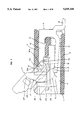
- FIG. 1 is a vertical front-to-rear section through an electrical connector according to the invention
- FIG. 2 is a top plan view of the housing for the connector
- FIG. 3 is a front elevational view of the housing
- FIG. 4 is a side elevational view of the housing
- FIG. 5 is a top plan view of the actuator or pressure plate of the connector
- FIG. 6 is a front elevational view of the pressure plate
- FIG. 7 is a side elevational view of the pressure plate
- FIG. 8 is an enlarged section taken generally alone line 8--8 in FIG. 6;
- FIG. 9 is an enlarged section taken generally along line 9--9 in FIG. 6;
- FIG. 10 is an enlarged section taken generally along line 10--10 in FIG. 6;
- FIG. 11 is a side elevational view of the connector, with the pressure plate in its open position
- FIG. 12 is a vertical section through the connector, with the pressure plate in its open position and with a flat cable inserted into the connector;
- FIG. 13 is a side elevational view of the connector, with the pressure plate beginning to be rotated toward its closed position;
- FIG. 14 is a vertical section through the connector in the condition of FIG. 13;
- FIG. 15 is a side elevational view of the connector, with the cam surfaces just beginning to engage;
- FIG. 16 is a vertical section through the connector in the condition of FIG. 15;
- FIG. 17 is a side elevational view of the connector, with the pressure plate beginning to move linearly or translationally of the housing;
- FIG. 18 is a vertical section through the connector in the condition of FIG. 17;
- FIG. 19 is a side elevational view of the connector, with the pressure plate near its final position
- FIG. 20 is a vertical section through the connector in the condition of FIG. 19;
- FIG. 21 is a side elevational view of the connector with the pressure plate in its final closed position
- FIG. 22 is a vertical section through the connector in the condition of FIG. 21.
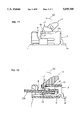
- FIG. 23 is a fragmented, somewhat schematic view of various contact points on the pressure plate in its final closed position.
- FIG. 1 shows an electrical connector for flat electrical cables according to the present invention.
- the connector includes a housing, generally designated 1, mounting a plurality of terminals, generally designated 2, and an actuator or pressure plate, generally designated 3.
- FIGS. 2-4 show further details of housing 1
- FIGS. 5-10 show details of the actuator or pressure plate 3.
- Housing 1 is unitarily molded of dielectric material such as plastic or the like.
- the housing includes a bottom plate 5 having a plurality of slots 4 to accommodate terminals 2.
- the housing further includes opposite side walls 6 and a ceiling or top wall 7 which covers the top and approximately the rear one-half of the interior of the housing.
- Top wall 7 leaves an opening 8 in the front one-half of the housing and the front face of the housing for receiving the flat cable.
- each side wall 6 has a counter cam surface 9 facing in a rearward direction generally toward top wall 7. The counter cam surface cooperates with a cam surface on pressure plate 3 for guiding the pressure plate during its rotational and translational movements, as described hereinafter.
- each terminal 2 is stamped and formed of sheet metal material and in a generally bifurcated configuration to define a relatively long, lower contact branch 11 and a relatively short, upper support branch 10.
- the upper support branch includes a triangular barb 12 that bites into the plastic material of the housing to establish an interference fit therewith and, thereby, fix the terminal in the housing.
- Lower contact branch 11 of each terminal 2 is vertically flexible and includes an upwardly projecting contact portion 13 at its forward distal end and an L-shaped tail 14 at its rear end. Tail 14 is adapted for soldering to a circuit trace on a printed circuit board (not shown), and the bottom of tail 14 is flush with the lower surface of the wall 5 of the housing.
- the terminals are mounted in a generally parallel array transversely or side-to-side of the housing.
- the actuator or pressure plate 3 is unitarily molded of dielectric material such as plastic or the like.
- the pressure plate includes a major transverse flat plate 15 large enough to cover the opening or space 8 at the top front of housing 1.
- a pair of flanges 16 are integrally formed with opposite sides of the transverse flat plate 15.
- Each flange 16 is generally triangular and has a forwardly facing cam surface 17.
- Cam surfaces 17 on opposite flanges 16 of pressure plate 3 confront counter cam surfaces 9 on housing 1.
- Each flange 16 of pressure plate 3 has a laterally outwardly extending projection 18 on its outer surface.
- Each lateral projection 18 is movably fitted in an L-shaped slot 19 (FIG. 2) on the inner surface 19a of a respective one of the side walls 6 of housing 1.
- the transverse flat plate 15 of the pressure plate has lateral projections 20 at its opposite sides and which extend beneath inwardly-projecting lateral extensions 21 (FIG. 3) inside opposite side walls 6 of housing 1.
- counter cam surface 9 on housing 1 includes a vertically linear cam section 22, a slanted cam section 23 and a curved cam section 24 consecutively or seriatim from the top to the bottom of cam surface 9.
- Cam surface 17 on pressure plate 3 includes a curved cam section 25, an angled cam section 26 and a vertically linear cam section 27 as viewed from bottom to top of cam surface 17.
- a forward extension 15a of transverse flat plate 15 of pressure plate 3 advances into housing 1 such that the upper surface of forward extension 15a engages and moves under a comb-like lower bearing surface or shelf 28 defined by the underside of support branches 10 of the generally parallel array of terminals 2.
- FIGS. 11 and subsequent drawings show the manner in which pressure plate 3 moves in a floating action (i.e. like a floating pivot) with respect to housing 1.
- pressure plate 3 is shown in its fully opened position in which a flat flexible cable 29 can be inserted into the housing. It should be noted that the flat cable is inserted into the housing without requiring any insertion force. It can be seen in FIG. 12 that the flat cable rests on top of contact portions 13 of flexible contact branches 11 of terminals 2. Thereafter, pressure plate 3 is rotated in the direction of arrows 30 until cam surfaces 17 on the pressure plate begins to abut the counter cam surfaces 9 on the housing, as shown in FIGS. 13, 14, 15 and 16.
- FIGS. 21 and 22 show the final position of actuator or pressure plate 3 relative to housing 1.
- vertically linear cam section 27 of cam surface 17 of pressure plate 3 abuts vertically linear cam section 22 of cam surface 9 on housing 1, while forward extension 15a of the transverse plate 15 of pressure plate 3 is positioned fully under the shelf means formed by support branches 10 of terminals 2.
- flat cable 29 is sandwiched between the lower surface of forward extension 15a and contact portions 13 of contact branches 11 of terminals 2, with each exposed conductor on the underside of the flat cable contacting a contact portion 13 of a respective one of the terminals.
- FIG. 23 is a schematic illustration to show a horizontal distance "L” between a final center of rotation “O” of pressure plate 3 and the point of pressure "P” in the final position of the pressure plate.
- pressure plate 3 is pushed forwardly while being rotated in a floating pivoting manner, as a counter action to housing 1 caused by the cooperation between cam surface 17 on the pressure plate and counter cam surface 9 on the housing.
- This provides an increased horizontal distance "L” (FIG. 23) from the final center of rotation to the pressure point, compared to prior art actuators that rotate about a fixed pivot.
- increased resistance is provided against the flat cable from slipping out of the connector when subjected to undesirable pulling forces which might tend to rotate pressure plate 3 toward its open position.
- pressure point "P” moves from the left-hand side of center of rotation "O" to the right-hand side as viewed in FIG. 23 to form a type of toggle arrangement as the pressure plate rotates and translates toward its final position. Therefore, no latching mechanism is necessitated because pulling on the cable only tightens its clamped engagement.
- inward lateral extensions 21 of the side walls of housing 1 overhang the opposite longitudinal edges of flat cable 29. These overhanging extensions tend to absorb at least a part of any undesirable pulling force applied to the flat cable, thereby reducing transmission of the pulling force to pressure plate 3 in the opening direction of the pressure plate.
- pressure plate 3 In order to remove flat cable 29 from the electrical connector, pressure plate 3 is rotated in the direction of arrow 32 (FIG. 22) to cause a pulling force on the pressure plate then can be rotated about its floating or moving pivot back to its fully open position as shown in FIGS. 11 and 12 to permit easy removal of the flat cable.
- housing 1 may be designed to have a horizontal extension on the inside thereof to provide a shelf means or bearing surface 28 rather than providing the bearing surface by means of support branches 10 of terminals 3.
- L-shaped tails 14 of terminals 2 may be replaced by pin-like tails which can be inserted into holes in a printed circuit board.
Abstract
A zero insertion force electrical connector is provided for a flat cable. The connector includes a dielectric housing mounting a plurality of terminals. The housing has a front end with an opening for receiving an end of the flat cable in engagement with contact portions of the terminals. An actuator is pivotally mounted relative to the housing for floating movement between a first position allowing free insertion of the flat cable into the opening and a second position biasing the cable against the terminals. A cam surface on the actuator abuts a counter cam surface on the housing as the actuator rotates and translates about a moving pivot from its first position to its second position sandwiching the end of the flat cable between the contact portions of the terminals and the actuator.
Description
This invention generally relates to the art of electrical connectors and, particularly, to an electrical connector for terminating a flat cable, such as a flat flexible cable, without requiring any insertion force.
There are a wide variety of zero insertion force electrical connectors particularly adapted for terminating flat cables, such as flexible flat cables. These electrical connectors conventionally use actuators to push the flexible flat cables, flexible printed circuit boards or the like against resilient contacts or terminals which are mounted in the connector housings.
Heretofore, the actuators have been designed to be pushed in and pulled out of the connector housings. Such designs require the application of insertion forces to the flat cables. In addition, such designs have inevitably resulted in an increase in the overall size of the connectors.
Consequently, some zero insertion force electrical connectors for flat cables have been designed with actuators which are pivotable between first, open positions allowing free insertion of the cables into the connector housings, and second, closed positions for clamping the flat cables against the terminals. In some such connectors, lock means are provided to hold the actuators in locked condition relative to the connector housing.
The present invention is directed to a new and improved zero insertion force electrical connector for flat cables of the character described above, wherein the actuator is pivotally mounted on the connector housing by means of a floating-pivot means and allows for increased linear or translational movement of the actuator in pushing the cable into the connector.
An object, therefore, of the invention is to provide a new and improved zero insertion force electrical connector for flat electrical cables, of the character described.
In the exemplary embodiment of the invention, the zero insertion force electrical connector includes a dielectric housing mounting a plurality of terminals in a generally parallel array. The housing has opposite sides and a front end with an opening between the sides for receiving an end of the flat cable in engagement with contact portions of the terminals. An actuator in the form of a pressure plate is pivotally mounted relative to the housing for floating movement between a first position allowing free insertion of the flat cable into the opening, and a second position biasing the cable against the terminals. The actuator or pressure plate has an extension on its rearward end for movement beneath an overhanging shelf means on the housing. A forwardly facing cam surface is provided on the pressure plate for abutting a rearwardly facing cam surface on the housing as the pressure plate is rotated about a moving pivot from its first position to its second position causing the extension of the pressure plate to advance beneath the overhanging shelf means on the housing, thereby sandwiching the end of the flat cable between the contact portions of the terminals and the pressure plate.
As disclosed herein, each of the terminals is bifurcated to define a contact branch and a support branch between which the flat cable is insertable. The support branches of the parallel array of terminals form the overhanging shelf means on the housing. The cam surfaces have cam profiles to allow substantial pivoting movement of the pressure plate relative to the housing followed by substantial translational movement of the pressure plate relative to the housing.
Other objects, features and advantages of the invention will be apparent from the following detailed description taken in connection with the accompanying drawings.
The features of this invention which are believed to be novel are set forth with particularity in the appended claims. The invention, together with its objects and the advantages thereof, may be best understood by reference to the following description taken in conjunction with the accompanying drawings, in which like reference numerals identify like elements in the figures and in which:
FIG. 1 is a vertical front-to-rear section through an electrical connector according to the invention;
FIG. 2 is a top plan view of the housing for the connector;
FIG. 3 is a front elevational view of the housing;
FIG. 4 is a side elevational view of the housing;
FIG. 5 is a top plan view of the actuator or pressure plate of the connector;
FIG. 6 is a front elevational view of the pressure plate;
FIG. 7 is a side elevational view of the pressure plate;
FIG. 8 is an enlarged section taken generally alone line 8--8 in FIG. 6;
FIG. 9 is an enlarged section taken generally along line 9--9 in FIG. 6;
FIG. 10 is an enlarged section taken generally along line 10--10 in FIG. 6;
FIG. 11 is a side elevational view of the connector, with the pressure plate in its open position;
FIG. 12 is a vertical section through the connector, with the pressure plate in its open position and with a flat cable inserted into the connector;
FIG. 13 is a side elevational view of the connector, with the pressure plate beginning to be rotated toward its closed position;
FIG. 14 is a vertical section through the connector in the condition of FIG. 13;
FIG. 15 is a side elevational view of the connector, with the cam surfaces just beginning to engage;
FIG. 16 is a vertical section through the connector in the condition of FIG. 15;
FIG. 17 is a side elevational view of the connector, with the pressure plate beginning to move linearly or translationally of the housing;
FIG. 18 is a vertical section through the connector in the condition of FIG. 17;
FIG. 19 is a side elevational view of the connector, with the pressure plate near its final position;
FIG. 20 is a vertical section through the connector in the condition of FIG. 19;
FIG. 21 is a side elevational view of the connector with the pressure plate in its final closed position;
FIG. 22 is a vertical section through the connector in the condition of FIG. 21; and
FIG. 23 is a fragmented, somewhat schematic view of various contact points on the pressure plate in its final closed position.
Referring to the drawings in greater detail, FIG. 1 shows an electrical connector for flat electrical cables according to the present invention. The connector includes a housing, generally designated 1, mounting a plurality of terminals, generally designated 2, and an actuator or pressure plate, generally designated 3. FIGS. 2-4 show further details of housing 1, and FIGS. 5-10 show details of the actuator or pressure plate 3.
As seen best in FIG. 1, each terminal 2 is stamped and formed of sheet metal material and in a generally bifurcated configuration to define a relatively long, lower contact branch 11 and a relatively short, upper support branch 10. The upper support branch includes a triangular barb 12 that bites into the plastic material of the housing to establish an interference fit therewith and, thereby, fix the terminal in the housing. Lower contact branch 11 of each terminal 2 is vertically flexible and includes an upwardly projecting contact portion 13 at its forward distal end and an L-shaped tail 14 at its rear end. Tail 14 is adapted for soldering to a circuit trace on a printed circuit board (not shown), and the bottom of tail 14 is flush with the lower surface of the wall 5 of the housing. The terminals are mounted in a generally parallel array transversely or side-to-side of the housing.
Referring to FIGS. 5-7, the actuator or pressure plate 3 is unitarily molded of dielectric material such as plastic or the like. The pressure plate includes a major transverse flat plate 15 large enough to cover the opening or space 8 at the top front of housing 1. A pair of flanges 16 are integrally formed with opposite sides of the transverse flat plate 15. Each flange 16 is generally triangular and has a forwardly facing cam surface 17. Cam surfaces 17 on opposite flanges 16 of pressure plate 3 confront counter cam surfaces 9 on housing 1.
Each flange 16 of pressure plate 3 has a laterally outwardly extending projection 18 on its outer surface. Each lateral projection 18 is movably fitted in an L-shaped slot 19 (FIG. 2) on the inner surface 19a of a respective one of the side walls 6 of housing 1. In addition, the transverse flat plate 15 of the pressure plate has lateral projections 20 at its opposite sides and which extend beneath inwardly-projecting lateral extensions 21 (FIG. 3) inside opposite side walls 6 of housing 1.
As seen best in FIG. 1, counter cam surface 9 on housing 1 includes a vertically linear cam section 22, a slanted cam section 23 and a curved cam section 24 consecutively or seriatim from the top to the bottom of cam surface 9. Cam surface 17 on pressure plate 3 includes a curved cam section 25, an angled cam section 26 and a vertically linear cam section 27 as viewed from bottom to top of cam surface 17.
As pressure plate 3 is rotated from its open position shown in FIGS. 11 and 12 toward its closed position shown in FIGS. 21 and 22, a forward extension 15a of transverse flat plate 15 of pressure plate 3 advances into housing 1 such that the upper surface of forward extension 15a engages and moves under a comb-like lower bearing surface or shelf 28 defined by the underside of support branches 10 of the generally parallel array of terminals 2.
FIGS. 11 and subsequent drawings show the manner in which pressure plate 3 moves in a floating action (i.e. like a floating pivot) with respect to housing 1. Referring to FIGS. 11 and 12, pressure plate 3 is shown in its fully opened position in which a flat flexible cable 29 can be inserted into the housing. It should be noted that the flat cable is inserted into the housing without requiring any insertion force. It can be seen in FIG. 12 that the flat cable rests on top of contact portions 13 of flexible contact branches 11 of terminals 2. Thereafter, pressure plate 3 is rotated in the direction of arrows 30 until cam surfaces 17 on the pressure plate begins to abut the counter cam surfaces 9 on the housing, as shown in FIGS. 13, 14, 15 and 16.
As seen in FIGS. 17 and 18, curved cam section 25 of cam surface 17 on pressure plate 3 abuts slanted cam section 23 of counter cam surface 9 on housing 1. At this point, pressure plate 3 begins to be pushed forward as a counter action relative to the housing in the direction of arrows 31. This causes forward extension 15a of transverse plate 15 to advance under the lower bearing surface or shelf means 28 defined by support branches 10 of terminals 2. The distal ends of support branches 10 have angled, straight surfaces 10a (FIG. 1) which confront the top flat surface of forward extension 15a, and this engagement, along with the counter action between the cam surfaces of the housing and the pressure plate, expedite the forward advancing of forward extension 15a of the transverse plate 15 into the housing as seen in FIGS. 1, 19 and 20. During this pivoting and translational movement of pressure plate 3 relative to housing 1, a pressure point "P" on the underside of forward extension 15a near the end of transverse plate 15 pushes flat cable 29 against contacts 13 of the underlying contact branches 11 of terminals 2. Pressure point "P" moves downwardly and forwardly as indicated by broken line "Q" in FIG. 1.
FIGS. 21 and 22 show the final position of actuator or pressure plate 3 relative to housing 1. In the final position, vertically linear cam section 27 of cam surface 17 of pressure plate 3 abuts vertically linear cam section 22 of cam surface 9 on housing 1, while forward extension 15a of the transverse plate 15 of pressure plate 3 is positioned fully under the shelf means formed by support branches 10 of terminals 2. In this position, flat cable 29 is sandwiched between the lower surface of forward extension 15a and contact portions 13 of contact branches 11 of terminals 2, with each exposed conductor on the underside of the flat cable contacting a contact portion 13 of a respective one of the terminals.
FIG. 23 is a schematic illustration to show a horizontal distance "L" between a final center of rotation "O" of pressure plate 3 and the point of pressure "P" in the final position of the pressure plate.
As can be understood from the above, pressure plate 3 is pushed forwardly while being rotated in a floating pivoting manner, as a counter action to housing 1 caused by the cooperation between cam surface 17 on the pressure plate and counter cam surface 9 on the housing. This provides an increased horizontal distance "L" (FIG. 23) from the final center of rotation to the pressure point, compared to prior art actuators that rotate about a fixed pivot. In addition, increased resistance is provided against the flat cable from slipping out of the connector when subjected to undesirable pulling forces which might tend to rotate pressure plate 3 toward its open position. In other words, it can be understood that pressure point "P" moves from the left-hand side of center of rotation "O" to the right-hand side as viewed in FIG. 23 to form a type of toggle arrangement as the pressure plate rotates and translates toward its final position. Therefore, no latching mechanism is necessitated because pulling on the cable only tightens its clamped engagement.
As seen in FIG. 2, inward lateral extensions 21 of the side walls of housing 1 overhang the opposite longitudinal edges of flat cable 29. These overhanging extensions tend to absorb at least a part of any undesirable pulling force applied to the flat cable, thereby reducing transmission of the pulling force to pressure plate 3 in the opening direction of the pressure plate.
In order to remove flat cable 29 from the electrical connector, pressure plate 3 is rotated in the direction of arrow 32 (FIG. 22) to cause a pulling force on the pressure plate then can be rotated about its floating or moving pivot back to its fully open position as shown in FIGS. 11 and 12 to permit easy removal of the flat cable.
Lastly, housing 1 may be designed to have a horizontal extension on the inside thereof to provide a shelf means or bearing surface 28 rather than providing the bearing surface by means of support branches 10 of terminals 3. In addition, L-shaped tails 14 of terminals 2 may be replaced by pin-like tails which can be inserted into holes in a printed circuit board.
It will be understood that the invention may be embodied in other specific forms without departing from the spirit or central characteristics thereof. The present examples and embodiments, therefore, are to be considered in all respects as illustrative and not restrictive, and the invention is not to be limited to the details given herein.
Claims (7)
1. A zero insertion force electrical connector for a flat cable, comprising:
a dielectric housing mounting a plurality of terminals in a generally parallel array, the housing having opposite sides and a front end with an opening between the sides for receiving an end of the flat cable in engagement with contact portions of the terminals;
a pressure plate pivotally mounted relative to the housing for floating movement between a first position allowing free insertion of the flat cable into the opening and a second position biasing the cable against the terminals, the pressure plate having an extension on its rearward end for movement beneath an overhanging shelf means on the housing; and
a forwardly facing cam surface on the pressure plate for abutting a rearwardly facing cam surface on the housing as the pressure plate is rotated about a moving pivot from its first position to its second position causing substantial translational movement of the pressure plate relative to the housing and causing the extension of the pressure plate to advance beneath the overhanging shelf means on the housing, sandwiching the end of the flat cable between the contact portions of the terminal and the pressure plate.
2. The zero insertion force electrical connector of claim 1 wherein each of said terminals is bifurcated to define a contact branch and a support branch, the support branches of the parallel array of terminals forming said overhanging shelf means on the housing.
3. The zero insertion force electrical connector of claim 1 wherein at least one of said cam surfaces has a cam profile to effect the rotational movement of the pressure plate about the moving pivot and the substantial translational movement of the pressure plate relative to the housing.
4. The zero insertion force electrical connector of claim 3 wherein at least one of said cam surfaces has a plurality of discrete cam sections to define said cam profile to effect said pivoting and translational movements.
5. A zero insertion force electrical connector for a flat cable, comprising:
a dielectric housing mounting a plurality of terminals, the housing having a front end with an opening for receiving an end of the flat cable in engagement with contact portions of the terminals;
an actuator pivotally mounted relative to the housing for floating movement between a first position allowing free insertion of the flat cable into the opening and a second position biasing the cable against the terminals; and
a cam surface on the actuator for abutting a counter cam surface on the housing as the actuator is rotated about a moving pivot from its first position to its second position, causing the actuator to rotate and translate relative to the housing and sandwiching the end of the flat cable between the contact portions of the terminals and the actuator.
6. The zero insertion force electrical connector of claim 5 wherein at least one of said cam surfaces has a cam profile to effect the rotational movement of the actuator about the moving pivot and the translational movement of the actuator relative to the housing.
7. The zero insertion force electrical connector of claim 6 wherein at least one of said cam surfaces has a plurality of discrete cam sections to define said cam profile to effect said pivoting and translational movements.
Applications Claiming Priority (2)
| Application Number | Priority Date | Filing Date | Title |
|---|---|---|---|
| JP7-144099 | 1995-05-18 | ||
| JP7144099A JP2824747B2 (en) | 1995-05-18 | 1995-05-18 | Electrical connector for flat flexible cable |
Publications (1)
| Publication Number | Publication Date |
|---|---|
| US5695360A true US5695360A (en) | 1997-12-09 |
Family
ID=15354179
Family Applications (1)
| Application Number | Title | Priority Date | Filing Date |
|---|---|---|---|
| US08/623,269 Expired - Lifetime US5695360A (en) | 1995-05-18 | 1996-03-28 | Zero insertion force electrical connector for flat cable |
Country Status (9)
| Country | Link |
|---|---|
| US (1) | US5695360A (en) |
| EP (1) | EP0743715B1 (en) |
| JP (1) | JP2824747B2 (en) |
| KR (1) | KR100212925B1 (en) |
| DE (1) | DE69611320T2 (en) |
| ES (1) | ES2154362T3 (en) |
| MY (1) | MY116520A (en) |
| SG (1) | SG66309A1 (en) |
| TW (1) | TW311763U (en) |
Cited By (27)
| Publication number | Priority date | Publication date | Assignee | Title |
|---|---|---|---|---|
| US5906504A (en) * | 1996-04-15 | 1999-05-25 | Japan Aviation Electronic Industry, Ltd. | Electrical connector for connecting FPC to printed circuit with means for fixedly connecting FPC to the connector without removal of FPC from the connector |
| US5906498A (en) * | 1997-01-24 | 1999-05-25 | Nec Corporation | Electrical connector having joint structure to connect electrical connecting element to circuit board |
| US6042408A (en) * | 1997-05-13 | 2000-03-28 | Sumitomo Wiring Systems, Ltd. | Connector for flat conductive path |
| US6056571A (en) * | 1997-01-23 | 2000-05-02 | Sumitomo Hiring Systems, Ltd. | Electrical connector for flat electrical conductor |
| US6099346A (en) * | 1998-07-31 | 2000-08-08 | Japan Aviation Electronics Industry, Limited | Cable connector capable of surely connecting a cable |
| US6146172A (en) * | 1999-06-08 | 2000-11-14 | Hon Hai Precision Ind. Co., Ltd. | Electrical connector |
| US6203345B1 (en) * | 1999-11-09 | 2001-03-20 | Hon Hai Precision Ind. Co., Ltd. | Flexible circuit connector |
| US6210190B1 (en) * | 1999-09-09 | 2001-04-03 | Hon Hai Precision Ind. Co., Ltd. | Compact flexible board connector |
| US6213802B1 (en) * | 1999-06-08 | 2001-04-10 | Hon Hai Precision Ind. Co., Ltd. | Electrical connector |
| US6254413B1 (en) * | 1998-09-25 | 2001-07-03 | Molex Incorporated | Electrical connector for flat circuits |
| US6345998B1 (en) * | 2001-05-04 | 2002-02-12 | Super Link Electronics Co., Ltd. | Flexible printed circuit connector |
| US6471541B2 (en) | 2000-06-05 | 2002-10-29 | Molex Incorporated | Electrical connector for flat cables |
| US6699066B2 (en) | 2002-06-20 | 2004-03-02 | Hon Hai Precision Ind. Co., Ltd. | Electrical connector assembly |
| US20040110412A1 (en) * | 2002-12-06 | 2004-06-10 | Yazaki Corporation | Connector |
| US20040266242A1 (en) * | 2003-06-27 | 2004-12-30 | Shiu Guo Jiun | Zero insertion force electrical connector |
| US20050020125A1 (en) * | 2003-07-23 | 2005-01-27 | Huang Chien Hsun | Electrical connector for flexible printed circuit board |
| US20050026487A1 (en) * | 2003-08-01 | 2005-02-03 | Hung-Chi Yu | Electrical connector with improved contact |
| US20050287865A1 (en) * | 2004-06-23 | 2005-12-29 | Hon Hai Precision Ind. Co., Ltd. | Flexible printed circuit electrical connector |
| US20060089045A1 (en) * | 2004-10-26 | 2006-04-27 | J. S. T. Mfg. Co., Ltd. | Connector |
| US7121874B1 (en) | 2005-09-26 | 2006-10-17 | Myoungsoo Jeon | Flexible printed circuit (FPC) edge connector |
| US20060252302A1 (en) * | 2005-05-06 | 2006-11-09 | Hon Hai Precision Ind. Co., Ltd. | Connector for flexible printed circuit |
| US20070054558A1 (en) * | 2005-09-03 | 2007-03-08 | Harlan Tod M | Connector with improved pulling portion |
| US20070175741A1 (en) * | 2005-12-27 | 2007-08-02 | Takeki Fukazawa | Cam structure and connector using the same |
| US20080116988A1 (en) * | 2002-03-18 | 2008-05-22 | Applied Micro Circuits Corporation | Flexible interconnect cable for an electronic assembly |
| US20090318001A1 (en) * | 2005-05-31 | 2009-12-24 | Omron Corporation | Connector |
| US20110121922A1 (en) * | 2002-03-18 | 2011-05-26 | Qualcomm Incorporated | Flexible interconnect cable for an electronic assembly |
| US20160380368A1 (en) * | 2015-06-26 | 2016-12-29 | Panasonic Intellectual Property Management Co., Ltd. | Connector and connector assembly including the same |
Families Citing this family (10)
| Publication number | Priority date | Publication date | Assignee | Title |
|---|---|---|---|---|
| JP3005497B2 (en) | 1997-05-29 | 2000-01-31 | 東北日本電気株式会社 | Flexible board connector |
| JP3075707B2 (en) * | 1997-12-24 | 2000-08-14 | 日本圧着端子製造株式会社 | Printed wiring board connector |
| JP3316747B2 (en) * | 1998-07-17 | 2002-08-19 | モレックス インコーポレーテッド | Electrical connector for FPC |
| JP2002252043A (en) * | 2001-02-22 | 2002-09-06 | Yazaki Corp | Connector for flat circuit body |
| JP3786400B2 (en) | 2001-03-23 | 2006-06-14 | ヒロセ電機株式会社 | Electric connector for flat cable and method for manufacturing the same |
| US6371798B1 (en) * | 2001-07-18 | 2002-04-16 | Molex Incorporated | Electrical connector assembly for flat flexible circuitry |
| JP4168986B2 (en) | 2004-07-06 | 2008-10-22 | モレックス インコーポレーテッド | FPC connector |
| KR100790335B1 (en) * | 2006-10-30 | 2008-01-02 | 한국단자공업 주식회사 | Connector housing with two-step seperation and combination |
| DE102014119420B3 (en) * | 2014-12-22 | 2016-05-12 | Wago Verwaltungsgesellschaft Mbh | terminal |
| CN106410482A (en) * | 2016-06-02 | 2017-02-15 | 浙江新富尔电子有限公司 | Vertical flipping connector |
Citations (7)
| Publication number | Priority date | Publication date | Assignee | Title |
|---|---|---|---|---|
| US4447137A (en) * | 1982-01-23 | 1984-05-08 | Asahi Kogaku Kogyo Kabushiki Kaisha | Large-aperture telephoto lens |
| US4936792A (en) * | 1987-05-01 | 1990-06-26 | Amp Incorporated | Flexible printed cable connector |
| US4944690A (en) * | 1988-01-14 | 1990-07-31 | Amp Incorporated | Electrical connector for flat electrical cables |
| JPH03163771A (en) * | 1990-10-25 | 1991-07-15 | Elco Internatl:Kk | Zero-inserting/removing force connector |
| EP0618643A2 (en) * | 1993-04-02 | 1994-10-05 | Hirose Electric Co., Ltd. | Flexible board electrical connector |
| EP0619624A2 (en) * | 1993-04-07 | 1994-10-12 | Thomas & Betts Corporation | Electrical connector for flat cable |
| US5580272A (en) * | 1994-08-05 | 1996-12-03 | Hirose Electric Co., Ltd. | Flexible board electrical connector |
Family Cites Families (2)
| Publication number | Priority date | Publication date | Assignee | Title |
|---|---|---|---|---|
| DE8626537U1 (en) * | 1986-10-03 | 1988-06-23 | Grote & Hartmann Gmbh & Co Kg, 5600 Wuppertal, De | |
| US4778403A (en) * | 1987-07-15 | 1988-10-18 | Elco Corporation | Zero insertion force connector |
-
1995
- 1995-05-18 JP JP7144099A patent/JP2824747B2/en not_active Expired - Fee Related
-
1996
- 1996-03-25 TW TW086203032U patent/TW311763U/en unknown
- 1996-03-28 US US08/623,269 patent/US5695360A/en not_active Expired - Lifetime
- 1996-05-07 ES ES96107185T patent/ES2154362T3/en not_active Expired - Lifetime
- 1996-05-07 EP EP96107185A patent/EP0743715B1/en not_active Expired - Lifetime
- 1996-05-07 DE DE69611320T patent/DE69611320T2/en not_active Expired - Fee Related
- 1996-05-14 MY MYPI96001814A patent/MY116520A/en unknown
- 1996-05-16 SG SG1996009813A patent/SG66309A1/en unknown
- 1996-05-17 KR KR1019960016601A patent/KR100212925B1/en not_active IP Right Cessation
Patent Citations (8)
| Publication number | Priority date | Publication date | Assignee | Title |
|---|---|---|---|---|
| US4447137A (en) * | 1982-01-23 | 1984-05-08 | Asahi Kogaku Kogyo Kabushiki Kaisha | Large-aperture telephoto lens |
| US4936792A (en) * | 1987-05-01 | 1990-06-26 | Amp Incorporated | Flexible printed cable connector |
| US4944690A (en) * | 1988-01-14 | 1990-07-31 | Amp Incorporated | Electrical connector for flat electrical cables |
| JPH03163771A (en) * | 1990-10-25 | 1991-07-15 | Elco Internatl:Kk | Zero-inserting/removing force connector |
| EP0618643A2 (en) * | 1993-04-02 | 1994-10-05 | Hirose Electric Co., Ltd. | Flexible board electrical connector |
| US5458506A (en) * | 1993-04-02 | 1995-10-17 | Hirose Electric Co., Ltd. | Flexible board electrical connector |
| EP0619624A2 (en) * | 1993-04-07 | 1994-10-12 | Thomas & Betts Corporation | Electrical connector for flat cable |
| US5580272A (en) * | 1994-08-05 | 1996-12-03 | Hirose Electric Co., Ltd. | Flexible board electrical connector |
Cited By (42)
| Publication number | Priority date | Publication date | Assignee | Title |
|---|---|---|---|---|
| US5906504A (en) * | 1996-04-15 | 1999-05-25 | Japan Aviation Electronic Industry, Ltd. | Electrical connector for connecting FPC to printed circuit with means for fixedly connecting FPC to the connector without removal of FPC from the connector |
| US6056571A (en) * | 1997-01-23 | 2000-05-02 | Sumitomo Hiring Systems, Ltd. | Electrical connector for flat electrical conductor |
| US5906498A (en) * | 1997-01-24 | 1999-05-25 | Nec Corporation | Electrical connector having joint structure to connect electrical connecting element to circuit board |
| US6042408A (en) * | 1997-05-13 | 2000-03-28 | Sumitomo Wiring Systems, Ltd. | Connector for flat conductive path |
| US6099346A (en) * | 1998-07-31 | 2000-08-08 | Japan Aviation Electronics Industry, Limited | Cable connector capable of surely connecting a cable |
| US6254413B1 (en) * | 1998-09-25 | 2001-07-03 | Molex Incorporated | Electrical connector for flat circuits |
| US6146172A (en) * | 1999-06-08 | 2000-11-14 | Hon Hai Precision Ind. Co., Ltd. | Electrical connector |
| US6213802B1 (en) * | 1999-06-08 | 2001-04-10 | Hon Hai Precision Ind. Co., Ltd. | Electrical connector |
| US6210190B1 (en) * | 1999-09-09 | 2001-04-03 | Hon Hai Precision Ind. Co., Ltd. | Compact flexible board connector |
| US6203345B1 (en) * | 1999-11-09 | 2001-03-20 | Hon Hai Precision Ind. Co., Ltd. | Flexible circuit connector |
| US6471541B2 (en) | 2000-06-05 | 2002-10-29 | Molex Incorporated | Electrical connector for flat cables |
| US6345998B1 (en) * | 2001-05-04 | 2002-02-12 | Super Link Electronics Co., Ltd. | Flexible printed circuit connector |
| US20080116988A1 (en) * | 2002-03-18 | 2008-05-22 | Applied Micro Circuits Corporation | Flexible interconnect cable for an electronic assembly |
| US8847696B2 (en) | 2002-03-18 | 2014-09-30 | Qualcomm Incorporated | Flexible interconnect cable having signal trace pairs and ground layer pairs disposed on opposite sides of a flexible dielectric |
| US8044746B2 (en) | 2002-03-18 | 2011-10-25 | Qualcomm Incorporated | Flexible interconnect cable with first and second signal traces disposed between first and second ground traces so as to provide different line width and line spacing configurations |
| US20110121922A1 (en) * | 2002-03-18 | 2011-05-26 | Qualcomm Incorporated | Flexible interconnect cable for an electronic assembly |
| US20100201462A1 (en) * | 2002-03-18 | 2010-08-12 | Qualcomm Incorporated | Flexible interconnect cable for an electronic assembly |
| US7719378B2 (en) | 2002-03-18 | 2010-05-18 | Qualcomm Incorporated | Flexible interconnect cable for an electronic assembly |
| US6699066B2 (en) | 2002-06-20 | 2004-03-02 | Hon Hai Precision Ind. Co., Ltd. | Electrical connector assembly |
| US6875047B2 (en) * | 2002-12-06 | 2005-04-05 | Yazaki Corporation | Connector |
| US20040110412A1 (en) * | 2002-12-06 | 2004-06-10 | Yazaki Corporation | Connector |
| US6971908B2 (en) * | 2003-06-27 | 2005-12-06 | Hon Hai Precision Ind. Co., Ltd. | Zero insertion force electrical connector |
| US20040266242A1 (en) * | 2003-06-27 | 2004-12-30 | Shiu Guo Jiun | Zero insertion force electrical connector |
| US20050020125A1 (en) * | 2003-07-23 | 2005-01-27 | Huang Chien Hsun | Electrical connector for flexible printed circuit board |
| US6902425B2 (en) | 2003-07-23 | 2005-06-07 | Hon Hai Precision Ind. Co., Ltd. | Electrical connector for flexible printed circuit board |
| US20050026487A1 (en) * | 2003-08-01 | 2005-02-03 | Hung-Chi Yu | Electrical connector with improved contact |
| US6921274B2 (en) | 2003-08-01 | 2005-07-26 | Hon Hai Precision Ind. Co., Ltd. | Electrical connector with improved contact |
| US7063559B2 (en) * | 2004-06-23 | 2006-06-20 | Hon Hai Precision Ind. Co., Ltd. | Flexible printed circuit electrical connector |
| US20050287865A1 (en) * | 2004-06-23 | 2005-12-29 | Hon Hai Precision Ind. Co., Ltd. | Flexible printed circuit electrical connector |
| US7112079B2 (en) * | 2004-10-26 | 2006-09-26 | J.S.T. Mfg. Co., Ltd. | Flexible printed circuit board connector |
| US20060089045A1 (en) * | 2004-10-26 | 2006-04-27 | J. S. T. Mfg. Co., Ltd. | Connector |
| CN100435425C (en) * | 2004-10-26 | 2008-11-19 | 日本压着端子制造株式会社 | Connector |
| US20060252302A1 (en) * | 2005-05-06 | 2006-11-09 | Hon Hai Precision Ind. Co., Ltd. | Connector for flexible printed circuit |
| US7267574B2 (en) * | 2005-05-06 | 2007-09-11 | Hon Hai Precision Ind. Co., Ltd. | Connector for flexible printed circuit |
| US7789688B2 (en) * | 2005-05-31 | 2010-09-07 | Omron Corporation | Connector |
| US20090318001A1 (en) * | 2005-05-31 | 2009-12-24 | Omron Corporation | Connector |
| US20070054558A1 (en) * | 2005-09-03 | 2007-03-08 | Harlan Tod M | Connector with improved pulling portion |
| US7121874B1 (en) | 2005-09-26 | 2006-10-17 | Myoungsoo Jeon | Flexible printed circuit (FPC) edge connector |
| US7581973B2 (en) * | 2005-12-27 | 2009-09-01 | Ddk Ltd. | Cam structure and connector using the same |
| US20070175741A1 (en) * | 2005-12-27 | 2007-08-02 | Takeki Fukazawa | Cam structure and connector using the same |
| US20160380368A1 (en) * | 2015-06-26 | 2016-12-29 | Panasonic Intellectual Property Management Co., Ltd. | Connector and connector assembly including the same |
| US9799974B2 (en) * | 2015-06-26 | 2017-10-24 | Panasonic Intellectual Property Management Co., Ltd. | Connector and connector assembly including the same |
Also Published As
| Publication number | Publication date |
|---|---|
| EP0743715A2 (en) | 1996-11-20 |
| KR960043348A (en) | 1996-12-23 |
| SG66309A1 (en) | 1999-07-20 |
| KR100212925B1 (en) | 1999-08-02 |
| JP2824747B2 (en) | 1998-11-18 |
| ES2154362T3 (en) | 2001-04-01 |
| DE69611320T2 (en) | 2001-06-13 |
| JPH08321365A (en) | 1996-12-03 |
| TW311763U (en) | 1997-07-21 |
| EP0743715B1 (en) | 2000-12-27 |
| EP0743715A3 (en) | 1997-10-01 |
| DE69611320D1 (en) | 2001-02-01 |
| MY116520A (en) | 2004-02-28 |
Similar Documents
| Publication | Publication Date | Title |
|---|---|---|
| US5695360A (en) | Zero insertion force electrical connector for flat cable | |
| KR100675046B1 (en) | Electric connector for flat type conductor connection | |
| US5695359A (en) | Zero insertion force electrical connector for flat cable | |
| US4778403A (en) | Zero insertion force connector | |
| KR950003111Y1 (en) | Electrical connector for flat cable | |
| EP0667651B1 (en) | Electric connector | |
| KR100373597B1 (en) | Connector having a rotary actuator engaged with a contact in a direction parallel to a sheet-like object connected to the connector | |
| EP0561288B1 (en) | Edge card connector with biasing means | |
| US8979570B2 (en) | Connector configured to temporarily hold an object being connected while an actuator which is closed to lock the object is in an open state | |
| JP2003151662A (en) | Fpc connector | |
| US4577920A (en) | Electrical assembly with cable guiding member | |
| US5895287A (en) | Flat cable connector | |
| US20060105621A1 (en) | Connector for flexible printed circuit | |
| US5934932A (en) | Electrical connector for flat cables | |
| US5921785A (en) | Electrical connector for flat cables | |
| US20020048999A1 (en) | Electrical connector | |
| US4444450A (en) | Flat transmission cable connector and housing therefor | |
| US7344399B2 (en) | Flat circuit connector | |
| US6648659B2 (en) | Lever-type connector and a method for mounting a lever-type connector into a hole of a panel | |
| US6196883B1 (en) | Connection spring for electrical connections | |
| US7112088B2 (en) | Connector for flexible printed circuit | |
| WO1998009345A1 (en) | Flexible circuit board connector | |
| US6254413B1 (en) | Electrical connector for flat circuits | |
| US5741154A (en) | Electrical connector for flat cable | |
| EP0978904A1 (en) | Low profile electrical connector for flat circuits |
Legal Events
| Date | Code | Title | Description |
|---|---|---|---|
| AS | Assignment |
Owner name: MOLEX INCORPORATED, ILLINOIS Free format text: ASSIGNMENT OF ASSIGNORS INTEREST;ASSIGNORS:SETO, MASASHI;KUNISHI, SHINSUKE;REEL/FRAME:008015/0576 Effective date: 19960318 |
|
| STCF | Information on status: patent grant |
Free format text: PATENTED CASE |
|
| FPAY | Fee payment |
Year of fee payment: 4 |
|
| FPAY | Fee payment |
Year of fee payment: 8 |
|
| FPAY | Fee payment |
Year of fee payment: 12 |