US5495411A - Secure software rental system using continuous asynchronous password verification - Google Patents
Secure software rental system using continuous asynchronous password verification Download PDFInfo
- Publication number
- US5495411A US5495411A US08/178,398 US17839893A US5495411A US 5495411 A US5495411 A US 5495411A US 17839893 A US17839893 A US 17839893A US 5495411 A US5495411 A US 5495411A
- Authority
- US
- United States
- Prior art keywords
- user
- computer
- rental
- password
- application
- Prior art date
- Legal status (The legal status is an assumption and is not a legal conclusion. Google has not performed a legal analysis and makes no representation as to the accuracy of the status listed.)
- Expired - Lifetime
Links
- 238000012795 verification Methods 0.000 title claims description 84
- 238000004891 communication Methods 0.000 claims abstract description 122
- 238000012546 transfer Methods 0.000 claims abstract description 97
- 238000000034 method Methods 0.000 claims description 76
- 230000004044 response Effects 0.000 claims description 25
- 230000001419 dependent effect Effects 0.000 claims description 7
- 238000013475 authorization Methods 0.000 description 47
- 230000008569 process Effects 0.000 description 43
- 238000010586 diagram Methods 0.000 description 24
- 238000010200 validation analysis Methods 0.000 description 16
- 230000008878 coupling Effects 0.000 description 10
- 238000010168 coupling process Methods 0.000 description 10
- 238000005859 coupling reaction Methods 0.000 description 10
- 230000006870 function Effects 0.000 description 9
- 230000005540 biological transmission Effects 0.000 description 5
- 238000012545 processing Methods 0.000 description 4
- 238000012544 monitoring process Methods 0.000 description 3
- 238000012360 testing method Methods 0.000 description 3
- 238000005314 correlation function Methods 0.000 description 2
- 230000000977 initiatory effect Effects 0.000 description 2
- 238000012986 modification Methods 0.000 description 2
- 230000004048 modification Effects 0.000 description 2
- 230000000737 periodic effect Effects 0.000 description 2
- 241000699670 Mus sp. Species 0.000 description 1
- 230000003213 activating effect Effects 0.000 description 1
- 230000009118 appropriate response Effects 0.000 description 1
- 230000008859 change Effects 0.000 description 1
- 238000005336 cracking Methods 0.000 description 1
Images




Classifications
-
- G—PHYSICS
- G06—COMPUTING; CALCULATING OR COUNTING
- G06F—ELECTRIC DIGITAL DATA PROCESSING
- G06F21/00—Security arrangements for protecting computers, components thereof, programs or data against unauthorised activity
- G06F21/10—Protecting distributed programs or content, e.g. vending or licensing of copyrighted material ; Digital rights management [DRM]
- G06F21/12—Protecting executable software
- G06F21/121—Restricting unauthorised execution of programs
- G06F21/125—Restricting unauthorised execution of programs by manipulating the program code, e.g. source code, compiled code, interpreted code, machine code
-
- G—PHYSICS
- G06—COMPUTING; CALCULATING OR COUNTING
- G06Q—INFORMATION AND COMMUNICATION TECHNOLOGY [ICT] SPECIALLY ADAPTED FOR ADMINISTRATIVE, COMMERCIAL, FINANCIAL, MANAGERIAL OR SUPERVISORY PURPOSES; SYSTEMS OR METHODS SPECIALLY ADAPTED FOR ADMINISTRATIVE, COMMERCIAL, FINANCIAL, MANAGERIAL OR SUPERVISORY PURPOSES, NOT OTHERWISE PROVIDED FOR
- G06Q30/00—Commerce
- G06Q30/06—Buying, selling or leasing transactions
- G06Q30/0645—Rental transactions; Leasing transactions
-
- G—PHYSICS
- G06—COMPUTING; CALCULATING OR COUNTING
- G06F—ELECTRIC DIGITAL DATA PROCESSING
- G06F2211/00—Indexing scheme relating to details of data-processing equipment not covered by groups G06F3/00 - G06F13/00
- G06F2211/007—Encryption, En-/decode, En-/decipher, En-/decypher, Scramble, (De-)compress
-
- G—PHYSICS
- G06—COMPUTING; CALCULATING OR COUNTING
- G06F—ELECTRIC DIGITAL DATA PROCESSING
- G06F2221/00—Indexing scheme relating to security arrangements for protecting computers, components thereof, programs or data against unauthorised activity
- G06F2221/21—Indexing scheme relating to G06F21/00 and subgroups addressing additional information or applications relating to security arrangements for protecting computers, components thereof, programs or data against unauthorised activity
- G06F2221/2135—Metering
-
- G—PHYSICS
- G06—COMPUTING; CALCULATING OR COUNTING
- G06Q—INFORMATION AND COMMUNICATION TECHNOLOGY [ICT] SPECIALLY ADAPTED FOR ADMINISTRATIVE, COMMERCIAL, FINANCIAL, MANAGERIAL OR SUPERVISORY PURPOSES; SYSTEMS OR METHODS SPECIALLY ADAPTED FOR ADMINISTRATIVE, COMMERCIAL, FINANCIAL, MANAGERIAL OR SUPERVISORY PURPOSES, NOT OTHERWISE PROVIDED FOR
- G06Q20/00—Payment architectures, schemes or protocols
- G06Q20/38—Payment protocols; Details thereof
- G06Q20/40—Authorisation, e.g. identification of payer or payee, verification of customer or shop credentials; Review and approval of payers, e.g. check credit lines or negative lists
- G06Q20/401—Transaction verification
- G06Q20/4014—Identity check for transactions
-
- G—PHYSICS
- G06—COMPUTING; CALCULATING OR COUNTING
- G06Q—INFORMATION AND COMMUNICATION TECHNOLOGY [ICT] SPECIALLY ADAPTED FOR ADMINISTRATIVE, COMMERCIAL, FINANCIAL, MANAGERIAL OR SUPERVISORY PURPOSES; SYSTEMS OR METHODS SPECIALLY ADAPTED FOR ADMINISTRATIVE, COMMERCIAL, FINANCIAL, MANAGERIAL OR SUPERVISORY PURPOSES, NOT OTHERWISE PROVIDED FOR
- G06Q30/00—Commerce
- G06Q30/06—Buying, selling or leasing transactions
-
- G—PHYSICS
- G06—COMPUTING; CALCULATING OR COUNTING
- G06Q—INFORMATION AND COMMUNICATION TECHNOLOGY [ICT] SPECIALLY ADAPTED FOR ADMINISTRATIVE, COMMERCIAL, FINANCIAL, MANAGERIAL OR SUPERVISORY PURPOSES; SYSTEMS OR METHODS SPECIALLY ADAPTED FOR ADMINISTRATIVE, COMMERCIAL, FINANCIAL, MANAGERIAL OR SUPERVISORY PURPOSES, NOT OTHERWISE PROVIDED FOR
- G06Q40/00—Finance; Insurance; Tax strategies; Processing of corporate or income taxes
- G06Q40/10—Tax strategies
Definitions
- the present invention relates to the field of secure software rental systems.
- PC personal computers
- CM communication modems
- PC users communicate more frequently amongst themselves.
- centralized computer systems have evolved allowing PC users to access large databases.
- databases include various information libraries: news, weather, sports, stock markets, entertainment, education, and so on. Access to such databases is commonly controlled so that users must subscribe to the centralized computer systems.
- the user connects to the centralized computer system using the PC, transfers information to the user's PC, and is further useable without being connected to the database of the centralized computer system.
- the centralized computer system enables a large number of users to concurrently access the database of the central computer system.
- the primary reason for not providing copyrighted application software from databases of centralized computer systems is due to a lack of tamper-proof security methods and apparatuses for preventing unauthorized copying of copyrighted application software.
- Prior art systems do not provide a comprehensive method or apparatus for permitting the rental of copyrighted application software without having any possibility of the copyrighted application software being copied and used without being connected to the database.
- a prior art system disclosed in U.S. Pat. Nos. 4,796,181 and 5,047,928 issued to John D. Wiedemer on Jan. 3, 1989 and Sep. 10, 1991, respectively, implements a computer software security and billing system that enciphers an application program using a numeric key.
- the computer of the user requires a hardware security device and a removable billing device. Both devices carry unique codes.
- the security device containing the billing device is coupled to the user's computer.
- a security program accesses the application software and writes billing information into the billing device.
- the billing module must be periodically replaced so the user can be charged for the software usage.
- the system of Wiedemer is directed to a security device including a billing device that is installed in a user's computer for enciphering/deciphering software and billing for usage of the software.
- This system disadvantageously requires special hardware for billing use of application software and does not use a dynamic password for preventing unauthorized use of application software.
- a central station accepts credit card information, transmits an acceptance code to a caller, and terminates the call.
- the central station first verifies the caller's credit card, and then calls back the caller.
- the transaction is continued after receiving the acceptance code.
- the central station transfers a control transfer program and initialization program to the caller.
- the caller or purchaser
- executes the initialization program so that the central station can control the caller's computer.
- the control transfer program then transfers a protection program for ensuring that a copying program is not resident in the memory of the caller's computer.
- a storing program is then transferred to the caller's computer for modifying the purchased program for storage on the caller's computer.
- the purchased program is then transferred to the caller's computer.
- the various transmitted programs are erased so that only a copy of the purchased software remains on the caller's computer.
- the system of Chernow, et al. is directed to a system of transmitting copy protected versions of software to a caller's computer for a limited amount of time similar to a demonstration.
- the system of Chernow et al. is similar to copy protection of software and does not use a dynamic password for preventing unauthorized use of application software.
- a further prior art system disclosed in U.S. Pat. No. 5,138,712 issued to John R. Corbin on Aug. 11, 1992, implements a method and apparatus for licensing software on a computer network.
- Encrypted license information is stored in a license token, and is sorted in a database controlled by a license server.
- the license server locates the correct license token for a software application and transmits the license token to a license library.
- the application has an attached application specific license access module that decodes the licensing token.
- the license information is verified by license library routines coupled to the software application.
- the license is then checked out and the:license token is updated.
- the application specific license access module encodes the updated license token before returning it to the license server.
- the system of Corbin is directed to providing network protection against unauthorized use of software in a computer network.
- the present invention is a system for providing secure access and execution of application software stored on a first computer by a second computer using a communication device while a communication link is maintained between the first and second computers. More specifically, the present invention is a secure software rental system.
- the system enables a user in a remote location using a personal computer and a modem to connect to a central rental facility, transfer application software front the central rental facility to the remote computer, and execute the application software on the remote computer while electronically connected to the central rental facility.
- the application software no longer executes on the remote computer. This is accomplished by integrating header software with the application software according to the present invention.
- the application software stored on the central rental facility is integrated with the header software to provide a security feature of the present invention.
- the use of header software allows the user to only execute the application software while the user is electronically connected to the central rental facility continuously. This prevents the user from copying the application software to a storage device of the remote computer, and subsequently executing the application software after interrupting or terminating the communications link between the central and remote computers.
- the system of the present invention comprises a plurality of remote computers, communication modems, a multiuser communication modem, a database computer, and a memory system.
- the user connects the remote computer to the database of the central rental facility using methods well-known in the art of computer communications.
- the central rental facility requires the user to provide a unique user identification password to access the system.
- Each user of the system is allocated a unique user identification password.
- a plurality of users having remote computers are able to communicate with the central rental facility using multiuser communication modem coupled to the central rental facility.
- the database computer comprises a multiuser, multitasking controller, password validation modules, user registration databases, and memory system.
- the central rental facility activates the user registration database through the user password module.
- the user registration database contains information about each user that is stored in a separate file for each user.
- the user validation module compares the password with the password stored in the user registration database for the user.
- the controller of the central rental facility establishes continuous connection with the remote computer of the user. Otherwise, communications with the remote computer are terminated.
- the user When the continuous connection between the central rental facility and the remote computer is established, the user is able to access rental application software database through a directory request module of the central rental facility.
- the multiuser controller of the central rental facility initiates the interface between the user and the rental application software database.
- the user is then able to select application software from the rental application software database.
- the multiuser controller of the central rental facility transfers the software application to the remote computer using a file transfer module.
- the software is transmitted through the multiuser communication modem of the central rental facility and the communication modem of the remote computer to the user.
- the central rental facility registers a transfer time.
- the transfer time is temporarily stored in the user file for transfer of the application software.
- the temporary storage on the central rental facility is only maintained during the time that the user is continuously connected to the central rental facility.
- the multiuser controller of the central rental facility stores the transfer time of each application software that the user transfers in a separate file.
- the multiuser controller also transmits a message containing the transfer time and an identification number for each transmitted application software to the remote computer.
- the message is encrypted by the central rental facility before transfer, and transmission of the message is accomplished transparently to the user. The user is then able to execute the application software.
- the application software executes normally on the remote computer without any apparent modification of the application software.
- each application software of the rental application software database is modified to include header software.
- the application software is coupled to the header software by interface parameters.
- the header software is an integral part of the application software and is executed as part of the initialization process for the application software.
- the interface parameters are adapted to the application software although the header software is the same for all application software.
- the internal functions of the header software includes a rental security manager, user processor clock interface, user operating system interface, and user display interface.
- the header software primarily carries out dynamic password verification, which is an asynchronous process with respect to the functions of the application software and is carried out at finite intervals of time.
- the rental security manager performs functions including interfacing with the communication manager that in turn interfaces with the communication modem, interfacing with the controller of the central rental facility, and interfacing with the application software. Also, the rental security manager generates passwords, correlate passwords, executes authorization verification, continues authorization verification, and terminates execution of the application software.
- the user processor clock interface obtains the current time from the user processor at finite intervals and provides it to the rental security manager.
- the user operating system interface determines the appropriate interface parameters for executing the application software on the operating system on the remote computer.
- the user display interface generates and provides messages to the user as necessary.
- the rental security manager When the user executes the application software, the rental security manager initiates authorization verification.
- the authorization verification process begins by obtaining the time through the user processor clock interface.
- the rental security manager decrypts the authorization verification message containing the rental application software transfer time from the central rental facility. It determines the time difference between the transfer time from the central rental facility and the user processor clock time of the remote computer.
- the rental security manager generates a new authorization verification password using the time difference and the user identification password. It stores the new authorization verification password temporarily in a store of the rental security manager.
- the rental security manager then prepares a message containing the clock time, the user identification password, and identification number of the application software.
- the rental security manager encrypts the message, and transfers it to the central rental facility.
- the multiuser controller of the central rental facility decrypts the transmitted message. It then computes a time difference by differencing the user processor clock time and the transfer time. The transfer time was stored previously in the user file for the application software.
- the multiuser controller generates an authorization verification password using the time difference computed by the controller and the decrypted user identification password.
- the multiuser controller creates a new message containing the processor clock time, the user identification password, and the authorization verification password. The message is encrypted by the multiuser controller, and transmitted to the remote computer.
- the rental security manager decrypts the received message.
- the decrypted message is compared against the stored user processor clock time, the user identification password, and the authorization verification password using the password correlation module.
- the password correlation module completes successfully, the authorization verification process is completed and the application software continues to execute. Otherwise, the authorization verification fails and termination of the executing application software is initiated. The user is notified of the authorization verification failure.
- the system performs the authorization verification process three times consecutively when failures occur before terminating the application software execution. The above listed steps are repeated at fixed time intervals during execution of the application software. The authorization verification process occurs transparently to the user when successful.
- the authorization verification method thus prevents the user from circumventing the rental scheme in three ways. In one case, it prevents the user from transferring the application software to the remote computer and disconnecting the communication link while executing the application software. This attempt fails because the rental security manager is unable to communicate with the central rental facility. In another case, the authorization verification method prevents the user from copying the application software to a storage device, disconnecting the communication link, and re-executing the application software. This attempt fails because the transfer time is not available or the rental security manager is unable to communicate with the central rental facility. In yet another case, it prevents the user from establishing a communication link and re-executing a previously copied version of the application software that was stored on the remote computer. This attempt fails because the previous transfer time cannot be found on the central rental facility.
- the present invention provides a secure system for allowing remote execution of rental application software and monitoring the time period that the application software is executed.
- the system also allows a single user to access more than one application software while independently monitoring each execution of application software using the multiuser, multitasking controller of the central rental facility.
- the multiuser, multitasking controller of the central rental facility is also capable of interfacing with a plurality of users concurrently.
- FIG. 1 is a diagram illustrating a remote user computer system and a central rental facility
- FIG. 2 is a diagram further illustrating the remote user computer system the central rental facility
- FIG. 3 is a diagram illustrating a rental application comprising an application software and a header according to the present invention
- FIG. 4 is a flow diagram illustrating the present invention for preventing execution of a rental application stored in the user computer and the user computer is not connected to the central rental facility;
- FIG. 5 is a flow diagram further illustrating FIG. 4;
- FIG. 6 is a flow diagram illustrating the present invention when a rental application stored on the storage media of the user computer is executed after connecting to the database computer without transferring the rental application from the database computer;
- FIGS. 7A-7B are flow diagrams further illustrating FIG. 6;
- FIG. 8 is a flow diagram illustrating transfer of a communication manager from the central rental facility to the remote user computer system
- FIG. 9 is a flow diagram illustrating the step 1118 of FIG. 11 of the present invention.
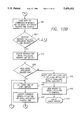
- FIGS. 10A-10D are flow diagrams illustrating the asynchronous header password verification process of the present invention.
- FIG. 11 is a flow diagram illustrating the present invention for providing a secure software rental system.
- FIG. 1 is a diagram illustrating a remote user computer system 150 connected to a central rental facility 180 by electronic communications path 136A for securely renting software.
- the remote user computer system 150 includes user computer 102, a display device 104, a keyboard 114, and a communication modem 106.
- the central rental facility 180 includes database computer 122, a display device 124, a keyboard 128, and a multiuser communication modem 126.
- Coupling 112 connects user computer 102 to display 104 for providing output to a user.
- Coupling 114 connects keyboard 108 to user computer 102 for providing input from a user.
- Modem 106 is connected to user computer 102 by coupling 110.
- Modem 106 of remote user computer system 150 is coupled to multiuser communication modem 126 by communication path 136A.
- communication path 136A is a telephone transmission line.
- the present invention is not limited to a telephone transmission line, and other communication paths may be utilized without departing from the scope of the present invention.
- Multiuser modem 126 is coupled to a plurality of communication paths 136A-136C for establishing communications with a plurality of remote user computer systems concurrently.
- Multiuser modem 126 is connected to database computer 122 by coupling 120.
- Coupling 132 connects database computer 122 to display 124 for providing output to an operator.
- Coupling 114 connects keyboard 128 to database computer 122 for providing input from an operator. While a single keyboard 128 and display device 124 are illustrated in FIG. 1, it should be apparent to a person skilled in the art that the present invention may be practiced with a plurality of such devices coupled to the database computer.
- the user computer 102 of the remote user computer system 150 comprises a processing means coupled to main memory (e.g., random access memory RAM and/or read only memory ROM), secondary storage means (e.g., media storage systems and/or CDROM), and input/output ports for communicating with other devices including keyboards, printers, displays, etc.
- main memory e.g., random access memory RAM and/or read only memory ROM
- secondary storage means e.g., media storage systems and/or CDROM
- input/output ports for communicating with other devices including keyboards, printers, displays, etc.
- the user computer system 150 may further include printing devices for providing hard copy output from the user computer 102, CD-ROM drives for storing information including multimedia information, scanning devices for providing electronic images as input, and manual input devices (e.g., mice, pen systems, etc.) for providing input.
- the database computer 122 is a multitasking, multiuser computer capable of executing a plurality of processes in parallel.
- a file server workstation operating the Windows operating environment is used as the database computer 122.
- the present invention may be implemented using a mainframe computer or a plurality of computers connected and operated in parallel for the database computer 122.
- the central rental facility may further comprise printing devices, CD-ROM drives, scanning devices, manual input devices, etc.
- a user accesses the central rental facility 180 using the remote user computer system 150 illustrated in FIG. 1.
- the remote user computer system 150 comprises the elements necessary for accessing the central rental facility 180.
- the user connects to the central rental facility 180 using communication methods well-known in the art for connecting to other database systems (e.g., Compuserve, etc.).
- the secure software rental system of the present invention requires that each user be assigned or allocated a unique user identification password.
- the user identification password is necessary for accessing the central rental facility 180.
- the central rental facility 180 requests the user to provide the user identification password.
- the user inputs the user identification password through the keyboard 108 to user computer 102.
- User computer 102 transmits the user identification password to the central rental facility using modem 106.
- the database computer 122 of central rental facility 180 receives the user identification password through multiuser modem 126.
- the database computer 122 retrieves the user registration database 212 using electronic connection 260 from system memory/storage 220.
- the user computer 102 comprises a rental application 284 and communication manager 280.
- the database computer 122 includes communication manager 202, multiuser controller 222, a plurality of control modules 204-210, databases 212-214, and system memory/storage 220.
- the user computer 102 is coupled to the database computer 122 through the multiuser modem 126 of the central rental facility 180, as illustrated in FIG. 1.
- the rental application 284 comprising header 284A and application 284B is coupled to communication manager 280 by software interface module 282.
- Communication manager 280 is coupled to modem 106 by connection 110.
- Modem 106 of the remote user computer system 150 is coupled to multiuser modem 126 through communication path 136A.
- Multiuser modem 126 is coupled to communication manager 202 by connection 120.
- Communication manager 202 is coupled to multiuser controller 222 by connection 200.
- Multiuser controller 222 is coupled to user password validation module 204, directory request module 206, file transfer module 208, and user status module 210 by software interface modules 230, 232, 234, and 236, respectively.
- the user password validation module is connected to user registration database 212 by coupling 240.
- the directory request module 206 is connected to the rental application database 214 by coupling 242.
- the file transfer module 208 is coupled to the rental application database 214 and user memory 216 by coupling 244 and 246, respectively.
- the user status module 210 is connected to user memory 216 and transaction log database 218 by coupling 248 and 250, respectively.
- User registration database 212, rental application database 214, user memory 216, and transaction log database 218 to system memory/storage 220 by software interface modules 260, 262, 264, and 266, respectively.
- the central rental facility 180 is operated by the multiuser controller 222 that is capable of processing a plurality of users and interfaces with various subsystem elements including multiuser modem 126. Initially, the multiuser controller 222 recognizes that the user has transmitted a user identification password to the central rental facility 180, thereby causing the controller 222 to activate the user registration database 212 through the user password validation module 204.
- the user registration database 212 contains stored information regarding the identifications of authorized users of the secure software rental system, as well as other relevant information regarding users, in an identifiable file for each user.
- the user identification password may comprise, up to a predetermined number of characters, any combination of letters of the alphabet and numbers. For example, the Social Security number of the user may be used as the user identification password.
- the password validation module 204 performs a check to determine whether or not the transmitted user identification password is authorized by first retrieving and then searching the user registration database 212. When the search fails to locate the user in the user registration database 212, the user password validation module 204 notifies the multiuser controller 222 of the failure. The password validation module 204 transmits the status of the search to controller 222 characterizing the user identification password transfer to the central rental facility 180 as an unauthorized access. The multiuser controller 222 transmits an appropriate message to the remote user computer system 150 that is displayed on its display 104 (shown in FIG. 1), and the central rental facility 180 terminates the connection to the remote user computer system 150.
- the user password validation module 204 transmits validity information to the multiuser controller 222.
- the multiuser controller 222 establishes continuous connection between the central rental facility 180 and the remote user computer system 150 using communication manager 202. This enables the user to directly access the database of the central rental facility 180 (including the rental application database 214) using the remote user computer system 150.
- the multiuser controller 222 initiates the interface between the remote user computer system 150 and the rental application database 214 by a series of queries from the multiuser controller 222 to the user and by receiving appropriate responses from the user.
- the user selects an application software by reviewing the directory of the rental application database 214 using the directory request module 206.
- the multiuser controller 222 transfers the selected application software from the rental application database 214 using the file transfer module.
- the file transfer module is electronically coupled to the rental application database 214 by connection 244, and it transfers the selected application software from the rental application database through multiuser communication modem 126 to the remote user computer system 150.
- the multiuser controller 222 transmits the selected application software by means of the communication manager 202 through the multiuser modem 126 across communication path 136A to modem 106 that is controlled by communication manager 280 of the user computer 102.
- the multiuser controller 222 registers a transfer time for the application software obtained from the timer clock of the database computer 122.
- the time of the database computer is measure to a precision of nanoseconds.
- the transfer time is temporarily stored in the user file of the user registration database 212. The temporarily stored transfer time is kept until the user terminates the communication link between the remote user computer system 150 and the central rental facility 180. If the user transfers another software application from the rental application database 214 to the remote user computer system 150 during the same time period that the user has already transferred an application software from the central rental facility 180, the multiuser controller 222 registers and stores the transfer time of the latter application software. In this manner, during a rental session when the remote user computer system 150 is continuously connected to the central rental facility 180, the multiuser controller 222 maintains a listing of transfer times containing the transfer time of each application software.
- the multiuser controller transmits a message containing the transfer time of the selected application software and an identification number for the application.
- the information contained in the message is not displayed to the user.
- the multiuser controller 222 of the database computer 122 includes encryption and decryption capabilities. Thus, the multiuser controller 222 encrypts the message before transmitting it to the user computer 102.
- the user is able to execute the application software on the user computer 102 of the remote user computer system 150 as though the user is independent of the central rental facility 180.
- the input and/or output format of the application software is not modified by the present invention.
- the method of using the software and the input and/or output format of the software are determined by the developer or manufacturer of the application software; therefore, the user executes the software as if the user purchased the software, without any noticeable difference in the operation or interface of the application software.
- Each application software of the present invention is modified, however, the modification is not apparent to the user.
- the application software 284B is modified by integrating it with header software 284A.
- the combined header and application software is referred to as the rental application software 284, as illustrated in FIG. 2.
- header software 284A The internal functions of header software 284A are shown in FIG. 3.
- header software 284A is identified as header 320
- application software 284B is identified as application software 310.
- Header 320 is coupled to application software 310 by application software interface parameters 315.
- the header software 320 comprises a rental security manager 321, an operating system interface 322, a clock interface 324, user display interface 326, and communication manager interface 328.
- the rental security manager comprises several functions or modules: an execution authorization module 321A, an execution termination module 321B, an encryption/decryption module 321C, a message transfer processor 321D, a password generation module 321E, and password validation module 321F.
- the rental security manager 321 performs this function.
- the rental security manager 321 interfaces with the application software 310 through the interface parameters 315.
- the rental security manager 321 determines whether the user may continue to access the application software 310 using a series of tests. When the user passes the periodic test, the user is authorized to continue executing the application software 310. When the test fails, rite rental security manager 321 terminates execution of the application software 310 and notifies the user of unauthorized use.
- the user operating system interface 322 determines the appropriate interface parameters 315 for executing the application software 310 dependent on the user processor and the operating system (e.g., DOS, Windows, OS/2, etc.).
- the operating system e.g., DOS, Windows, OS/2, etc.
- the clock interface 324 of header 320 obtains the current time, at finite time intervals, from the processor clock of the user computer 102.
- the time interval is set by the header software 320. In the preferred embodiment of the present invention, a value of 100 ms is used for the time interval. The present invention is not limited to a time interval of 100 ms, and other time intervals may be utilized without departing from the scope of the present invention.
- the user processor clock interface 324 may register the time to a precision level of nanoseconds; however, this depends on the number of bits used to represent the precision of the clock.
- the user processor clock interface 324 provides the timing information to the rental security manger 321.
- the user display interface 326 generates and provides messages (e.g., "Execution is terminated.”, etc.) to the user.
- the header 320 also includes a communication manager interface 328 for controlling the communication modem 106 and interfacing with the multiuser controller 222 of the central rental facility 180.
- the authorization verification module 321A obtains the current time from the processor clock of the user computer 102 through the user processor clock interface 324. The time is designated as the local processor clock time, and a sufficient number of digits are used to represent the time to achieve a precision of nanoseconds.
- the rental security manger 321 also includes encryption/decryption module 321C for encrypting/decrypting authorization verification messages.
- the multiuser controller 222 and the encryption/decryption module 321C of the rental security manager 321 employ the same encryption/decryption method (DEM).
- the authorization verification messages are communicated by the message transfer processor 321D between the header software 320 and the multiuser controller 222 of the central rental facility 180.
- the multiuser controller 222 of the central rental facility 180 decrypts the authorization verification message containing the user processor clock time and the identification number of the application software 310.
- the time difference between the transfer time and the current processor clock time of the user computer 102 is computed by multiuser controller 222.
- initial access to the central rental facility 180 is achieved, and a new authorization verification password is generated by the multiuser controller 222 using the password generation module.
- the password generation module (of controller 222 and module 321E of rental security manager 321) utilizes a pseudorandom number generation algorithm that is dependent on two parameters: the time difference and the user identification password.
- the password generation module is flexible so that a large number of pseudorandom values may be generated by proper selection of variables. Moreover, the number of characters associated with the pseudorandom number parameters may be preset by proper selection of the algorithm variables as well.
- the password generation algorithm is deterministic, and therefore a unique, pseudorandom number exists for a specific time difference and user identification password. If either the time difference or the user identification password is changed in any manner, the password generation module generates a resulting pseudorandom value that is significantly different from the previous one.
- the password generation module guarantees a varying, unique, pseudorandom number for the user that is used as the password for continuous authorization verification.
- the password can not be reproduced unless the exact user processor clock time (accurate to the nanosecond level of precision), the exact transfer time, the user identification password, and the deterministic algorithm are known.
- the pseudorandom number generation algorithm is kept confidential from the user.
- the user cannot derive the algorithm from the executable element of the integrated application software 310 and the header software 320 because the source code of the rental application 284 is not available to the user.
- the password generation module (of controller 222 and module 321E of rental security manager 321) utilizing the algorithm operates without the user's knowledge, and information regarding password generation is not provided to the user until the authorization verification fails.
- authorization verification fails, the user is notified that the application software is terminating and is advised to verify the communication link.
- the rental security manager 321 stores the password temporarily as a function of the processor clock time.
- the message transfer processor 321D of the rental security manager 321 prepares a message containing the user processor clock time, the user identification password, and the identification number of the application software 310 that is to be transmitted to the multiuser controller 222 at the central facility 180.
- the encryption/decryption module 321C encrypts the message.
- the encrypted message is transmitted to the multiuser controller 222 of the central facility 180 through the communication manager interface 328. Encrypting the message provides added protection in case the message communicated between the remote user computer system 150 and the central rental facility 180 is tapped.
- Multiuser controller 222 receives the encrypted message containing the processor clock time, the user identification password, and the identification number of the application software 310 via multiuser communication modem 126, and decrypts the message using the DEM algorithm.
- the message does not contain the authorization verification password generated by the pseudorandom number password generation module 321E of the header software 320.
- the multiuser controller 222 computes the time difference between the user processor clock time and the transfer time of the application software 310 that was stored temporarily in the user file of the user registration database 212.
- the multiuser controller 222 generates a pseudorandom number parameter using the deterministic algorithm dependent on the time difference and the user identification password.
- the multiuser controller 222 and the password generation module 321E of the rental security manager 321 use the same encryption/decryption algorithm, the multiuser controller 222 generates a pseudorandom number parameter that is identical to the one generated by the rental security manager 321 using identical input parameters.
- the multiuser controller 222 Once the multiuser controller 222 generates a pseudorandom number parameter, it creates a new message containing the processor clock time, the user identification password, and the pseudorandom number parameter. The multiuser controller 222 encrypts the message using the DEM algorithm, and transmits the message back to the user. The multiuser controller 222 does not use the clock time of the database computer 122 to accomplish this. Any time difference between the user processor clock of the user computer 102 and the clock of the central rental facility 180 is irrelevant to this process. Therefore, the authorization verification process is dependent on the user processor clock time for computing the time difference from the transfer time. The user processor clock time of the user computer 102 may err from true time known to the central rental facility 180 or any other clock. The authorization verification process is therefore independent of the accuracy of the user processor clock time. The multiuser controller 222 computes the time difference using the user processor clock time to distinguish the authorization verification password from other passwords.
- the rental security manager 321 receives the encrypted message containing the user processor clock time, the user identification password, and the pseudorandom number parameter generated by multiuser controller 222.
- the encryption/decryption module 321C of the rental security manager 321 decrypts the received message.
- the password validation module 321F compares the message using a password correlation algorithm against the stored information regarding the user processor clock time, the user identification password, and the authorization verification password.
- the correlation process of the password validation module 321F compares the received message and the stored message on a bit-by-bit basis. When the correlation function is successfully completed, the current authorization verification process is completed, and the header 320 allows the application software to continue executing. The entire authorization verification process is performed without the knowledge of the user.
- the password validation module 321F (using the password correlation function) detects a discrepancy between the received message and the stored message, the password correlation fails causing the authorization verification process to fail.
- the execution termination module 321B initiates termination of the executing application software 310; however, the application software 310 is not terminated based on a single authorization verification failure.
- the rental security manager 321 does not terminate execution of application software 310 until three consecutive failures of authorization verification occur. This prevents erroneous authorization verification failure caused by the header software 320 or the central rental facility 180 or both including bit errors introduced during communication or by either the encryption or decryption process. If three failures do occur, the execution termination module 321B also notifies the user (through the user display interface 326) that the user has attempted to execute the application software 310 without proper authorization.
- the rental security manager 321 sequences the authorization verification process to occur at finite time intervals throughout the execution of the application software 310.
- authorization verification is continuously successful during this period, the user does not have knowledge of this process, and it does not impact the execution and use of the application software 310.
- FIG. 11 is a flow diagram illustrating the present invention for providing secure software rental.
- the communication manager 280 is transferred from the database computer 122 (alternatively referred to as the central rental facility 180) to the user computer 102.
- the communication manager 280 is executed using the user computer 102.
- the user computer 102 accesses the database computer 122 to begin a rental session.
- a rental application is selected from a rental application database 214 contained in the database computer 122.
- the user browses the rental application database 214 on file database computer 122 using the directory request module, and selects one or more rental applications.
- the selected rental application is transferred from the database computer 122 to the user computer 102.
- the rental application is executed on the user computer 102.
- the normal flow of the rental application is executed. Execution continues toward step 1120.
- step 1114 an asynchronous header password verification process is executed in parallel with the normal flow of rental application of step 1118. This process ensures that continuous communication is maintained between the user computer 102 and the database computer 122.
- decision block 1116 a check is made to determine if the password verification is successful. When decision block 1116 returns true (yes), execution continues at step 1114. When decision block 1116 returns false (no), execution continues toward step 1120. In step 1120, the rental application is terminated. In step 1122, the rental session is terminated.
- FIG. 8 is a flow diagram illustrating step 1102 of FIG. 11 for transferring the communication manager 280 to the user computer 102 from the database computer 122.
- Step 1102 is normally performed once. Subsequent execution of the steps illustrated in FIG. 11 is performed without step 1102.
- any communication software that supports communication over telephone transmission lines is executed using the user computer 102.
- the communication software may be any off-the-shelf communication application.
- the user computer 102 accesses the database computer 122 using the communication software.
- a communication manager of the Secure Rental System is copied from the database computer 122 to the user computer 102.
- the user computer 102 is disconnected from the database computer 122.
- FIG. 9 is a flow diagram illustrating the step 1118 of FIG. 11 for performing the normal flow of the rental application.
- the rental application starts executing.
- the rental application is initialized.
- the asynchronous header password verification process is started using the application software interface parameters 315.
- the asynchronous header password verification process operates in parallel with the process including steps 908 and 912.
- execution continues at step 908.
- the rental application receives input from the user.
- step 910 the input received from the user is processed. Execution continues at decision block 912.
- step 918 the password verification process is performed.
- decision block 920 a check is made to determine if the verification is successful. When decision block 920 returns true (yes), execution continues at step 918. When decision block 920 returns false (no), execution continues at step 922. In step 922, the user is notified that the rental application is terminating. In step 924, a message is sent to the rental application for it to terminate. Execution continues toward block 914.
- decision block 912 a check is made to determine if the rental application should terminate. When decision block 912 returns false (no), execution continues at step 908. When decision block 912 returns true (yes), execution continues at step 914. Thus, decision block 912 returns true (yes) when either the rental application terminates normally, or the password verification process is not successful and sends a terminate message to the normal flow process. In step 914, the header is notified that the rental application is terminating. In step 916, the rental application is terminated.
- FIGS. 10A-10D are flow diagrams illustrating the asynchronous header password verification process of the present invention.
- the password verification process is started.
- the header software 320 establishes program-to-program communications with communication manager 280 of the user computer 102.
- decision block 1006 a check is made to determine if communication is established between the header software 320 and the communication manager 280. When decision block 1006 returns false (no), execution continues at step 1016.
- step 1016 the user is notified that communication with the database computer 122 is not established.
- a message is sent to the rental application for it to terminate.
- the header 320 terminates.
- step 1006 When decision block 1006 returns true (yes), execution continues at step 1008.
- step 1008 a rental application transfer time request is created using a user identifier and a rental application identifier (alternatively referred to as the application identifier).
- step 1010 the rental application transfer time request is encrypted.
- step 1012 the rental application transfer time request is sent to the database computer 122 using the communication manager 280.
- decision block 1014 a check is made to determine if thirty seconds has elapsed since the rental application transfer time request was sent to the database computer 122. When decision block 1014 returns false (no), execution continues at decision block 1014. When decision block 1014 returns true (yes), execution continues at step 1022 of FIG. 10B.
- step 1022 shown in FIG. 10B the communication manager is checked for the rental application transfer time request.
- decision block 1024 a check is made to determine if a response was received for the rental application transfer time request.
- decision block 1024 returns false (no)
- decision block 1024 returns true (yes)
- step 1026 the response for the rental application transfer time request is decrypted.
- decision block 1028 a check is made to determine if the rental application transfer time is valid. When decision block returns false (no), execution continues at step 1034. In step 1034, the user is notified that a new copy of the rental application must be transferred from the database computer 122 to the user computer 102 before it can be executed. In step 1036, a message is sent to the rental application for it to terminate. In step 1038, the header 320 is terminated. When decision block 1028 returns true (yes), execution continues at step 1030. In step 1030, the system time of the user computer 102 is obtained. In step 1032, the difference between the system time of the user computer 102 and the rental application transfer time are computed. Execution continues at step 1040 of FIG. 10C.
- a random password is computed dependent upon the computed time difference, the user identifier, and the application identifier.
- the random password is stored in memory of the user computer 102.
- a password verification request is created containing the user identifier, the application identifier, and the current system time of the user computer system.
- the password verification request is encrypted.
- the password verification request is sent to the controller 222 of the database computer 122 through the communication manager.
- step 1050 a check is made to determine if thirty seconds has elapsed since the password verification request was sent to the multiuser controller 222. When decision block 1050 returns false (no), execution continues at decision block 1050. When decision block 1050 returns true (yes), execution continues at step 1052.
- step 1052 the communication manager is checked for a password response to the password verification request.
- decision block 1054 a check is made to determine whether a password has been received from the multiuser controller 222. When decision block 1054 returns false (no), execution continues at step 1016 shown in FIG. 10A. When decision block 1054 returns true (yes), execution continues at step 1056.
- step 1056 the password response message from the multiuser controller 222 is decrypted. The decrypted password received from the multiuser controller 222 is compared with the password stored in the memory of the user computer 102. Execution continues at step 1060 of FIG. 10D.
- decision block 1060 a check is made to determine if the received password matches the password stored in the memory. When decision block 1060 returns false (no), execution continues at step 1064. In step 1064, the user is notified that the received password is invalid. In step 1066, a message is sent to the rental application for it to terminate. In step 1068, the header 320 terminates.
- decision block 1060 returns true (yes)
- decision block 1062 In decision block 1062, a check is made to determine if thirty seconds has elapsed. When decision block 1062 returns false (no), execution continues at decision block 1062. When decision block 1062 returns true (yes), execution continues at step 1030 shown in FIG. 10B.
- the user disconnects the communication link while the application software 310 is being executed. This event is detected by the header software 320 because the dynamic password authorization procedure fails due to the lack of a communications link.
- the user attempts to execute a previously transferred and stored application software 310 without having a communication link to the central rental facility 180. This event is detected by the header software 320 producing a failure because a communication link does not exist.
- the third method the user attempts to execute a previously stored application software using an established communication link with the central rental facility 180. This event is detected by the header software 320 producing a failure because a valid transfer time does not exist. The three methods are disclosed in detail below.
- FIG. 9 is a flow diagram illustrating step 1118 of FIG. 11 for performing the normal flow of the rental application prior to the user disconnecting the communication link with the central rental facility 180.
- FIGS. 10A-10D are flow diagrams illustrating the asynchronous password verification process under normal operation. If the communication link is disconnected after initiating execution of the application software 310, communication failure is located in one of two places in the asynchronous password verification process.
- the first failure begins at step 1012 of FIG. 10A.
- step 1012 the rental application transfer time request is sent to the database computer 122 using the communication manager 280 of the user computer 102.
- decision block 1014 a check is made to determine if thirty seconds has elapsed since the rental application transfer time request was sent to the database computer 122. When decision block 1014 returns false (no), execution continues at decision block 1014. When decision block 1014 returns true (yes), execution continues at step 1022 of FIG. 10B.
- the communication manager 280 is checked for the rental application transfer time request. In decision block 1024, a check is made to determine if a response was received for the rental application transfer time request.
- a rental application transfer request is not obtained because the communication link was disconnected after execution of the application software 310 was initiated.
- Decision block 1024 returns false (no) and execution continues at step 1016 of FIG. 10A.
- step 1016 the user is notified that communication with the database computer 122 is not established.
- a message is sent to terminate the rental application in step 1018 and the header 320 terminates in step 1020.
- step 1048 the password verification request is sent to the multiuser controller 222 of the database computer 122 through the communication manager 280.
- decision block 1050 a check is made to determine if thirty seconds has elapsed since the password verification request was sent to the multiuser controller 222. When decision block 1050 returns false (no), execution continues at decision block 1050. When decision block 1050 returns true (yes), execution continues at step 1052.
- step 1052 the communication manager 280 is checked for a password response to the password verification request.
- decision block 1054 a check is made to determine if a password has been received from the multiuser controller 222.
- step 1016 the user is notified that communication with the database computer 122 is not established. A message is sent to terminate the rental application in step 1018 and the header 320 terminates in step 1020.
- the user copies the executable element of the application software 310 to a storage device (e.g., a hard disc or a floppy disc) of the user computer 102.
- the user subsequently loads the executable element of the application software 310 from the storage device and attempts to execute it using the user computer 102 without a communication link established between the user computer 102 and the central rental facility 180.
- the rental security manager 321 initiates the authorization verification process.
- an encrypted message containing the user processor clock time, the user identification password, and the identification number for the application software 310 is communicated to the multiuser controller 222 of the central rental facility 180.
- the rental security manager 321 attempts to initiate communications using the communication manager interface 328, it however detects an error because the communication link with the central rental facility 180 is disconnected.
- the rental security manager 321 determines that an unauthorized attempt to execute the application software 310 occurred, and it terminates the application software 310.
- An appropriate message is displayed to the user through the user display interface 326.
- FIGS. 4 and 5 illustrate the present invention in detail for this case.
- FIG. 4 is a flow diagram illustrating the present invention when a rental application that is stored on the storage media of the user computer 102 is executed without connecting to the database computer 122.
- a rental application is copied from a storage media of the user computer 102 to the memory of the user computer 102 without connecting to the database computer 122.
- the rental application is executed on the user computer 102.
- the normal flow of the rental application is performed as disclosed in FIG. 2. Execution continues toward step 408.
- step 410 in parallel with the normal flow of the rental application of step 406, the asynchronous header password verification process is performed without connecting to the database computer 122.
- a message for an unsuccessful connection is sent to the rental application. Execution continues toward step 408.
- the rental application is terminated.
- FIG. 5 is a flow diagram illustrating step 410 of FIG. 4 for performing the asynchronous header password verification without connecting to the database computer 122.
- the password verification process starts.
- communication is established between the header software 320 and the communication manager 280 of the user computer 102.
- a check is made to determine if communication is established between the header software 320 and the communication manager 280 of the user computer 102.
- decision block 506 returns false (no)
- execution continues at step 520.
- decision block 506 returns true (yes) execution continues at step 508.
- a rental application transfer time request is created using the user identifier and the application identifier.
- step 510 the rental application transfer time request is encrypted.
- step 512 the rental application transfer time request is sent to the multiuser controller 222 through the communication manager.
- decision block 514 a check is made to determine if 30 seconds has expired. When decision block 514 returns false (no), execution continues at decision block 514. When decision block 514 returns true (yes), execution continues at step 516.
- step 516 the communication manager is checked for the rental application transfer time response.
- decision block 518 a check is made to determine if a response was received for the rental application transfer time request. Decision block 518 returns false (no) because the user computer 102 is not connected to the database computer 122 and execution continues at step 520.
- step 520 the user is notified that communication with the database computer 122 is not established.
- step 522 a message is sent to the rental application for it to terminate.
- step 524 the header terminates.
- the rental security manager 321 transmits the encrypted transfer time request message (containing the user identification password and the identification number of the application software) to the multiuser controller 222 of the central rental facility 180. After the message is received by the multiuser controller 222, it decrypts the message and tries to retrieve the transfer time associated with the application software 310 that is represented by an identification number. As stated previously, the transfer time of a particular application software 310 is stored temporarily in the user file in the central rental facility 180 during the time period when the user computer 102 is connected to the central rental facility 180 by a communication link and the user transfers then application software 310 to the user computer 102 from the rental application database 262. The multiuser controller 222 uses the file transfer module 208 to transfer the application software 310.
- the third method of attempting to circumvent the present invention involves the user establishing a communication link between user computer 102 and the central rental facility 180. Instead of currently transferring the application software 310 from the rental application database 214 of the central rental facility 180, the user loads an executable element of the application software 310 into the user computer 102 from a copy of the application software 310 previously stored in a storage device of the user computer 102.
- the information including the application software transfer time is erased from storage of the central rental facility 180 when the communication session with the user is terminated. If the user computer 102 subsequently reestablishes a communication link with the central rental facility 180, the transfer time of the application software 310 transferred in a prior session is not available at the central rental facility 180. Therefore, when the multiuser controller 222 tries to retrieve the transfer time from the user file, it fails to locate the information. This triggers an error condition, and the error condition is communicated to the rental security manager 321. The rental security manager 321 determines that an unauthorized attempt to execute the application software has been made and terminates the application software 310. An appropriate message is displayed to the user through the user display interface 326. FIGS. 6, 7A and 7B illustrate the present invention in detail for this case.
- FIG. 6 is a flow diagram illustrating the present invention when a rental application that is stored one the storage media of the user computer 102 is executed after connecting to the database computer 122 without, however, transferring the rental application from the database computer 122.
- the communication manager of the present invention is executed.
- a rental session is started by accessing the database computer 122.
- the rental application is copied from the storage media of the user computer 102 into the memory of the user computer 102.
- the rental application is executed.
- step 610 the normal flow of the rental application is performed. Execution continues at step 616.
- step 612 in parallel with the normal flow process of step 610, the asynchronous header password verification process is performed without transferring the rental application.
- a message for an unsuccessful connection is sent to the rental application. Execution continues toward step 616.
- the rental application is terminated.
- the rental session is terminated.
- FIGS. 7A-7B are flow diagrams illustrating step 612 of FIG. 6 for performing the asynchronous header password verification process after connecting to the database computer 122 without, however, transferring the rental application from the database computer 122.
- the password verification process is started.
- communication is established between the user and database computers using the communication manager of the present invention.
- decision 706 a check is made to determine if communication is established using the communication manager. When decision block 706 returns false (no), execution continues at step 720. When decision block 706 returns true (yes), execution continues at step 708.
- a rental application transfer time request is created using the user identifier and the application identifier.
- the rental application transfer time request is encrypted.
- the rental application transfer time request is sent to the multiuser controller 222 through the communication manager.
- decision block 714 a check is made to determine if thirty seconds has expired. When decision block 714 returns false (no), execution continues at decision block 714. When decision block 714 returns true (yes), execution continues at step 716.
- the communication manager is checked for rental application transfer time response.
- decision block 718 a check is made to determine if a response is received for the rental application transfer time request. When decision block 718 returns false (no), execution continues at step 720.
- step 720 the user is notified that communication with the database computer 122 could not be established.
- step 722 a message is sent to the rental application for it to terminate.
- step 724 the header is terminated.
- step 726 shown in FIG. 7B the response for the rental application transfer time request is decrypted.
- decision block 728 a check is made to determine if the rental application transfer time is valid. When decision block 728 returns false (no), execution continues at step 730.
- step 730 the user is notified that a new copy of the rental application must be transferred to the user computer 102 before the rental application can be executed.
- step 732 a message is sent to the rental application for it to terminate.
- step 734 the header 320 is terminated.
- the present invention requires the user to transfer the application software 310 from the rental application database 214 to user computer 102 in each communication session between the remote user computer system 150 and the central rental facility 180 for the user to execute the application software 310.
- the present invention enables the central rental facility 180 to monitor the time period when a particular application software 310 is executed by a user. Since the multiuser controller 222 continuously interfaces and interacts with the rental security manager 321 during execution of the application software 310, the multiuser controller 222 is able to monitor and record the pertinent information regarding the execution in the user file for billing and accounting purposes.
- the multiuser controller 222 is able to transfer, interface, and monitor more than one application software 310 concurrently with regard to a user.
- the user may transfer more than one application software 310 from the rental application database 214 and execute each one during a single communication session between the user computer 102 and the central rental facility 180.
- the multiuser controller 222 is capable of interfacing with a number of users concurrently. However, each user is handled separately and no other user has access to any information of any other user.
- the multiuser controller 222 operates by interfacing with user password validation module 204, directory request module 206, file transfer module 208, and user status module 210.
- the user password validation module 204 interfaces with user registration database 214 through electronic interface 240.
- Directory request module 206 interfaces with rental application database 214 through electronic interface 242.
- File transfer module 208 interfaces both rental application database 214 and user memory 216 through electronic interfaces 244 and 246.
- User status module 210 interfaces the connected user status in memory 216 through electronic interface 248 and also interfaces transaction log database 218 through electronic interface 250.
- the memory/storage unit 220 of central rental facility 180 stores all relevant information for operating the central rental facility 180 and can be updated as needed using on-line executive and management software in the database computer 122 of the central rental facility 180.
- the management function includes monitoring and administrating operations of central rental facility 180. Further, the management software is capable of providing periodic status information of the operations of the central rental facility 180 to the operator.
- the present invention provides a system for securely renting application software to users connected to the database computer 122. It prevents unauthorized copying and usage of the application software.
- the system provides a unique security method that is specific to each user for preventing circumvention of the system by the user and persons other than the user, thereby preventing other persons from using the application software.
- the present invention implements a general security scheme that is independent of any specific application software. The system allows the user to access application software without being made aware that the security system is continuously processing during execution of the application software.
- the present invention modifies application software by integrating header software with application software.
- the combined header and application software are the rental application software.
- the header software is an integral element of the secure rental software system.
- the header software operates transparently so that the user provides normal input/output operations to the application software without change. When an unauthorized usage of the application software occurs, a message notifies the user that the application software is terminating, and the application software terminates.
Abstract
Description
Claims (15)
Priority Applications (5)
| Application Number | Priority Date | Filing Date | Title |
|---|---|---|---|
| US08/178,398 US5495411A (en) | 1993-12-22 | 1993-12-22 | Secure software rental system using continuous asynchronous password verification |
| US08/271,472 US5548645A (en) | 1993-12-22 | 1994-07-07 | Secure software rental system using distributed software |
| PCT/US1994/014923 WO1995017732A1 (en) | 1993-12-22 | 1994-12-22 | A secure software rental system using continuous asynchronous password verification |
| AU14460/95A AU1446095A (en) | 1993-12-22 | 1994-12-22 | A secure software rental system using continuous asynchronous password verification |
| US08/482,429 US5638513A (en) | 1993-12-22 | 1995-06-07 | Secure software rental system using continuous asynchronous password verification |
Applications Claiming Priority (1)
| Application Number | Priority Date | Filing Date | Title |
|---|---|---|---|
| US08/178,398 US5495411A (en) | 1993-12-22 | 1993-12-22 | Secure software rental system using continuous asynchronous password verification |
Related Child Applications (2)
| Application Number | Title | Priority Date | Filing Date |
|---|---|---|---|
| US08/271,472 Continuation-In-Part US5548645A (en) | 1993-12-22 | 1994-07-07 | Secure software rental system using distributed software |
| US08/482,429 Continuation US5638513A (en) | 1993-12-22 | 1995-06-07 | Secure software rental system using continuous asynchronous password verification |
Publications (1)
| Publication Number | Publication Date |
|---|---|
| US5495411A true US5495411A (en) | 1996-02-27 |
Family
ID=22652402
Family Applications (3)
| Application Number | Title | Priority Date | Filing Date |
|---|---|---|---|
| US08/178,398 Expired - Lifetime US5495411A (en) | 1993-12-22 | 1993-12-22 | Secure software rental system using continuous asynchronous password verification |
| US08/271,472 Expired - Lifetime US5548645A (en) | 1993-12-22 | 1994-07-07 | Secure software rental system using distributed software |
| US08/482,429 Expired - Lifetime US5638513A (en) | 1993-12-22 | 1995-06-07 | Secure software rental system using continuous asynchronous password verification |
Family Applications After (2)
| Application Number | Title | Priority Date | Filing Date |
|---|---|---|---|
| US08/271,472 Expired - Lifetime US5548645A (en) | 1993-12-22 | 1994-07-07 | Secure software rental system using distributed software |
| US08/482,429 Expired - Lifetime US5638513A (en) | 1993-12-22 | 1995-06-07 | Secure software rental system using continuous asynchronous password verification |
Country Status (3)
| Country | Link |
|---|---|
| US (3) | US5495411A (en) |
| AU (1) | AU1446095A (en) |
| WO (1) | WO1995017732A1 (en) |
Cited By (151)
| Publication number | Priority date | Publication date | Assignee | Title |
|---|---|---|---|---|
| US5548645A (en) * | 1993-12-22 | 1996-08-20 | Ananda; Mohan | Secure software rental system using distributed software |
| WO1996041449A1 (en) * | 1995-06-07 | 1996-12-19 | Digital River, Inc. | Try-before-you-buy software distribution and marketing system |
| WO1997030575A2 (en) * | 1996-02-26 | 1997-08-28 | Network Engineering Technologies | Automated system for management of licensed software |
| EP0809221A2 (en) * | 1996-05-23 | 1997-11-26 | Sun Microsystems, Inc. | Virtual vending system and method for managing the distribution, licensing and rental of electronic data |
| US5765152A (en) * | 1995-10-13 | 1998-06-09 | Trustees Of Dartmouth College | System and method for managing copyrighted electronic media |
| US5812661A (en) * | 1994-08-10 | 1998-09-22 | Fujitsu Limited | Software reproduction apparatus |
| US5822291A (en) * | 1995-03-23 | 1998-10-13 | Zoom Television, Inc. | Mass storage element and drive unit therefor |
| US5845077A (en) * | 1995-11-27 | 1998-12-01 | Microsoft Corporation | Method and system for identifying and obtaining computer software from a remote computer |
| US5870543A (en) * | 1995-06-07 | 1999-02-09 | Digital River, Inc. | System for preventing unauthorized copying of active software |
| US5883955A (en) * | 1995-06-07 | 1999-03-16 | Digital River, Inc. | On-line try before you buy software distribution system |
| US5883954A (en) * | 1995-06-07 | 1999-03-16 | Digital River, Inc. | Self-launching encrypted try before you buy software distribution system |
| US5887060A (en) * | 1995-06-07 | 1999-03-23 | Digital River, Inc. | Central database system for automatic software program sales |
| US5903647A (en) * | 1995-06-07 | 1999-05-11 | Digital River, Inc. | Self-launching encrypted digital information distribution system |
| US5937164A (en) * | 1995-12-07 | 1999-08-10 | Hyperlock Technologies, Inc. | Method and apparatus of secure server control of local media via a trigger through a network for instant local access of encrypted data on local media within a platform independent networking system |
| US6009543A (en) * | 1996-03-01 | 1999-12-28 | Massachusetts Institute Of Technology | Secure software system and related techniques |
| US6035403A (en) * | 1996-09-11 | 2000-03-07 | Hush, Inc. | Biometric based method for software distribution |
| US6047258A (en) * | 1997-08-11 | 2000-04-04 | Trimble Navigation Limited | Renting/leasing instrument options using satellite positioning system |
| US6049671A (en) * | 1996-04-18 | 2000-04-11 | Microsoft Corporation | Method for identifying and obtaining computer software from a network computer |
| US6090693A (en) * | 1996-10-31 | 2000-07-18 | Micron Technology, Inc. | Transistors having controlled conductive spacers, uses of such transistors and methods of making such transistors |
| WO2001001622A2 (en) * | 1999-06-28 | 2001-01-04 | Starpay.Com, Inc. | Apparatus and method for performing secure network transactions |
| US6286036B1 (en) | 1995-07-27 | 2001-09-04 | Digimarc Corporation | Audio- and graphics-based linking to internet |
| US6292692B1 (en) | 1999-04-30 | 2001-09-18 | Medical Research Laboratories, Inc. | Medical treatment device with functions, operated under passcode control |
| US6304972B1 (en) | 2000-01-03 | 2001-10-16 | Massachusetts Institute Of Technology | Secure software system and related techniques |
| US6310956B1 (en) * | 1998-03-19 | 2001-10-30 | Hitachi, Ltd. | Copy protection apparatus and method |
| US20010037313A1 (en) * | 2000-05-01 | 2001-11-01 | Neil Lofgren | Digital watermarking systems |
| US6324573B1 (en) | 1993-11-18 | 2001-11-27 | Digimarc Corporation | Linking of computers using information steganographically embedded in data objects |
| US20020016846A1 (en) * | 2000-03-09 | 2002-02-07 | Ibm Corporation | Information transmission method and system |
| US6347398B1 (en) | 1996-12-12 | 2002-02-12 | Microsoft Corporation | Automatic software downloading from a computer network |
| WO2002015077A1 (en) * | 2000-08-14 | 2002-02-21 | Starpay.Com, Inc. | Apparatus and method for performing secure network transactions |
| US20020023215A1 (en) * | 1996-12-04 | 2002-02-21 | Wang Ynjiun P. | Electronic transaction systems and methods therefor |
| US6381742B2 (en) | 1998-06-19 | 2002-04-30 | Microsoft Corporation | Software package management |
| US20020078142A1 (en) * | 2000-12-20 | 2002-06-20 | Microsoft Corporation | Method and system for enabling offline detection of software updates |
| US6411725B1 (en) | 1995-07-27 | 2002-06-25 | Digimarc Corporation | Watermark enabled video objects |
| US20020083183A1 (en) * | 2000-11-06 | 2002-06-27 | Sanjay Pujare | Conventionally coded application conversion system for streamed delivery and execution |
| US20020080993A1 (en) * | 1993-11-18 | 2002-06-27 | Rhoads Geoffrey B. | Hiding encrypted messages in information carriers |
| US20020083003A1 (en) * | 2000-09-26 | 2002-06-27 | Halliday David C. | Method and apparatus for the accurate metering of software application usage and the reporting of such usage to a remote site on a public network |
| US20020087883A1 (en) * | 2000-11-06 | 2002-07-04 | Curt Wohlgemuth | Anti-piracy system for remotely served computer applications |
| US20020111997A1 (en) * | 2000-04-26 | 2002-08-15 | Maurice Herlihy | Methods and systems for securing computer software |
| US6446211B1 (en) * | 1998-06-04 | 2002-09-03 | Z4 Technologies, Inc. | Method and apparatus for monitoring software using encryption |
| US6453334B1 (en) | 1997-06-16 | 2002-09-17 | Streamtheory, Inc. | Method and apparatus to allow remotely located computer programs and/or data to be accessed on a local computer in a secure, time-limited manner, with persistent caching |
| US20020178354A1 (en) * | 1999-10-18 | 2002-11-28 | Ogg Craig L. | Secured centralized public key infrastructure |
| US20020186844A1 (en) * | 2000-12-18 | 2002-12-12 | Levy Kenneth L. | User-friendly rights management systems and methods |
| US20030004882A1 (en) * | 2000-11-06 | 2003-01-02 | Holler Anne Marie | Optimized server for streamed applications |
| US20030009670A1 (en) * | 2001-04-02 | 2003-01-09 | Digimarc Corporation | Background watermark processing |
| US6513120B2 (en) * | 1998-03-10 | 2003-01-28 | Fujitsu Limited | Security system for transmission device |
| US6516318B2 (en) * | 1994-10-26 | 2003-02-04 | Canon Kabushiki Kaisha | Management system and terminal apparatus to manage and control distribution and use of software and the like |
| US20030025423A1 (en) * | 1999-11-05 | 2003-02-06 | Miller Marc D. | Embedding watermark components during separate printing stages |
| US6522770B1 (en) | 1999-05-19 | 2003-02-18 | Digimarc Corporation | Management of documents and other objects using optical devices |
| US6526456B1 (en) | 1996-07-01 | 2003-02-25 | David Ian Allan | Distribution and controlled use of software products |
| US20030046550A1 (en) * | 2001-09-05 | 2003-03-06 | International Business Machines Corporation | Dynamic control of authorization to access internet services |
| US6557054B2 (en) | 1994-05-31 | 2003-04-29 | Richard R. Reisman | Method and system for distributing updates by presenting directory of software available for user installation that is not already installed on user station |
| US20030084311A1 (en) * | 2001-10-03 | 2003-05-01 | Lionel Merrien | System and method for creating a trusted network capable of facilitating secure open network transactions using batch credentials |
| US20030110375A1 (en) * | 1998-06-04 | 2003-06-12 | Z4 Technologies, Inc. | Method for monitoring software using encryption including digital signatures/certificates |
| US20030150922A1 (en) * | 2002-02-12 | 2003-08-14 | Hawes Jonathan L. | Linking documents through digital watermarking |
| US6647130B2 (en) | 1993-11-18 | 2003-11-11 | Digimarc Corporation | Printable interfaces and digital linking with embedded codes |
| US20030212992A1 (en) * | 1998-12-04 | 2003-11-13 | Ronning Joel A. | Apparatus and method for using application signatures for the identification of files |
| US6665800B1 (en) * | 1999-01-26 | 2003-12-16 | Dell Usa, L.P. | System and method for securing a computer system |
| US20030234292A1 (en) * | 2001-12-24 | 2003-12-25 | Robert Jones | Systems, compositions, and methods for full color laser engraving of ID documents |
| US6681028B2 (en) | 1995-07-27 | 2004-01-20 | Digimarc Corporation | Paper-based control of computer systems |
| US20040039923A1 (en) * | 2000-06-20 | 2004-02-26 | Koskins Steven James Joseph | System and method for distributing data |
| US6701125B1 (en) * | 1998-01-21 | 2004-03-02 | Jesper Lohse | Method for developing a flexible and efficient educational system |
| US6721891B1 (en) * | 1999-03-29 | 2004-04-13 | Activcard Ireland Limited | Method of distributing piracy protected computer software |
| US20040103322A1 (en) * | 1996-02-06 | 2004-05-27 | Wesinger Ralph E. | Firewall providing enhanced network security and user transparency |
| US6744891B1 (en) * | 1994-07-25 | 2004-06-01 | Lucent Technologies Inc. | Methods and system for ensuring royalty payments for data delivered over a telephone network utilizing bidirectional communication |
| US20040107368A1 (en) * | 1998-06-04 | 2004-06-03 | Z4 Technologies, Inc. | Method for digital rights management including self activating/self authentication software |
| US20040117631A1 (en) * | 1998-06-04 | 2004-06-17 | Z4 Technologies, Inc. | Method for digital rights management including user/publisher connectivity interface |
| US20040117663A1 (en) * | 1998-06-04 | 2004-06-17 | Z4 Technologies, Inc. | Method for authentication of digital content used or accessed with secondary devices to reduce unauthorized use or distribution |
| US20040117628A1 (en) * | 1998-06-04 | 2004-06-17 | Z4 Technologies, Inc. | Computer readable storage medium for enhancing license compliance of software/digital content including self-activating/self-authenticating software/digital content |
| US20040117644A1 (en) * | 1998-06-04 | 2004-06-17 | Z4 Technologies, Inc. | Method for reducing unauthorized use of software/digital content including self-activating/self-authenticating software/digital content |
| US20040117664A1 (en) * | 1998-06-04 | 2004-06-17 | Z4 Technologies, Inc. | Apparatus for establishing a connectivity platform for digital rights management |
| US6769009B1 (en) | 1994-05-31 | 2004-07-27 | Richard R. Reisman | Method and system for selecting a personalized set of information channels |
| US20040177281A1 (en) * | 2000-04-12 | 2004-09-09 | Rudolph Balaz | VPN enrollment protocol gateway |
| US6799277B2 (en) | 1998-06-04 | 2004-09-28 | Z4 Technologies, Inc. | System and method for monitoring software |
| US6802061B1 (en) | 1996-12-12 | 2004-10-05 | Microsoft Corporation | Automatic software downloading from a computer network |
| US20040198858A1 (en) * | 2002-12-20 | 2004-10-07 | Brian Labrec | Increasing thermal conductivity of host polymer used with laser engraving methods and compositions |
| US6807534B1 (en) | 1995-10-13 | 2004-10-19 | Trustees Of Dartmouth College | System and method for managing copyrighted electronic media |
| US20040215571A1 (en) * | 1992-12-15 | 2004-10-28 | Jonathan Schull | System and method for controlling access to protected information |
| US20040225894A1 (en) * | 1998-06-04 | 2004-11-11 | Z4 Technologies, Inc. | Hardware based method for digital rights management including self activating/self authentication software |
| US6868497B1 (en) | 1999-03-10 | 2005-03-15 | Digimarc Corporation | Method and apparatus for automatic ID management |
| US20050132349A1 (en) * | 2003-12-15 | 2005-06-16 | Jason Roberts | System and method for a software distribution service |
| US20050132348A1 (en) * | 2003-12-15 | 2005-06-16 | Meulemans Michael E. | System and method for managing and communicating software updates |
| US20050138435A1 (en) * | 2003-12-23 | 2005-06-23 | Kaufman Charles W. | Method and system for providing a login and arbitrary user verification function to applications |
| US20050149449A1 (en) * | 1992-12-15 | 2005-07-07 | Jonathan Schull | Method for tracking software lineages |
| US20050154676A1 (en) * | 1998-12-04 | 2005-07-14 | Digital River, Inc. | Electronic commerce system method for detecting fraud |
| US20050161512A1 (en) * | 2001-12-24 | 2005-07-28 | Jones Robert L. | Optically variable personalized indicia for identification documents |
| US20050235348A1 (en) * | 1996-02-06 | 2005-10-20 | Coley Christopher D | System for preventing unwanted access to information on a computer |
| US20050242194A1 (en) * | 2004-03-11 | 2005-11-03 | Jones Robert L | Tamper evident adhesive and identification document including same |
| US20050254684A1 (en) * | 1995-05-08 | 2005-11-17 | Rhoads Geoffrey B | Methods for steganographic encoding media |
| US20050268345A1 (en) * | 2004-05-29 | 2005-12-01 | Harrison Robert B | Method and apparatus for providing temporary access to a network device |
| US20050273435A1 (en) * | 1996-02-26 | 2005-12-08 | Coley Christopher D | Firewall for licensing protected software on a computer |
| US20050286736A1 (en) * | 1994-11-16 | 2005-12-29 | Digimarc Corporation | Securing media content with steganographic encoding |
| US20060021005A1 (en) * | 2004-07-21 | 2006-01-26 | Williams Cuong G | System and method for lost data destruction of electronic data stored on a portable electronic device using a security interval |
| US20060020552A1 (en) * | 2004-07-26 | 2006-01-26 | James Sloan | Copy-restriction system for digitally recorded, computer disk-based music recordings |
| US20060021007A1 (en) * | 2004-07-21 | 2006-01-26 | Rensin David K | System and method for lost data destruction of electronic data stored on portable electronic devices |
| US20060021006A1 (en) * | 2004-07-21 | 2006-01-26 | Rensin David K | System and method for lost data destruction of electronic data stored on a portable electronic device which communicates with servers that are inside of and outside of a firewall |
| US20060048136A1 (en) * | 2004-08-25 | 2006-03-02 | Vries Jeff D | Interception-based resource detection system |
| US20060062426A1 (en) * | 2000-12-18 | 2006-03-23 | Levy Kenneth L | Rights management systems and methods using digital watermarking |
| US7035427B2 (en) | 1993-11-18 | 2006-04-25 | Digimarc Corporation | Method and system for managing, accessing and paying for the use of copyrighted electronic media |
| US7047241B1 (en) | 1995-10-13 | 2006-05-16 | Digimarc Corporation | System and methods for managing digital creative works |
| US7051086B2 (en) | 1995-07-27 | 2006-05-23 | Digimarc Corporation | Method of linking on-line data to printed documents |
| US20060123185A1 (en) * | 2004-11-13 | 2006-06-08 | De Vries Jeffrey | Streaming from a media device |
| US20060136389A1 (en) * | 2004-12-22 | 2006-06-22 | Cover Clay H | System and method for invocation of streaming application |
| US20060143129A1 (en) * | 2003-02-07 | 2006-06-29 | Jukka Holm | Software distribution |
| US20060161968A1 (en) * | 2004-12-21 | 2006-07-20 | Nintendo Co., Ltd. | Method and apparatus for secure delivery and evaluation of prototype software over a network |
| US7089425B2 (en) | 2003-03-18 | 2006-08-08 | Ci4 Technologies, Inc. | Remote access authorization of local content |
| US20060218165A1 (en) * | 2005-03-23 | 2006-09-28 | Vries Jeffrey De | Explicit overlay integration rules |
| US20060230175A1 (en) * | 2005-03-23 | 2006-10-12 | De Vries Jeffrey | System and method for tracking changes to files in streaming applications |
| US7130831B2 (en) | 1999-02-08 | 2006-10-31 | Copyright Clearance Center, Inc. | Limited-use browser and security system |
| US20060265336A1 (en) * | 1996-02-26 | 2006-11-23 | Graphon Corporation | Automated system for management of licensed digital assets |
| US7171018B2 (en) | 1995-07-27 | 2007-01-30 | Digimarc Corporation | Portable devices and methods employing digital watermarking |
| US7240162B2 (en) | 2004-10-22 | 2007-07-03 | Stream Theory, Inc. | System and method for predictive streaming |
| US20070152390A1 (en) * | 2005-12-29 | 2007-07-05 | Dibiase Joe | Loading dock bumper with replaceable metal faceplate |
| US20070179893A1 (en) * | 1992-12-15 | 2007-08-02 | Sl Patent Holdings Llc | System and method for redistributing and licensing access to protected information among a plurality of devices |
| US20070219918A1 (en) * | 2001-01-19 | 2007-09-20 | Jonathan Schull | System and method for controlling access to protected information |
| US7299210B2 (en) | 2000-02-16 | 2007-11-20 | Stamps.Com | On-line value-bearing indicium printing using DSA |
| US7310735B1 (en) * | 1999-10-01 | 2007-12-18 | International Business Machines Corporation | Method, system, and program for distributing software between computer systems |
| US7359869B1 (en) | 2000-07-14 | 2008-04-15 | Stamps.Com, Inc. | Method and system for facilitating secure electronic transactions with multiple merchants |
| US20080178298A1 (en) * | 2001-02-14 | 2008-07-24 | Endeavors Technology, Inc. | Intelligent network streaming and execution system for conventionally coded applications |
| US7451196B1 (en) | 2000-12-15 | 2008-11-11 | Stream Theory, Inc. | Method and system for executing a software application in a virtual environment |
| US7512986B2 (en) | 2001-03-28 | 2009-03-31 | Nds Limited | Digital rights management system and method |
| US20090119644A1 (en) * | 2007-11-07 | 2009-05-07 | Endeavors Technologies, Inc. | Deriving component statistics for a stream enabled application |
| US20090119458A1 (en) * | 2007-11-07 | 2009-05-07 | Endeavors Technologies, Inc. | Opportunistic block transmission with time constraints |
| US20090138975A1 (en) * | 2007-11-17 | 2009-05-28 | Uniloc Usa | System and Method for Adjustable Licensing of Digital Products |
| US7567940B1 (en) | 1999-10-18 | 2009-07-28 | Stamps.Com | Method and apparatus for on-line value-bearing item system |
| US7617124B1 (en) | 1998-12-04 | 2009-11-10 | Digital River, Inc. | Apparatus and method for secure downloading of files |
| US7685598B1 (en) * | 2003-12-23 | 2010-03-23 | The Weather Channel, Inc. | Desktop application framework |
| US7712673B2 (en) | 2002-12-18 | 2010-05-11 | L-L Secure Credentialing, Inc. | Identification document with three dimensional image of bearer |
| US7744001B2 (en) | 2001-12-18 | 2010-06-29 | L-1 Secure Credentialing, Inc. | Multiple image security features for identification documents and methods of making same |
| US20100169647A1 (en) * | 2006-10-27 | 2010-07-01 | Secustream Technologies As | Data Transmission |
| US7752141B1 (en) | 1999-10-18 | 2010-07-06 | Stamps.Com | Cryptographic module for secure processing of value-bearing items |
| US7778924B1 (en) | 1997-06-10 | 2010-08-17 | Stamps.Com | System and method for transferring items having value |
| US7789311B2 (en) | 2003-04-16 | 2010-09-07 | L-1 Secure Credentialing, Inc. | Three dimensional data storage |
| US7798413B2 (en) | 2001-12-24 | 2010-09-21 | L-1 Secure Credentialing, Inc. | Covert variable information on ID documents and methods of making same |
| US7804982B2 (en) | 2002-11-26 | 2010-09-28 | L-1 Secure Credentialing, Inc. | Systems and methods for managing and detecting fraud in image databases used with identification documents |
| US20100257613A1 (en) * | 2007-12-07 | 2010-10-07 | Jae-Chul Kim | Digital contents providing device and method, and user teminal for providing digital contents and method thereof |
| US7824029B2 (en) | 2002-05-10 | 2010-11-02 | L-1 Secure Credentialing, Inc. | Identification card printer-assembler for over the counter card issuing |
| US20100324983A1 (en) * | 2009-06-22 | 2010-12-23 | Etchegoyen Craig S | System and Method for Media Distribution |
| US20100323790A1 (en) * | 2009-06-19 | 2010-12-23 | Etchegoyen Craig S | Devices and Methods for Auditing and Enforcing Computer Game Licenses |
| US20100325734A1 (en) * | 2009-06-19 | 2010-12-23 | Etchegoyen Craig S | Modular Software Protection |
| US20110004555A1 (en) * | 2007-02-08 | 2011-01-06 | Ntt Docomo, Inc. | Content transaction management server device, content-providing server device, and terminal device and control program |
| US7962416B1 (en) * | 2000-11-22 | 2011-06-14 | Ge Medical Technology Services, Inc. | Method and system to remotely enable software-based options for a trial period |
| US8094949B1 (en) | 1994-10-21 | 2012-01-10 | Digimarc Corporation | Music methods and systems |
| US8103542B1 (en) | 1999-06-29 | 2012-01-24 | Digimarc Corporation | Digitally marked objects and promotional methods |
| US8261345B2 (en) | 2006-10-23 | 2012-09-04 | Endeavors Technologies, Inc. | Rule-based application access management |
| US20130138794A1 (en) * | 2011-03-29 | 2013-05-30 | Empire Technology Development Llc | "go home" feature for roaming applications |
| US20130198826A1 (en) * | 2010-10-15 | 2013-08-01 | Hewlett-Packard Development Company, L.P. | Authenticate a fingerprint image |
| US20140215584A1 (en) * | 2013-01-30 | 2014-07-31 | Hewlett-Packard Development Company | Use of Resource Up to Extension Value by Subscription Device |
| US8849719B2 (en) * | 2006-08-02 | 2014-09-30 | Christopher W. Baker | Providing content to a portable playback device |
| US9082139B2 (en) | 2010-03-10 | 2015-07-14 | Hewlett-Packard Development Company, L.P. | Printer credit management |
| US9898235B2 (en) | 2013-07-24 | 2018-02-20 | Hewlett-Packard Development Company, L.P. | Marking agent credit adjustments |
| US10621580B1 (en) | 2006-12-27 | 2020-04-14 | Stamps.Com Inc. | System and method for identifying and preventing on-line fraud |
Families Citing this family (205)
| Publication number | Priority date | Publication date | Assignee | Title |
|---|---|---|---|---|
| US8352400B2 (en) | 1991-12-23 | 2013-01-08 | Hoffberg Steven M | Adaptive pattern recognition based controller apparatus and method and human-factored interface therefore |
| US7080051B1 (en) * | 1993-11-04 | 2006-07-18 | Crawford Christopher M | Internet download systems and methods providing software to internet computer users for local execution |
| US5802274A (en) * | 1994-05-04 | 1998-09-01 | International Business Machines Corporation | Cartridge manufacturing system for game programs |
| JPH08101867A (en) * | 1994-09-30 | 1996-04-16 | Fujitsu Ltd | Software use permission system |
| JPH08137799A (en) * | 1994-11-08 | 1996-05-31 | Sony Corp | Cyber-space system |
| US6963859B2 (en) * | 1994-11-23 | 2005-11-08 | Contentguard Holdings, Inc. | Content rendering repository |
| JPH08263438A (en) * | 1994-11-23 | 1996-10-11 | Xerox Corp | Distribution and use control system of digital work and access control method to digital work |
| KR0152788B1 (en) | 1994-11-26 | 1998-10-15 | 이헌조 | Copy protecting method and apparatus of digital image system |
| KR0136458B1 (en) | 1994-12-08 | 1998-05-15 | 구자홍 | Copy protection apparatus of digital magnetic recording and reproducing system |
| US6452629B1 (en) * | 1995-03-15 | 2002-09-17 | Canon Kabushiki Kaisha | System for installing image sensing program |
| MX9700655A (en) | 1995-05-24 | 1998-01-31 | Walker Asset Man Ltd Partnersh | Readily openable pop-up dispenser. |
| US6671813B2 (en) | 1995-06-07 | 2003-12-30 | Stamps.Com, Inc. | Secure on-line PC postage metering system |
| US8574074B2 (en) | 2005-09-30 | 2013-11-05 | Sony Computer Entertainment America Llc | Advertising impression determination |
| US7895076B2 (en) | 1995-06-30 | 2011-02-22 | Sony Computer Entertainment Inc. | Advertisement insertion, profiling, impression, and feedback |
| US7003731B1 (en) * | 1995-07-27 | 2006-02-21 | Digimare Corporation | User control and activation of watermark enabled objects |
| US6141652A (en) * | 1995-10-10 | 2000-10-31 | British Telecommunications Public Limited Company | Operating apparatus |
| US6185306B1 (en) * | 1995-12-07 | 2001-02-06 | Hyperlock Technologies, Inc. | Method of secure server control of local media via a trigger through a network for local access of encrypted data on an internet webpage |
| US5775994A (en) * | 1995-12-27 | 1998-07-07 | United Microelectronics Corp. | Method for automatically activating a control procedure at a user's game system through a broadcast network when said user's license is expired |
| DE19612999C2 (en) * | 1996-03-22 | 1999-04-01 | Wasy Ges Fuer Wasserwirtschaft | System for protecting protected software against unauthorized use in computer networks |
| US5796941A (en) * | 1996-09-06 | 1998-08-18 | Catalyst Semiconductor, Inc. | Method for supervising software execution in a license restricted environment |
| JP3617884B2 (en) * | 1996-09-18 | 2005-02-09 | 株式会社東芝 | Portable information equipment |
| US6021492A (en) * | 1996-10-09 | 2000-02-01 | Hewlett-Packard Company | Software metering management of remote computing devices |
| US20020007347A1 (en) * | 1996-10-10 | 2002-01-17 | Michael S. Blumenthal | Secured electronic information delivery system having a metering device |
| WO1998016033A1 (en) * | 1996-10-10 | 1998-04-16 | Protocall Technologies, Inc. | Secured electronic information delivery system having separate data management |
| US5892828A (en) * | 1996-10-23 | 1999-04-06 | Novell, Inc. | User presence verification with single password across applications |
| US6122663A (en) * | 1996-12-10 | 2000-09-19 | Intel Corporation | Method and apparatus for tracking program execution time in a computer system |
| US6169789B1 (en) * | 1996-12-16 | 2001-01-02 | Sanjay K. Rao | Intelligent keyboard system |
| WO1998029974A1 (en) * | 1996-12-25 | 1998-07-09 | Sony Corporation | Game machine system, broadcasting system, data distribution system and its method, and program executing device and its method |
| US6233684B1 (en) * | 1997-02-28 | 2001-05-15 | Contenaguard Holdings, Inc. | System for controlling the distribution and use of rendered digital works through watermaking |
| US5923842A (en) * | 1997-03-06 | 1999-07-13 | Citrix Systems, Inc. | Method and apparatus for simultaneously providing anonymous user login for multiple users |
| US5974549A (en) * | 1997-03-27 | 1999-10-26 | Soliton Ltd. | Security monitor |
| US6041411A (en) * | 1997-03-28 | 2000-03-21 | Wyatt; Stuart Alan | Method for defining and verifying user access rights to a computer information |
| US6161145A (en) * | 1997-05-08 | 2000-12-12 | International Business Machines Corporation | Updating server-related data at a client |
| US6167136A (en) * | 1997-05-16 | 2000-12-26 | Software Security, Inc. | Method for preventing copying of digital video disks |
| US8516132B2 (en) * | 1997-06-19 | 2013-08-20 | Mymail, Ltd. | Method of accessing a selected network |
| US6571290B2 (en) | 1997-06-19 | 2003-05-27 | Mymail, Inc. | Method and apparatus for providing fungible intercourse over a network |
| US6453352B1 (en) * | 1997-07-14 | 2002-09-17 | Electronic Data Systems Corporation | Integrated electronic commerce system and method |
| JP3688099B2 (en) * | 1997-07-22 | 2005-08-24 | 富士通株式会社 | Electronic information distribution method and recording medium |
| DE69724946T2 (en) * | 1997-07-31 | 2004-08-12 | Siemens Ag | Program rental system and method for renting programs |
| US6463418B1 (en) * | 1997-08-15 | 2002-10-08 | Sun Microsystems, Inc. | Secure and stateful electronic business transaction system |
| US20010025273A1 (en) * | 1997-12-22 | 2001-09-27 | Jay Walker | Parallel data network billing and collection system |
| US20020059468A1 (en) * | 1999-11-18 | 2002-05-16 | Freeny Charles C. | Split personal computer system |
| US6170014B1 (en) * | 1998-03-25 | 2001-01-02 | Community Learning And Information Network | Computer architecture for managing courseware in a shared use operating environment |
| IL124895A0 (en) * | 1998-06-14 | 1999-01-26 | Csafe Ltd | Methods and apparatus for preventing reuse of text images and software transmitted via networks |
| US6298446B1 (en) * | 1998-06-14 | 2001-10-02 | Alchemedia Ltd. | Method and system for copyright protection of digital images transmitted over networks |
| EP1086560A1 (en) | 1998-06-19 | 2001-03-28 | Netsafe, Inc. | Method and apparatus for providing connections over a network |
| US6049789A (en) * | 1998-06-24 | 2000-04-11 | Mentor Graphics Corporation | Software pay per use licensing system |
| US6865675B1 (en) * | 1998-07-14 | 2005-03-08 | Koninklijke Philips Electronics N.V. | Method and apparatus for use of a watermark and a unique time dependent reference for the purpose of copy protection |
| US20060069657A1 (en) * | 1998-10-01 | 2006-03-30 | Freeny Charles C Jr | Multiple customer and multiple location PC service provider system |
| US7017188B1 (en) * | 1998-11-16 | 2006-03-21 | Softricity, Inc. | Method and apparatus for secure content delivery over broadband access networks |
| US6763370B1 (en) * | 1998-11-16 | 2004-07-13 | Softricity, Inc. | Method and apparatus for content protection in a secure content delivery system |
| US6928469B1 (en) * | 1998-12-29 | 2005-08-09 | Citrix Systems, Inc. | Apparatus and method for determining a program neighborhood for a client node in a client-server network using markup language techniques |
| US7904187B2 (en) | 1999-02-01 | 2011-03-08 | Hoffberg Steven M | Internet appliance system and method |
| US7730169B1 (en) | 1999-04-12 | 2010-06-01 | Softricity, Inc. | Business method and system for serving third party software applications |
| US7370071B2 (en) | 2000-03-17 | 2008-05-06 | Microsoft Corporation | Method for serving third party software applications from servers to client computers |
| US7134145B1 (en) * | 1999-04-30 | 2006-11-07 | Koninklijke Philips Electronics N.V. | Registering copy protected material in a check-out, check-in system |
| US8099758B2 (en) | 1999-05-12 | 2012-01-17 | Microsoft Corporation | Policy based composite file system and method |
| US20010034705A1 (en) * | 1999-05-19 | 2001-10-25 | Rhoads Geoffrey B. | Payment-based systems for internet music |
| US6769068B1 (en) * | 1999-09-02 | 2004-07-27 | International Business Machines Corporation | Dynamic credential refresh in a distributed system |
| US6834351B1 (en) | 1999-10-29 | 2004-12-21 | Gateway, Inc. | Secure information handling system |
| US6763465B1 (en) * | 1999-11-23 | 2004-07-13 | International Business Machines Corporation | Method of ensuring that the PC is not used to make unauthorized and surreptitious telephone calls |
| US6832230B1 (en) * | 1999-12-22 | 2004-12-14 | Nokia Corporation | Apparatus and associated method for downloading an application with a variable lifetime to a mobile terminal |
| US6496802B1 (en) * | 2000-01-07 | 2002-12-17 | Mp3.Com, Inc. | System and method for providing access to electronic works |
| US7270193B2 (en) | 2000-02-14 | 2007-09-18 | Kabushiki Kaisha Toshiba | Method and system for distributing programs using tamper resistant processor |
| JP2001236400A (en) * | 2000-02-23 | 2001-08-31 | Yozan Inc | Rental machine and recording medium |
| WO2001071600A1 (en) * | 2000-03-18 | 2001-09-27 | Kent Ridge Digital Labs | Transfer of computing environment |
| US6948168B1 (en) | 2000-03-30 | 2005-09-20 | International Business Machines Corporation | Licensed application installer |
| DE10020562C1 (en) * | 2000-04-27 | 2001-07-26 | Deutsche Post Ag | Error handling method for data processing unit has error information encoded before transmission from data processing unit to central data processor for evaluation |
| US6619544B2 (en) * | 2000-05-05 | 2003-09-16 | Pitney Bowes Inc. | System and method for instant online postage metering |
| US7143142B1 (en) * | 2000-05-15 | 2006-11-28 | Ricoh Co., Ltd. | Method and apparatus for appliance host supported network-based application delivery |
| JP2001337733A (en) * | 2000-05-25 | 2001-12-07 | Sony Corp | System and method for supplying software |
| US7962603B1 (en) | 2000-06-06 | 2011-06-14 | Nobuyoshi Morimoto | System and method for identifying individual users accessing a web site |
| US7024696B1 (en) | 2000-06-14 | 2006-04-04 | Reuben Bahar | Method and system for prevention of piracy of a given software application via a communications network |
| US7020773B1 (en) | 2000-07-17 | 2006-03-28 | Citrix Systems, Inc. | Strong mutual authentication of devices |
| US6317686B1 (en) | 2000-07-21 | 2001-11-13 | Bin Ran | Method of providing travel time |
| KR100331704B1 (en) * | 2000-07-31 | 2002-04-09 | 윤길림 | Program rent system through internet |
| US20020022971A1 (en) * | 2000-08-21 | 2002-02-21 | Masanori Tanaka | Software rental system, software rental method, and computer program for being executed on the software rental system |
| US7603319B2 (en) | 2000-08-28 | 2009-10-13 | Contentguard Holdings, Inc. | Method and apparatus for preserving customer identity in on-line transactions |
| US7743259B2 (en) * | 2000-08-28 | 2010-06-22 | Contentguard Holdings, Inc. | System and method for digital rights management using a standard rendering engine |
| US6931545B1 (en) * | 2000-08-28 | 2005-08-16 | Contentguard Holdings, Inc. | Systems and methods for integrity certification and verification of content consumption environments |
| EP1352307A2 (en) * | 2000-09-22 | 2003-10-15 | EDC Systems, Inc. | Systems and methods for preventing unauthorized use of digital content |
| WO2002033954A2 (en) | 2000-10-17 | 2002-04-25 | Digimarc Corporation | User control and activation of watermark enabled objects |
| US6986040B1 (en) | 2000-11-03 | 2006-01-10 | Citrix Systems, Inc. | System and method of exploiting the security of a secure communication channel to secure a non-secure communication channel |
| US7343324B2 (en) | 2000-11-03 | 2008-03-11 | Contentguard Holdings Inc. | Method, system, and computer readable medium for automatically publishing content |
| TW584801B (en) * | 2000-12-11 | 2004-04-21 | Ntt Docomo Inc | Terminal and repeater |
| US7996321B2 (en) * | 2000-12-18 | 2011-08-09 | Burlington English Ltd. | Method and apparatus for access control to language learning system |
| US7203840B2 (en) * | 2000-12-18 | 2007-04-10 | Burlingtonspeech Limited | Access control for interactive learning system |
| KR20010016616A (en) * | 2000-12-29 | 2001-03-05 | 강명덕 | Application rental system and method to take advantage of rental application remote control |
| US6912294B2 (en) | 2000-12-29 | 2005-06-28 | Contentguard Holdings, Inc. | Multi-stage watermarking process and system |
| US7028009B2 (en) | 2001-01-17 | 2006-04-11 | Contentguardiholdings, Inc. | Method and apparatus for distributing enforceable property rights |
| US8069116B2 (en) | 2001-01-17 | 2011-11-29 | Contentguard Holdings, Inc. | System and method for supplying and managing usage rights associated with an item repository |
| US7774279B2 (en) | 2001-05-31 | 2010-08-10 | Contentguard Holdings, Inc. | Rights offering and granting |
| US6754642B2 (en) * | 2001-05-31 | 2004-06-22 | Contentguard Holdings, Inc. | Method and apparatus for dynamically assigning usage rights to digital works |
| US7072950B2 (en) * | 2001-01-23 | 2006-07-04 | Sony Corporation | Method and apparatus for operating system and application selection |
| US8751310B2 (en) | 2005-09-30 | 2014-06-10 | Sony Computer Entertainment America Llc | Monitoring advertisement impressions |
| US20020124175A1 (en) * | 2001-03-02 | 2002-09-05 | Seiko Epson Corporation | Data processing system utilizing discrete operating device |
| US20020133464A1 (en) * | 2001-03-16 | 2002-09-19 | Erica Ress | System and method for providing on-line ancillary content for printed materials |
| US20020178264A1 (en) * | 2001-03-27 | 2002-11-28 | Isource Concepts Inc. | Secure creation and distribution of instructions to uniquely support network applications |
| US20020147601A1 (en) * | 2001-04-05 | 2002-10-10 | Fagan Von E. | Lease arrangements for providing computer equipment |
| US7350078B1 (en) * | 2001-04-26 | 2008-03-25 | Gary Odom | User selection of computer login |
| KR20020090416A (en) * | 2001-05-25 | 2002-12-05 | 윤용상 | Performing method of software in distant place via communication network and medium stored with software so programmed to perform the method |
| KR20010078968A (en) * | 2001-05-28 | 2001-08-22 | 이상욱 | Method for providing software ASP through the internet |
| US7725401B2 (en) | 2001-05-31 | 2010-05-25 | Contentguard Holdings, Inc. | Method and apparatus for establishing usage rights for digital content to be created in the future |
| US8275709B2 (en) | 2001-05-31 | 2012-09-25 | Contentguard Holdings, Inc. | Digital rights management of content when content is a future live event |
| US8275716B2 (en) | 2001-05-31 | 2012-09-25 | Contentguard Holdings, Inc. | Method and system for subscription digital rights management |
| US6895503B2 (en) | 2001-05-31 | 2005-05-17 | Contentguard Holdings, Inc. | Method and apparatus for hierarchical assignment of rights to documents and documents having such rights |
| US8001053B2 (en) | 2001-05-31 | 2011-08-16 | Contentguard Holdings, Inc. | System and method for rights offering and granting using shared state variables |
| US8099364B2 (en) | 2001-05-31 | 2012-01-17 | Contentguard Holdings, Inc. | Digital rights management of content when content is a future live event |
| US6876984B2 (en) | 2001-05-31 | 2005-04-05 | Contentguard Holdings, Inc. | Method and apparatus for establishing usage rights for digital content to be created in the future |
| AU2002305814B2 (en) | 2001-06-07 | 2004-06-10 | Contentguard Holdings, Inc. | Cryptographic trust zones in digital rights management |
| US7774280B2 (en) | 2001-06-07 | 2010-08-10 | Contentguard Holdings, Inc. | System and method for managing transfer of rights using shared state variables |
| US7100200B2 (en) * | 2001-06-13 | 2006-08-29 | Citrix Systems, Inc. | Method and apparatus for transmitting authentication credentials of a user across communication sessions |
| US20050198379A1 (en) | 2001-06-13 | 2005-09-08 | Citrix Systems, Inc. | Automatically reconnecting a client across reliable and persistent communication sessions |
| US7562146B2 (en) | 2003-10-10 | 2009-07-14 | Citrix Systems, Inc. | Encapsulating protocol for session persistence and reliability |
| KR20030012294A (en) * | 2001-07-31 | 2003-02-12 | (주)리베로넷 | A system for software rent and a method thereof |
| JP2003141267A (en) * | 2001-11-05 | 2003-05-16 | Sony Corp | System and method for correspondence education |
| US7350206B2 (en) * | 2001-11-05 | 2008-03-25 | Hewlett-Packard Development Company, L.P. | Method to reduce provisioning time in shared storage systems by preemptive copying of images |
| US7840488B2 (en) * | 2001-11-20 | 2010-11-23 | Contentguard Holdings, Inc. | System and method for granting access to an item or permission to use an item based on configurable conditions |
| US7558759B2 (en) * | 2001-11-20 | 2009-07-07 | Contentguard Holdings, Inc. | Systems and methods for creating, manipulating and processing rights and contract expressions using tokenized templates |
| US7974923B2 (en) * | 2001-11-20 | 2011-07-05 | Contentguard Holdings, Inc. | Extensible rights expression processing system |
| US7020635B2 (en) * | 2001-11-21 | 2006-03-28 | Line 6, Inc | System and method of secure electronic commerce transactions including tracking and recording the distribution and usage of assets |
| US6679885B2 (en) * | 2001-11-29 | 2004-01-20 | Bioplate, Inc. | Bone alignment and fixation device and installation method, using multiple clip section attachment structure |
| EP1318451B1 (en) * | 2001-12-10 | 2004-10-06 | Aladdin Knowledge Systems GmbH& Co. KG | Method to execute a program on a computer |
| US8166562B2 (en) | 2002-05-31 | 2012-04-24 | Peoplechart Corporation | Method and system for protecting information on a computer system |
| US7647320B2 (en) * | 2002-01-18 | 2010-01-12 | Peoplechart Corporation | Patient directed system and method for managing medical information |
| US7984157B2 (en) | 2002-02-26 | 2011-07-19 | Citrix Systems, Inc. | Persistent and reliable session securely traversing network components using an encapsulating protocol |
| US7661129B2 (en) * | 2002-02-26 | 2010-02-09 | Citrix Systems, Inc. | Secure traversal of network components |
| US7805371B2 (en) | 2002-03-14 | 2010-09-28 | Contentguard Holdings, Inc. | Rights expression profile system and method |
| AU2003221995A1 (en) * | 2002-03-14 | 2003-09-29 | Contentguard Holdings, Inc. | System and method for graphical rights expressions |
| US20030229593A1 (en) * | 2002-03-14 | 2003-12-11 | Michael Raley | Rights expression profile system and method |
| US8135843B2 (en) * | 2002-03-22 | 2012-03-13 | Citrix Systems, Inc. | Methods and systems for providing access to an application |
| US8543511B2 (en) | 2002-04-29 | 2013-09-24 | Contentguard Holdings, Inc. | System and method for specifying and processing legality expressions |
| GB0222038D0 (en) * | 2002-09-23 | 2002-10-30 | Inqucor Ltd | Authentication system and method |
| JP2004171107A (en) * | 2002-11-18 | 2004-06-17 | Sony Corp | Software providing system, software providing device and method, recording medium, and program |
| US7319535B2 (en) * | 2002-12-17 | 2008-01-15 | Hewlett-Packard Development Company, | Authentication system and method for imaging system |
| US20040133797A1 (en) * | 2003-01-06 | 2004-07-08 | International Business Machines Corporation | Rights management enhanced storage |
| US7370212B2 (en) | 2003-02-25 | 2008-05-06 | Microsoft Corporation | Issuing a publisher use license off-line in a digital rights management (DRM) system |
| US7685642B2 (en) | 2003-06-26 | 2010-03-23 | Contentguard Holdings, Inc. | System and method for controlling rights expressions by stakeholders of an item |
| US7707255B2 (en) | 2003-07-01 | 2010-04-27 | Microsoft Corporation | Automatic grouping of electronic mail |
| US10437964B2 (en) | 2003-10-24 | 2019-10-08 | Microsoft Technology Licensing, Llc | Programming interface for licensing |
| JP2005301333A (en) * | 2004-04-06 | 2005-10-27 | Hitachi Global Storage Technologies Netherlands Bv | Magnetic disk drive with use time limiting function |
| US9003548B2 (en) * | 2004-04-13 | 2015-04-07 | Nl Systems, Llc | Method and system for digital rights management of documents |
| US20060242406A1 (en) | 2005-04-22 | 2006-10-26 | Microsoft Corporation | Protected computing environment |
| US7500267B2 (en) * | 2004-04-30 | 2009-03-03 | Microsoft Corporation | Systems and methods for disabling software components to protect digital media |
| US8074287B2 (en) * | 2004-04-30 | 2011-12-06 | Microsoft Corporation | Renewable and individualizable elements of a protected environment |
| US20060020554A1 (en) * | 2004-07-26 | 2006-01-26 | Septon Daven W | License proxy |
| US7703036B2 (en) | 2004-08-16 | 2010-04-20 | Microsoft Corporation | User interface for displaying selectable software functionality controls that are relevant to a selected object |
| US8255828B2 (en) | 2004-08-16 | 2012-08-28 | Microsoft Corporation | Command user interface for displaying selectable software functionality controls |
| US8146016B2 (en) | 2004-08-16 | 2012-03-27 | Microsoft Corporation | User interface for displaying a gallery of formatting options applicable to a selected object |
| US8763157B2 (en) | 2004-08-23 | 2014-06-24 | Sony Computer Entertainment America Llc | Statutory license restricted digital media playback on portable devices |
| US8347078B2 (en) | 2004-10-18 | 2013-01-01 | Microsoft Corporation | Device certificate individualization |
| US20060107326A1 (en) * | 2004-11-12 | 2006-05-18 | Demartini Thomas | Method, system, and device for verifying authorized issuance of a rights expression |
| US8336085B2 (en) | 2004-11-15 | 2012-12-18 | Microsoft Corporation | Tuning product policy using observed evidence of customer behavior |
| US8660961B2 (en) | 2004-11-18 | 2014-02-25 | Contentguard Holdings, Inc. | Method, system, and device for license-centric content consumption |
| US7908080B2 (en) | 2004-12-31 | 2011-03-15 | Google Inc. | Transportation routing |
| US20060195366A1 (en) * | 2005-02-11 | 2006-08-31 | Clayton Richard M | Granting greater rights to stored content |
| US20060225055A1 (en) * | 2005-03-03 | 2006-10-05 | Contentguard Holdings, Inc. | Method, system, and device for indexing and processing of expressions |
| US8438645B2 (en) | 2005-04-27 | 2013-05-07 | Microsoft Corporation | Secure clock with grace periods |
| US8725646B2 (en) | 2005-04-15 | 2014-05-13 | Microsoft Corporation | Output protection levels |
| US9436804B2 (en) | 2005-04-22 | 2016-09-06 | Microsoft Technology Licensing, Llc | Establishing a unique session key using a hardware functionality scan |
| US9363481B2 (en) | 2005-04-22 | 2016-06-07 | Microsoft Technology Licensing, Llc | Protected media pipeline |
| US20060265758A1 (en) | 2005-05-20 | 2006-11-23 | Microsoft Corporation | Extensible media rights |
| US8627222B2 (en) | 2005-09-12 | 2014-01-07 | Microsoft Corporation | Expanded search and find user interface |
| US8239682B2 (en) * | 2005-09-28 | 2012-08-07 | Nl Systems, Llc | Method and system for digital rights management of documents |
| US8626584B2 (en) | 2005-09-30 | 2014-01-07 | Sony Computer Entertainment America Llc | Population of an advertisement reference list |
| US8997246B2 (en) * | 2005-10-04 | 2015-03-31 | Disney Enterprises, Inc. | System and/or method for authentication and/or authorization via a network |
| US7720767B2 (en) * | 2005-10-24 | 2010-05-18 | Contentguard Holdings, Inc. | Method and system to support dynamic rights and resources sharing |
| US10657538B2 (en) | 2005-10-25 | 2020-05-19 | Sony Interactive Entertainment LLC | Resolution of advertising rules |
| US20070118425A1 (en) | 2005-10-25 | 2007-05-24 | Podbridge, Inc. | User device agent for asynchronous advertising in time and space shifted media network |
| US11004089B2 (en) | 2005-10-25 | 2021-05-11 | Sony Interactive Entertainment LLC | Associating media content files with advertisements |
| US8676900B2 (en) | 2005-10-25 | 2014-03-18 | Sony Computer Entertainment America Llc | Asynchronous advertising placement based on metadata |
| US8181016B1 (en) * | 2005-12-01 | 2012-05-15 | Jpmorgan Chase Bank, N.A. | Applications access re-certification system |
| US7924884B2 (en) * | 2005-12-20 | 2011-04-12 | Citrix Systems, Inc. | Performance logging using relative differentials and skip recording |
| US7913249B1 (en) | 2006-03-07 | 2011-03-22 | Jpmorgan Chase Bank, N.A. | Software installation checker |
| CN103279874B (en) | 2006-05-05 | 2016-08-03 | 美国索尼电脑娱乐公司 | Advertisement rotation |
| US9727989B2 (en) | 2006-06-01 | 2017-08-08 | Microsoft Technology Licensing, Llc | Modifying and formatting a chart using pictorially provided chart elements |
| US20080004886A1 (en) * | 2006-06-28 | 2008-01-03 | The Business Software Centre Limited | Software rental system and method |
| US8788829B2 (en) * | 2006-08-17 | 2014-07-22 | Aol Inc. | System and method for interapplication communications |
| JP5053617B2 (en) * | 2006-10-20 | 2012-10-17 | 株式会社リコー | Software execution control program and software execution control method |
| US8839236B2 (en) * | 2007-04-04 | 2014-09-16 | Microsoft Corp. | Virtual machine support for metered computer usage |
| US8484578B2 (en) | 2007-06-29 | 2013-07-09 | Microsoft Corporation | Communication between a document editor in-space user interface and a document editor out-space user interface |
| US8762880B2 (en) | 2007-06-29 | 2014-06-24 | Microsoft Corporation | Exposing non-authoring features through document status information in an out-space user interface |
| US8160962B2 (en) * | 2007-09-20 | 2012-04-17 | Uniloc Luxembourg S.A. | Installing protected software product using unprotected installation image |
| US8416247B2 (en) | 2007-10-09 | 2013-04-09 | Sony Computer Entertaiment America Inc. | Increasing the number of advertising impressions in an interactive environment |
| US8769558B2 (en) | 2008-02-12 | 2014-07-01 | Sony Computer Entertainment America Llc | Discovery and analytics for episodic downloaded media |
| US10373398B1 (en) | 2008-02-13 | 2019-08-06 | Stamps.Com Inc. | Systems and methods for distributed activation of postage |
| US9978185B1 (en) | 2008-04-15 | 2018-05-22 | Stamps.Com Inc. | Systems and methods for activation of postage indicia at point of sale |
| US9911246B1 (en) | 2008-12-24 | 2018-03-06 | Stamps.Com Inc. | Systems and methods utilizing gravity feed for postage metering |
| US8423473B2 (en) * | 2009-06-19 | 2013-04-16 | Uniloc Luxembourg S. A. | Systems and methods for game activation |
| US8763090B2 (en) | 2009-08-11 | 2014-06-24 | Sony Computer Entertainment America Llc | Management of ancillary content delivery and presentation |
| US10713634B1 (en) | 2011-05-18 | 2020-07-14 | Stamps.Com Inc. | Systems and methods using mobile communication handsets for providing postage |
| US10846650B1 (en) | 2011-11-01 | 2020-11-24 | Stamps.Com Inc. | Perpetual value bearing shipping labels |
| CN103176805B (en) * | 2011-12-21 | 2017-09-19 | 富泰华工业(深圳)有限公司 | The method and system that executable program is installed |
| US10922641B1 (en) | 2012-01-24 | 2021-02-16 | Stamps.Com Inc. | Systems and methods providing known shipper information for shipping indicia |
| CN104217359A (en) * | 2013-05-30 | 2014-12-17 | 华为终端有限公司 | Software reselling method, device and system |
| US9536067B1 (en) | 2014-01-01 | 2017-01-03 | Bryant Christopher Lee | Password submission without additional user input |
| WO2016102019A1 (en) * | 2014-12-23 | 2016-06-30 | Telefonaktiebolaget L M Ericsson (Publ) | Technique for generating a password |
| US9954832B2 (en) | 2015-04-24 | 2018-04-24 | Encryptics, Llc | System and method for enhanced data protection |
| JP6598540B2 (en) * | 2015-07-09 | 2019-10-30 | 株式会社Fuji | Stocker |
| US10694352B2 (en) | 2015-10-28 | 2020-06-23 | Activision Publishing, Inc. | System and method of using physical objects to control software access |
| US10846779B2 (en) | 2016-11-23 | 2020-11-24 | Sony Interactive Entertainment LLC | Custom product categorization of digital media content |
| US10860987B2 (en) | 2016-12-19 | 2020-12-08 | Sony Interactive Entertainment LLC | Personalized calendar for digital media content-related events |
| US10861079B2 (en) | 2017-02-23 | 2020-12-08 | Activision Publishing, Inc. | Flexible online pre-ordering system for media |
| US10931991B2 (en) | 2018-01-04 | 2021-02-23 | Sony Interactive Entertainment LLC | Methods and systems for selectively skipping through media content |
| JP7012140B2 (en) * | 2020-12-17 | 2022-01-27 | 株式会社Fuji | Sales management system, product distribution system, delivery method unlocking method and stocker |
Citations (9)
| Publication number | Priority date | Publication date | Assignee | Title |
|---|---|---|---|---|
| US4562306A (en) * | 1983-09-14 | 1985-12-31 | Chou Wayne W | Method and apparatus for protecting computer software utilizing an active coded hardware device |
| US4802217A (en) * | 1985-06-07 | 1989-01-31 | Siemens Corporate Research & Support, Inc. | Method and apparatus for securing access to a computer facility |
| US4949257A (en) * | 1987-04-28 | 1990-08-14 | Zvi Orbach | Automated merchandising system for computer software |
| US4999806A (en) * | 1987-09-04 | 1991-03-12 | Fred Chernow | Software distribution system |
| US5047928A (en) * | 1986-10-24 | 1991-09-10 | Wiedemer John D | Billing system for computer software |
| US5153917A (en) * | 1990-02-14 | 1992-10-06 | Brother Kogyo Kabushiki Kaisha | Communication terminal system |
| US5166886A (en) * | 1989-07-31 | 1992-11-24 | Molnar Charles E | System to demonstrate and sell computer programs |
| US5267171A (en) * | 1990-03-29 | 1993-11-30 | Brother Kogyo Kabushiki Kaisha | Computer software vending machine |
| US5311596A (en) * | 1992-08-31 | 1994-05-10 | At&T Bell Laboratories | Continuous authentication using an in-band or out-of-band side channel |
Family Cites Families (19)
| Publication number | Priority date | Publication date | Assignee | Title |
|---|---|---|---|---|
| US4433207A (en) * | 1981-09-10 | 1984-02-21 | Best Robert M | Cryptographic decoder for computer programs |
| US5010571A (en) * | 1986-09-10 | 1991-04-23 | Titan Linkabit Corporation | Metering retrieval of encrypted data stored in customer data retrieval terminal |
| US5109413A (en) * | 1986-11-05 | 1992-04-28 | International Business Machines Corporation | Manipulating rights-to-execute in connection with a software copy protection mechanism |
| US4970504A (en) * | 1987-05-26 | 1990-11-13 | Chen Hai C | Security system |
| US5060263A (en) * | 1988-03-09 | 1991-10-22 | Enigma Logic, Inc. | Computer access control system and method |
| US4949254A (en) * | 1988-09-29 | 1990-08-14 | Ibm Corp. | Method to manage concurrent execution of a distributed application program by a host computer and a large plurality of intelligent work stations on an SNA network |
| JP2568434B2 (en) * | 1989-01-06 | 1997-01-08 | シャープ株式会社 | Image reading device |
| CA2053261A1 (en) * | 1989-04-28 | 1990-10-29 | Gary D. Hornbuckle | Method and apparatus for remotely controlling and monitoring the use of computer software |
| US5123045A (en) * | 1989-08-18 | 1992-06-16 | Massachusetts Institute Of Technology | Comprehensive software protection system |
| FR2654851B1 (en) * | 1989-11-23 | 1992-03-27 | Schlumberger Ind Sa | METHOD AND SYSTEM FOR SECURE OPERATION OF SOFTWARE. |
| US5163097A (en) * | 1991-08-07 | 1992-11-10 | Dynamicserve, Ltd. | Method and apparatus for providing secure access to a limited access system |
| JP2942837B2 (en) * | 1992-01-31 | 1999-08-30 | 株式会社セガ・エンタープライゼス | Security check method, game device, and information storage medium used for them |
| JP3073590B2 (en) * | 1992-03-16 | 2000-08-07 | 富士通株式会社 | Electronic data protection system, licensor's device and user's device |
| IL110891A (en) * | 1993-09-14 | 1999-03-12 | Spyrus | System and method for data access control |
| US5481611A (en) * | 1993-12-09 | 1996-01-02 | Gte Laboratories Incorporated | Method and apparatus for entity authentication |
| US5495411A (en) * | 1993-12-22 | 1996-02-27 | Ananda; Mohan | Secure software rental system using continuous asynchronous password verification |
| US5398285A (en) * | 1993-12-30 | 1995-03-14 | Motorola, Inc. | Method for generating a password using public key cryptography |
| US5553143A (en) * | 1994-02-04 | 1996-09-03 | Novell, Inc. | Method and apparatus for electronic licensing |
| US5553139A (en) * | 1994-04-04 | 1996-09-03 | Novell, Inc. | Method and apparatus for electronic license distribution |
-
1993
- 1993-12-22 US US08/178,398 patent/US5495411A/en not_active Expired - Lifetime
-
1994
- 1994-07-07 US US08/271,472 patent/US5548645A/en not_active Expired - Lifetime
- 1994-12-22 WO PCT/US1994/014923 patent/WO1995017732A1/en active Application Filing
- 1994-12-22 AU AU14460/95A patent/AU1446095A/en not_active Abandoned
-
1995
- 1995-06-07 US US08/482,429 patent/US5638513A/en not_active Expired - Lifetime
Patent Citations (9)
| Publication number | Priority date | Publication date | Assignee | Title |
|---|---|---|---|---|
| US4562306A (en) * | 1983-09-14 | 1985-12-31 | Chou Wayne W | Method and apparatus for protecting computer software utilizing an active coded hardware device |
| US4802217A (en) * | 1985-06-07 | 1989-01-31 | Siemens Corporate Research & Support, Inc. | Method and apparatus for securing access to a computer facility |
| US5047928A (en) * | 1986-10-24 | 1991-09-10 | Wiedemer John D | Billing system for computer software |
| US4949257A (en) * | 1987-04-28 | 1990-08-14 | Zvi Orbach | Automated merchandising system for computer software |
| US4999806A (en) * | 1987-09-04 | 1991-03-12 | Fred Chernow | Software distribution system |
| US5166886A (en) * | 1989-07-31 | 1992-11-24 | Molnar Charles E | System to demonstrate and sell computer programs |
| US5153917A (en) * | 1990-02-14 | 1992-10-06 | Brother Kogyo Kabushiki Kaisha | Communication terminal system |
| US5267171A (en) * | 1990-03-29 | 1993-11-30 | Brother Kogyo Kabushiki Kaisha | Computer software vending machine |
| US5311596A (en) * | 1992-08-31 | 1994-05-10 | At&T Bell Laboratories | Continuous authentication using an in-band or out-of-band side channel |
Cited By (392)
| Publication number | Priority date | Publication date | Assignee | Title |
|---|---|---|---|---|
| US7092908B2 (en) | 1992-12-15 | 2006-08-15 | Sl Patent Holdings Llc | System and method for selling protected information in an oem context |
| US20050149445A1 (en) * | 1992-12-15 | 2005-07-07 | Jonathan Schull | Method for tracking software lineages |
| US7353205B2 (en) | 1992-12-15 | 2008-04-01 | Sl Patent Holdings Llc | Method for causing a digital product to revert to a demo mode |
| US7962417B2 (en) | 1992-12-15 | 2011-06-14 | Sl Patent Holdings Llc | System and method for distributing protected information |
| US7085743B2 (en) | 1992-12-15 | 2006-08-01 | Sl Patent Holdings Llc | System and method for creating and running protected information |
| US20070106615A1 (en) * | 1992-12-15 | 2007-05-10 | Sl Patent Holdings Llc | System and Method for Selectively Changing Parameter Settings Based on Lineage Analysis of Digital Information |
| US20050021473A1 (en) * | 1992-12-15 | 2005-01-27 | Jonathan Schull | System and method for operating a licensing server |
| US20050102239A1 (en) * | 1992-12-15 | 2005-05-12 | Jonathan Schull | System and method for selling protected information in an oem context |
| US20070179893A1 (en) * | 1992-12-15 | 2007-08-02 | Sl Patent Holdings Llc | System and method for redistributing and licensing access to protected information among a plurality of devices |
| US7831516B2 (en) | 1992-12-15 | 2010-11-09 | Sl Patent Holdings Llc | System and method for redistributing and licensing access to protected information among a plurality of devices |
| US20040215571A1 (en) * | 1992-12-15 | 2004-10-28 | Jonathan Schull | System and method for controlling access to protected information |
| US7319988B2 (en) * | 1992-12-15 | 2008-01-15 | Sl Patent Holdings Llc | System and method for processing protected audio information |
| US20100263056A1 (en) * | 1992-12-15 | 2010-10-14 | Sl Patent Holdings Llc | System and method for redistributing and licensing access to protected information among a plurality of devices |
| US7353207B2 (en) | 1992-12-15 | 2008-04-01 | Sl Patent Holdings Llc | Method of altering a software product in response to predetermined events |
| US20050149449A1 (en) * | 1992-12-15 | 2005-07-07 | Jonathan Schull | Method for tracking software lineages |
| US20050102238A1 (en) * | 1992-12-15 | 2005-05-12 | Jonathan Schull | System and method for processing protected text information |
| US8332328B2 (en) | 1992-12-15 | 2012-12-11 | Sl Patent Holdings Llc | System and method for redistributing and licensing access to protected information among a plurality of devices |
| US8140435B2 (en) | 1992-12-15 | 2012-03-20 | Sl Patent Holdings Llc | System and method for processing protected text information |
| US7555463B2 (en) | 1992-12-15 | 2009-06-30 | Sl Patent Holdings Llc | System and method for selectively changing parameter settings based on lineage analysis of digital information |
| US20050039026A1 (en) * | 1992-12-15 | 2005-02-17 | Jonathan Schull | System and method for creating and running protected information |
| US20050289073A1 (en) * | 1992-12-15 | 2005-12-29 | Jonathan Schull | System and method for distributing protected information |
| US20050060268A1 (en) * | 1992-12-15 | 2005-03-17 | Jonathan Schull | System and method for processing protected audio information |
| US7089212B2 (en) | 1992-12-15 | 2006-08-08 | Sl Patent Holdings Llc | System and method for controlling access to protected information |
| US7065508B2 (en) * | 1992-12-15 | 2006-06-20 | Sl Patent Holdings Llc | System and method for operating a licensing server |
| US20020080993A1 (en) * | 1993-11-18 | 2002-06-27 | Rhoads Geoffrey B. | Hiding encrypted messages in information carriers |
| US20020136430A1 (en) * | 1993-11-18 | 2002-09-26 | Digimarc Corporation | Network linking method using information embedded in data objects that have inherent noise |
| US6647130B2 (en) | 1993-11-18 | 2003-11-11 | Digimarc Corporation | Printable interfaces and digital linking with embedded codes |
| US6590998B2 (en) | 1993-11-18 | 2003-07-08 | Digimarc Corporation | Network linking method using information embedded in data objects that have inherent noise |
| US6324573B1 (en) | 1993-11-18 | 2001-11-27 | Digimarc Corporation | Linking of computers using information steganographically embedded in data objects |
| US7035427B2 (en) | 1993-11-18 | 2006-04-25 | Digimarc Corporation | Method and system for managing, accessing and paying for the use of copyrighted electronic media |
| US5548645A (en) * | 1993-12-22 | 1996-08-20 | Ananda; Mohan | Secure software rental system using distributed software |
| US5638513A (en) * | 1993-12-22 | 1997-06-10 | Ananda; Mohan | Secure software rental system using continuous asynchronous password verification |
| US6557054B2 (en) | 1994-05-31 | 2003-04-29 | Richard R. Reisman | Method and system for distributing updates by presenting directory of software available for user installation that is not already installed on user station |
| US8131883B1 (en) | 1994-05-31 | 2012-03-06 | Intellectual Ventures I, Limited Liability Company | Method for distributing content to a user station |
| US8407682B2 (en) | 1994-05-31 | 2013-03-26 | Intellectual Ventures I Llc | Software and method that enables selection of one of a plurality of online service providers |
| US20070073846A1 (en) * | 1994-05-31 | 2007-03-29 | Twintech E.U., Limited Liability Company | Software distribution over a network |
| US20090271499A1 (en) * | 1994-05-31 | 2009-10-29 | Twintech E.U., Limited Liability Company | Software and Method for Monitoring A Data Stream and for Capturing Desired Data Within the Data Stream |
| US7653687B2 (en) | 1994-05-31 | 2010-01-26 | Reisman Richard R | Method for distributing content to a user station |
| US20070073845A1 (en) * | 1994-05-31 | 2007-03-29 | Twintech E.U., Limited Liability Company | Content distribution over a network |
| US20090144398A1 (en) * | 1994-05-31 | 2009-06-04 | Twintech E.U., Limited Liability Company | Content Distribution Over A Network |
| US6769009B1 (en) | 1994-05-31 | 2004-07-27 | Richard R. Reisman | Method and system for selecting a personalized set of information channels |
| US8321499B2 (en) | 1994-05-31 | 2012-11-27 | Intellectual Ventures I Llc | Method for distributing content to a user station |
| US20080235106A1 (en) * | 1994-05-31 | 2008-09-25 | Twintech E.U., Limited Liability Company | Software and Method That Enables Selection of One of A Plurality of Online Service Providers |
| US20070094418A1 (en) * | 1994-05-31 | 2007-04-26 | Twintech E.U., Limited Liability Company | Providing and receiving content over a wireless communication system |
| US20070130400A1 (en) * | 1994-05-31 | 2007-06-07 | Twintech E.U., Limited Liability Company | Providing services from a remote computer system to a user station over a communications network |
| US20110016192A1 (en) * | 1994-05-31 | 2011-01-20 | Twintech E.U., Limited Liability Company | Providing services from a remote computer system to a user station over a communications network |
| US6658464B2 (en) | 1994-05-31 | 2003-12-02 | Richard R. Reisman | User station software that controls transport, storage, and presentation of content from a remote source |
| US9484078B2 (en) | 1994-05-31 | 2016-11-01 | Intellectual Ventures I Llc | Providing services from a remote computer system to a user station over a communications network |
| US8069204B2 (en) | 1994-05-31 | 2011-11-29 | Twintech E.U., Limited Liability Company | Providing and receiving content over a wireless communication system |
| US9484077B2 (en) | 1994-05-31 | 2016-11-01 | Intellectual Ventures I Llc | Providing services from a remote computer system to a user station over a communications network |
| US9111604B2 (en) | 1994-05-31 | 2015-08-18 | Intellectual Ventures I Llc | Software and method that enables selection of on-line content from one of a plurality of network content service providers in a single action |
| US8024399B2 (en) | 1994-05-31 | 2011-09-20 | Twintech E.U., Limited Liability Company | Software distribution over a network |
| US6611862B2 (en) | 1994-05-31 | 2003-08-26 | Richard R. Reisman | User station software that controls transport and presentation of content from a remote source |
| US8499030B1 (en) | 1994-05-31 | 2013-07-30 | Intellectual Ventures I Llc | Software and method that enables selection of one of a plurality of network communications service providers |
| US8635272B2 (en) | 1994-05-31 | 2014-01-21 | Intellectual Ventures I Llc | Method for distributing a list of updated content to a user station from a distribution server wherein the user station may defer installing the update |
| US6594692B1 (en) | 1994-05-31 | 2003-07-15 | Richard R. Reisman | Methods for transacting electronic commerce |
| US8719339B2 (en) | 1994-05-31 | 2014-05-06 | Intellectual Ventures I Llc | Software and method that enables selection of one of a plurality of online service providers |
| US20110016013A1 (en) * | 1994-05-31 | 2011-01-20 | Twintech E.U., Limited Liability Company | Providing services from a remote computer system to a user station over a communications network |
| US20070220107A1 (en) * | 1994-05-31 | 2007-09-20 | Twintech E.U., Limited Liability Copany | Method for Distributing Content to a User Station |
| US8812620B2 (en) | 1994-05-31 | 2014-08-19 | Intellectual Property I LLC | Software and method that enables selection of one of a plurality of online service providers |
| US8825872B2 (en) | 1994-05-31 | 2014-09-02 | Intellectual Ventures I Llc | Software and method for monitoring a data stream and for capturing desired data within the data stream |
| US6744891B1 (en) * | 1994-07-25 | 2004-06-01 | Lucent Technologies Inc. | Methods and system for ensuring royalty payments for data delivered over a telephone network utilizing bidirectional communication |
| US5812661A (en) * | 1994-08-10 | 1998-09-22 | Fujitsu Limited | Software reproduction apparatus |
| USRE40547E1 (en) * | 1994-08-10 | 2008-10-21 | Fujitsu Limited | Software reproduction apparatus |
| US8094949B1 (en) | 1994-10-21 | 2012-01-10 | Digimarc Corporation | Music methods and systems |
| US6516318B2 (en) * | 1994-10-26 | 2003-02-04 | Canon Kabushiki Kaisha | Management system and terminal apparatus to manage and control distribution and use of software and the like |
| US7248717B2 (en) | 1994-11-16 | 2007-07-24 | Digimarc Corporation | Securing media content with steganographic encoding |
| US20050286736A1 (en) * | 1994-11-16 | 2005-12-29 | Digimarc Corporation | Securing media content with steganographic encoding |
| US5822291A (en) * | 1995-03-23 | 1998-10-13 | Zoom Television, Inc. | Mass storage element and drive unit therefor |
| US7499566B2 (en) | 1995-05-08 | 2009-03-03 | Digimarc Corporation | Methods for steganographic encoding media |
| US20050254684A1 (en) * | 1995-05-08 | 2005-11-17 | Rhoads Geoffrey B | Methods for steganographic encoding media |
| US5870543A (en) * | 1995-06-07 | 1999-02-09 | Digital River, Inc. | System for preventing unauthorized copying of active software |
| US5903647A (en) * | 1995-06-07 | 1999-05-11 | Digital River, Inc. | Self-launching encrypted digital information distribution system |
| US5907617A (en) * | 1995-06-07 | 1999-05-25 | Digital River, Inc. | Try before you buy software distribution and marketing system |
| WO1996041449A1 (en) * | 1995-06-07 | 1996-12-19 | Digital River, Inc. | Try-before-you-buy software distribution and marketing system |
| US5887060A (en) * | 1995-06-07 | 1999-03-23 | Digital River, Inc. | Central database system for automatic software program sales |
| US5883954A (en) * | 1995-06-07 | 1999-03-16 | Digital River, Inc. | Self-launching encrypted try before you buy software distribution system |
| US5883955A (en) * | 1995-06-07 | 1999-03-16 | Digital River, Inc. | On-line try before you buy software distribution system |
| US7171018B2 (en) | 1995-07-27 | 2007-01-30 | Digimarc Corporation | Portable devices and methods employing digital watermarking |
| US7987245B2 (en) | 1995-07-27 | 2011-07-26 | Digimarc Corporation | Internet linking from audio |
| US6286036B1 (en) | 1995-07-27 | 2001-09-04 | Digimarc Corporation | Audio- and graphics-based linking to internet |
| US6681028B2 (en) | 1995-07-27 | 2004-01-20 | Digimarc Corporation | Paper-based control of computer systems |
| US6411725B1 (en) | 1995-07-27 | 2002-06-25 | Digimarc Corporation | Watermark enabled video objects |
| US6408331B1 (en) | 1995-07-27 | 2002-06-18 | Digimarc Corporation | Computer linking methods using encoded graphics |
| US8521850B2 (en) | 1995-07-27 | 2013-08-27 | Digimarc Corporation | Content containing a steganographically encoded process identifier |
| US20020078146A1 (en) * | 1995-07-27 | 2002-06-20 | Rhoads Geoffrey B. | Internet linking from audio and image content |
| US7051086B2 (en) | 1995-07-27 | 2006-05-23 | Digimarc Corporation | Method of linking on-line data to printed documents |
| US8190713B2 (en) | 1995-07-27 | 2012-05-29 | Digimarc Corporation | Controlling a device based upon steganographically encoded data |
| US7047241B1 (en) | 1995-10-13 | 2006-05-16 | Digimarc Corporation | System and methods for managing digital creative works |
| US5765152A (en) * | 1995-10-13 | 1998-06-09 | Trustees Of Dartmouth College | System and method for managing copyrighted electronic media |
| US20040210765A1 (en) * | 1995-10-13 | 2004-10-21 | Erickson John S. | Methods for playing protected content |
| US6807534B1 (en) | 1995-10-13 | 2004-10-19 | Trustees Of Dartmouth College | System and method for managing copyrighted electronic media |
| US8341424B2 (en) | 1995-10-13 | 2012-12-25 | Trustees Of Dartmouth College | Methods for playing protected content |
| US20020016956A1 (en) * | 1995-11-27 | 2002-02-07 | Microsoft Corporation | Method and system for identifying and obtaining computer software from a remote computer |
| US20060218246A1 (en) * | 1995-11-27 | 2006-09-28 | Microsoft Corporation | Method and system for identifying and obtaining computer software from a remote computer |
| US6327617B1 (en) | 1995-11-27 | 2001-12-04 | Microsoft Corporation | Method and system for identifying and obtaining computer software from a remote computer |
| US7925718B2 (en) | 1995-11-27 | 2011-04-12 | Microsoft Corporation | Method and system for identifying and obtaining computer software from a remote computer |
| US8612551B2 (en) | 1995-11-27 | 2013-12-17 | Microsoft Corporation | Method and system for identifying and obtaining computer software from a remote computer |
| US20060155737A1 (en) * | 1995-11-27 | 2006-07-13 | Microsoft Corporation | Method and system for identifying and obtaining computer software from a remote computer |
| US5845077A (en) * | 1995-11-27 | 1998-12-01 | Microsoft Corporation | Method and system for identifying and obtaining computer software from a remote computer |
| US6073214A (en) * | 1995-11-27 | 2000-06-06 | Microsoft Corporation | Method and system for identifying and obtaining computer software from a remote computer |
| US20110185351A1 (en) * | 1995-11-27 | 2011-07-28 | Microsoft Corporation | Method and system for identifying and obtaining computer software from a remote computer |
| US5937164A (en) * | 1995-12-07 | 1999-08-10 | Hyperlock Technologies, Inc. | Method and apparatus of secure server control of local media via a trigger through a network for instant local access of encrypted data on local media within a platform independent networking system |
| US20060112276A1 (en) * | 1996-02-06 | 2006-05-25 | Coley Christopher D | Method for authenticating a user access request |
| US20060112424A1 (en) * | 1996-02-06 | 2006-05-25 | Christopher Coley | Method for authenticating a user access request |
| US20050235348A1 (en) * | 1996-02-06 | 2005-10-20 | Coley Christopher D | System for preventing unwanted access to information on a computer |
| US20040103322A1 (en) * | 1996-02-06 | 2004-05-27 | Wesinger Ralph E. | Firewall providing enhanced network security and user transparency |
| US20060265336A1 (en) * | 1996-02-26 | 2006-11-23 | Graphon Corporation | Automated system for management of licensed digital assets |
| US20050273435A1 (en) * | 1996-02-26 | 2005-12-08 | Coley Christopher D | Firewall for licensing protected software on a computer |
| US5790664A (en) * | 1996-02-26 | 1998-08-04 | Network Engineering Software, Inc. | Automated system for management of licensed software |
| US20060085355A1 (en) * | 1996-02-26 | 2006-04-20 | Graphon Corporation | Downloadable software package incorporating license management software |
| WO1997030575A3 (en) * | 1996-02-26 | 1997-10-16 | Network Engineering Technologi | Automated system for management of licensed software |
| US20060106730A1 (en) * | 1996-02-26 | 2006-05-18 | Graphon Corporation | Retro-fitted network licensing system |
| US20050273436A1 (en) * | 1996-02-26 | 2005-12-08 | Coley Christopher D | Method for determining by a license server whether a client software application is licensed |
| US8510226B2 (en) | 1996-02-26 | 2013-08-13 | Graphon Corporation | Method for synchronous encryption between a client and a licensing agent |
| US20060106732A1 (en) * | 1996-02-26 | 2006-05-18 | Graphon Corporation | Network licensing system for portable computers |
| WO1997030575A2 (en) * | 1996-02-26 | 1997-08-28 | Network Engineering Technologies | Automated system for management of licensed software |
| US20060136343A1 (en) * | 1996-02-26 | 2006-06-22 | Coley Christopher D | Commercial network licensing system |
| US20060106733A1 (en) * | 1996-02-26 | 2006-05-18 | Graphon Corporation | Computer for operating distributed software |
| US20060106731A1 (en) * | 1996-02-26 | 2006-05-18 | Graphon Corporation | Regional network licensing system |
| US6009543A (en) * | 1996-03-01 | 1999-12-28 | Massachusetts Institute Of Technology | Secure software system and related techniques |
| US20010042112A1 (en) * | 1996-04-18 | 2001-11-15 | Microsoft Corporation | Methods and systems for obtaining computer software via a network |
| US6256668B1 (en) | 1996-04-18 | 2001-07-03 | Microsoft Corporation | Method for identifying and obtaining computer software from a network computer using a tag |
| US6049671A (en) * | 1996-04-18 | 2000-04-11 | Microsoft Corporation | Method for identifying and obtaining computer software from a network computer |
| US20050044544A1 (en) * | 1996-04-18 | 2005-02-24 | Microsoft Corporation | Methods and systems for obtaining computer software via a network |
| US7149789B2 (en) | 1996-04-18 | 2006-12-12 | Microsoft Corporation | Distributing software via distribution files |
| EP0809221A3 (en) * | 1996-05-23 | 1999-06-30 | Sun Microsystems, Inc. | Virtual vending system and method for managing the distribution, licensing and rental of electronic data |
| EP0809221A2 (en) * | 1996-05-23 | 1997-11-26 | Sun Microsystems, Inc. | Virtual vending system and method for managing the distribution, licensing and rental of electronic data |
| US6526456B1 (en) | 1996-07-01 | 2003-02-25 | David Ian Allan | Distribution and controlled use of software products |
| US6035403A (en) * | 1996-09-11 | 2000-03-07 | Hush, Inc. | Biometric based method for software distribution |
| US20060053486A1 (en) * | 1996-10-17 | 2006-03-09 | Graphon Nes Sub, Llc. | Method for providing a virtual private network connection |
| US6804783B1 (en) | 1996-10-17 | 2004-10-12 | Network Engineering Software | Firewall providing enhanced network security and user transparency |
| US7424737B2 (en) | 1996-10-17 | 2008-09-09 | Graphon Corporation | Virtual host for protocol transforming traffic traversing between an IP-compliant source and non-IP compliant destination |
| US20060288408A1 (en) * | 1996-10-17 | 2006-12-21 | Graphon Corporation | Virtual private network |
| US20070101421A1 (en) * | 1996-10-17 | 2007-05-03 | Graphon Corporation | Virtual private network |
| US6090693A (en) * | 1996-10-31 | 2000-07-18 | Micron Technology, Inc. | Transistors having controlled conductive spacers, uses of such transistors and methods of making such transistors |
| US8225089B2 (en) | 1996-12-04 | 2012-07-17 | Otomaku Properties Ltd., L.L.C. | Electronic transaction systems utilizing a PEAD and a private key |
| US20070089168A1 (en) * | 1996-12-04 | 2007-04-19 | Wang Ynjiun P | Electronic transaction systems and methods therfeor |
| US8016189B2 (en) | 1996-12-04 | 2011-09-13 | Otomaku Properties Ltd., L.L.C. | Electronic transaction systems and methods therefor |
| US7635084B2 (en) | 1996-12-04 | 2009-12-22 | Esignx Corporation | Electronic transaction systems and methods therefor |
| US20020023215A1 (en) * | 1996-12-04 | 2002-02-21 | Wang Ynjiun P. | Electronic transaction systems and methods therefor |
| US7634772B2 (en) | 1996-12-12 | 2009-12-15 | Microsoft Corporation | Automatic software downloading from a computer network |
| US6347398B1 (en) | 1996-12-12 | 2002-02-12 | Microsoft Corporation | Automatic software downloading from a computer network |
| US20050044541A1 (en) * | 1996-12-12 | 2005-02-24 | Microsoft Corporation | Automatic software downloading from a computer network |
| US6802061B1 (en) | 1996-12-12 | 2004-10-05 | Microsoft Corporation | Automatic software downloading from a computer network |
| US7778924B1 (en) | 1997-06-10 | 2010-08-17 | Stamps.Com | System and method for transferring items having value |
| US20050193139A1 (en) * | 1997-06-16 | 2005-09-01 | Jeffrey Vinson | Software streaming system and method |
| US20100023640A1 (en) * | 1997-06-16 | 2010-01-28 | Stream Theory, Inc. | Software streaming system and method |
| US6453334B1 (en) | 1997-06-16 | 2002-09-17 | Streamtheory, Inc. | Method and apparatus to allow remotely located computer programs and/or data to be accessed on a local computer in a secure, time-limited manner, with persistent caching |
| US9094480B2 (en) | 1997-06-16 | 2015-07-28 | Numecent Holdings, Inc. | Software streaming system and method |
| US8509230B2 (en) | 1997-06-16 | 2013-08-13 | Numecent Holdings, Inc. | Software streaming system and method |
| US7577751B2 (en) | 1997-06-16 | 2009-08-18 | Stream Theory, Inc./Endeavors Technologies, Inc. | Software streaming system and method |
| US9578075B2 (en) | 1997-06-16 | 2017-02-21 | Numecent Holdings, Inc. | Software streaming system and method |
| US6047258A (en) * | 1997-08-11 | 2000-04-04 | Trimble Navigation Limited | Renting/leasing instrument options using satellite positioning system |
| US6701125B1 (en) * | 1998-01-21 | 2004-03-02 | Jesper Lohse | Method for developing a flexible and efficient educational system |
| US6513120B2 (en) * | 1998-03-10 | 2003-01-28 | Fujitsu Limited | Security system for transmission device |
| US6865553B2 (en) | 1998-03-19 | 2005-03-08 | Hitachi, Ltd. | Copy protection apparatus and method |
| US6310956B1 (en) * | 1998-03-19 | 2001-10-30 | Hitachi, Ltd. | Copy protection apparatus and method |
| US20040225894A1 (en) * | 1998-06-04 | 2004-11-11 | Z4 Technologies, Inc. | Hardware based method for digital rights management including self activating/self authentication software |
| US6795925B2 (en) | 1998-06-04 | 2004-09-21 | Z4 Technologies, Inc. | Computer readable storage medium for providing repeated contact with software end-user |
| US20040107368A1 (en) * | 1998-06-04 | 2004-06-03 | Z4 Technologies, Inc. | Method for digital rights management including self activating/self authentication software |
| US6446211B1 (en) * | 1998-06-04 | 2002-09-03 | Z4 Technologies, Inc. | Method and apparatus for monitoring software using encryption |
| US6460142B1 (en) * | 1998-06-04 | 2002-10-01 | 24 Technologies, Inc. | Method and apparatus for repeated contact software end-user |
| US6785825B2 (en) | 1998-06-04 | 2004-08-31 | Z4 Technologies, Inc. | Method for securing software to decrease software piracy |
| US6484264B1 (en) * | 1998-06-04 | 2002-11-19 | Z4 Technologies, Inc. | Method for providing repeated contact with software end-user using authorized administrator |
| US6502195B1 (en) * | 1998-06-04 | 2002-12-31 | Z4 Technologies, Inc. | Computer readable storage medium for providing repeated contact with software end-user |
| US20030110375A1 (en) * | 1998-06-04 | 2003-06-12 | Z4 Technologies, Inc. | Method for monitoring software using encryption including digital signatures/certificates |
| US20040117631A1 (en) * | 1998-06-04 | 2004-06-17 | Z4 Technologies, Inc. | Method for digital rights management including user/publisher connectivity interface |
| US6792548B2 (en) | 1998-06-04 | 2004-09-14 | Z4 Technologies, Inc. | Method for providing repeated contact with software end-user using authorized administrator |
| US6986063B2 (en) | 1998-06-04 | 2006-01-10 | Z4 Technologies, Inc. | Method for monitoring software using encryption including digital signatures/certificates |
| US20040117644A1 (en) * | 1998-06-04 | 2004-06-17 | Z4 Technologies, Inc. | Method for reducing unauthorized use of software/digital content including self-activating/self-authenticating software/digital content |
| US20040117628A1 (en) * | 1998-06-04 | 2004-06-17 | Z4 Technologies, Inc. | Computer readable storage medium for enhancing license compliance of software/digital content including self-activating/self-authenticating software/digital content |
| US20040117663A1 (en) * | 1998-06-04 | 2004-06-17 | Z4 Technologies, Inc. | Method for authentication of digital content used or accessed with secondary devices to reduce unauthorized use or distribution |
| US20040117664A1 (en) * | 1998-06-04 | 2004-06-17 | Z4 Technologies, Inc. | Apparatus for establishing a connectivity platform for digital rights management |
| US6857078B2 (en) | 1998-06-04 | 2005-02-15 | Z4 Technologies, Inc. | Method for securing software to increase license compliance |
| US6792549B2 (en) | 1998-06-04 | 2004-09-14 | Z4 Technologies, Inc. | Method and apparatus for repeated contact of software end-user |
| US6813718B2 (en) | 1998-06-04 | 2004-11-02 | Z4 Technologies, Inc. | Computer readable storage medium for securing software to reduce unauthorized use |
| US6813717B2 (en) | 1998-06-04 | 2004-11-02 | Z4 Technologies, Inc. | Method for securing software to reduce unauthorized use |
| US6799277B2 (en) | 1998-06-04 | 2004-09-28 | Z4 Technologies, Inc. | System and method for monitoring software |
| US7222341B2 (en) | 1998-06-19 | 2007-05-22 | Microsoft Corporation | Method and system for processing software dependencies in management of software packages |
| US20020144248A1 (en) * | 1998-06-19 | 2002-10-03 | Microsoft Corporation | Software package management |
| US6381742B2 (en) | 1998-06-19 | 2002-04-30 | Microsoft Corporation | Software package management |
| US20030212992A1 (en) * | 1998-12-04 | 2003-11-13 | Ronning Joel A. | Apparatus and method for using application signatures for the identification of files |
| US7058597B1 (en) | 1998-12-04 | 2006-06-06 | Digital River, Inc. | Apparatus and method for adaptive fraud screening for electronic commerce transactions |
| US7165051B2 (en) | 1998-12-04 | 2007-01-16 | Digital River, Inc. | Electronic commerce system and method for detecting fraud |
| US7617124B1 (en) | 1998-12-04 | 2009-11-10 | Digital River, Inc. | Apparatus and method for secure downloading of files |
| US20100017417A1 (en) * | 1998-12-04 | 2010-01-21 | Digital River, Inc. | Secure Downloading of a File from a Network System and Method |
| US20070198362A1 (en) * | 1998-12-04 | 2007-08-23 | Digital River, Inc. | Electronic commerce system and method for detecting fraud |
| US20070198361A1 (en) * | 1998-12-04 | 2007-08-23 | Digital River, Inc. | Electronic commerce system and method for detecting fraud |
| US8050980B2 (en) | 1998-12-04 | 2011-11-01 | Digital River, Inc. | Secure downloading of a file from a network system and method |
| US8271396B2 (en) | 1998-12-04 | 2012-09-18 | Digital River, Inc. | Electronic commerce system and method for detecting fraud |
| US9817650B2 (en) | 1998-12-04 | 2017-11-14 | Digital River, Inc. | Scheduling of a file download and search for updates |
| US7881972B2 (en) | 1998-12-04 | 2011-02-01 | Digital River, Inc. | Electronic commerce system and method for detecting fraud |
| US20050154676A1 (en) * | 1998-12-04 | 2005-07-14 | Digital River, Inc. | Electronic commerce system method for detecting fraud |
| US6665800B1 (en) * | 1999-01-26 | 2003-12-16 | Dell Usa, L.P. | System and method for securing a computer system |
| US7225157B2 (en) | 1999-02-08 | 2007-05-29 | Copyright Clearance Center, Inc. | Limited-use browser and security system |
| US8024227B2 (en) | 1999-02-08 | 2011-09-20 | Kualo Properties Au, Llc | Limited-use browser and security system |
| US8868450B2 (en) | 1999-02-08 | 2014-10-21 | Kualo Properties Au, Llc | Limited-use browser and security system |
| US7130831B2 (en) | 1999-02-08 | 2006-10-31 | Copyright Clearance Center, Inc. | Limited-use browser and security system |
| US20070199063A1 (en) * | 1999-02-08 | 2007-08-23 | Copyright Clearance Center, Inc. | Limited-use browser and security system |
| US20100169984A1 (en) * | 1999-03-10 | 2010-07-01 | Levy Kenneth L | Method and apparatus for content management |
| US20050216513A1 (en) * | 1999-03-10 | 2005-09-29 | Levy Kenneth L | Method and apparatus for automatic ID management |
| US20070277247A1 (en) * | 1999-03-10 | 2007-11-29 | Levy Kenneth L | Method and Apparatus for Content Management |
| US8719958B2 (en) | 1999-03-10 | 2014-05-06 | Digimarc Corporation | Method and apparatus for content management |
| US6868497B1 (en) | 1999-03-10 | 2005-03-15 | Digimarc Corporation | Method and apparatus for automatic ID management |
| US7555785B2 (en) | 1999-03-10 | 2009-06-30 | Digimarc Corporation | Method and apparatus for content management |
| US8185967B2 (en) | 1999-03-10 | 2012-05-22 | Digimarc Corporation | Method and apparatus for content management |
| US6721891B1 (en) * | 1999-03-29 | 2004-04-13 | Activcard Ireland Limited | Method of distributing piracy protected computer software |
| USRE42861E1 (en) | 1999-03-29 | 2011-10-18 | Activcard Ireland, Ltd. | Method of distributing piracy protected computer software |
| US6292692B1 (en) | 1999-04-30 | 2001-09-18 | Medical Research Laboratories, Inc. | Medical treatment device with functions, operated under passcode control |
| US6522770B1 (en) | 1999-05-19 | 2003-02-18 | Digimarc Corporation | Management of documents and other objects using optical devices |
| WO2001001622A3 (en) * | 1999-06-28 | 2001-07-26 | Starpay Com Inc | Apparatus and method for performing secure network transactions |
| WO2001001622A2 (en) * | 1999-06-28 | 2001-01-04 | Starpay.Com, Inc. | Apparatus and method for performing secure network transactions |
| US8103542B1 (en) | 1999-06-29 | 2012-01-24 | Digimarc Corporation | Digitally marked objects and promotional methods |
| US6694043B2 (en) | 1999-06-29 | 2004-02-17 | Digimarc Corporation | Method of monitoring print data for text associated with a hyperlink |
| US6694042B2 (en) | 1999-06-29 | 2004-02-17 | Digimarc Corporation | Methods for determining contents of media |
| US7437570B2 (en) * | 1999-10-01 | 2008-10-14 | International Business Machines Corporation | Method, system, and program for distributing software between computer systems |
| US20070300075A1 (en) * | 1999-10-01 | 2007-12-27 | International Business Machines Corporation | Method, system, and program for distributing software between computer systems |
| US7310735B1 (en) * | 1999-10-01 | 2007-12-18 | International Business Machines Corporation | Method, system, and program for distributing software between computer systems |
| US20020178354A1 (en) * | 1999-10-18 | 2002-11-28 | Ogg Craig L. | Secured centralized public key infrastructure |
| US8301572B2 (en) * | 1999-10-18 | 2012-10-30 | Stamps.Com | Cryptographic module for secure processing of value-bearing items |
| US7392377B2 (en) | 1999-10-18 | 2008-06-24 | Stamps.Com | Secured centralized public key infrastructure |
| US8041644B2 (en) * | 1999-10-18 | 2011-10-18 | Stamps.Com | Cryptographic module for secure processing of value-bearing items |
| US8498943B2 (en) * | 1999-10-18 | 2013-07-30 | Stamps.Com | Secure and recoverable database for on-line value-bearing item system |
| US20100228674A1 (en) * | 1999-10-18 | 2010-09-09 | Stamps.Com | Cryptographic module for secure processing of value-bearing items |
| US8027926B2 (en) * | 1999-10-18 | 2011-09-27 | Stamps.Com | Secure and recoverable database for on-line value-bearing item system |
| US7752141B1 (en) | 1999-10-18 | 2010-07-06 | Stamps.Com | Cryptographic module for secure processing of value-bearing items |
| US20100070765A1 (en) * | 1999-10-18 | 2010-03-18 | Ogg Craig L | Secure and recoverable database for on-line value-bearing item system |
| US7567940B1 (en) | 1999-10-18 | 2009-07-28 | Stamps.Com | Method and apparatus for on-line value-bearing item system |
| US8027927B2 (en) | 1999-10-18 | 2011-09-27 | Stamps.Com | Cryptographic module for secure processing of value-bearing items |
| US7613639B1 (en) * | 1999-10-18 | 2009-11-03 | Stamps.Com | Secure and recoverable database for on-line value-bearing item system |
| US20030025423A1 (en) * | 1999-11-05 | 2003-02-06 | Miller Marc D. | Embedding watermark components during separate printing stages |
| US20010044902A1 (en) * | 2000-01-03 | 2001-11-22 | Shavit Nir N. | Secure software system and related techniques |
| US6304972B1 (en) | 2000-01-03 | 2001-10-16 | Massachusetts Institute Of Technology | Secure software system and related techniques |
| US7299210B2 (en) | 2000-02-16 | 2007-11-20 | Stamps.Com | On-line value-bearing indicium printing using DSA |
| US10580222B2 (en) | 2000-02-16 | 2020-03-03 | Stamps.Com Inc. | Secure on-line ticketing |
| US20070299684A1 (en) * | 2000-02-16 | 2007-12-27 | Goodwin Jonathan D | Secure on-line ticketing |
| US7483988B2 (en) * | 2000-03-09 | 2009-01-27 | International Business Machines Corporation | Information transmission method and system |
| US20020016846A1 (en) * | 2000-03-09 | 2002-02-07 | Ibm Corporation | Information transmission method and system |
| US20040177281A1 (en) * | 2000-04-12 | 2004-09-09 | Rudolph Balaz | VPN enrollment protocol gateway |
| US7171556B2 (en) | 2000-04-12 | 2007-01-30 | Microsoft Corporation | VPN enrollment protocol gateway |
| US7100046B2 (en) | 2000-04-12 | 2006-08-29 | Microsoft Corporation | VPN enrollment protocol gateway |
| US20050210237A1 (en) * | 2000-04-12 | 2005-09-22 | Microsoft Corporation | VPN enrollment protocol gateway |
| US6978364B1 (en) | 2000-04-12 | 2005-12-20 | Microsoft Corporation | VPN enrollment protocol gateway |
| US20050039055A1 (en) * | 2000-04-12 | 2005-02-17 | Microsoft Corporation | VPN enrollment protocol gateway |
| US20040177246A1 (en) * | 2000-04-12 | 2004-09-09 | Rudolph Balaz | VPN enrollment protocol gateway |
| US20060179298A1 (en) * | 2000-04-12 | 2006-08-10 | Microsoft Corporation | VPN Enrollment Protocol Gateway |
| US7069441B2 (en) | 2000-04-12 | 2006-06-27 | Microsoft Corporation | VPN enrollment protocol gateway |
| US7350073B2 (en) | 2000-04-12 | 2008-03-25 | Microsoft Corporation | VPN enrollment protocol gateway |
| US20020111997A1 (en) * | 2000-04-26 | 2002-08-15 | Maurice Herlihy | Methods and systems for securing computer software |
| US7111168B2 (en) | 2000-05-01 | 2006-09-19 | Digimarc Corporation | Digital watermarking systems |
| US20010037313A1 (en) * | 2000-05-01 | 2001-11-01 | Neil Lofgren | Digital watermarking systems |
| US20040039923A1 (en) * | 2000-06-20 | 2004-02-26 | Koskins Steven James Joseph | System and method for distributing data |
| US7359869B1 (en) | 2000-07-14 | 2008-04-15 | Stamps.Com, Inc. | Method and system for facilitating secure electronic transactions with multiple merchants |
| WO2002015077A1 (en) * | 2000-08-14 | 2002-02-21 | Starpay.Com, Inc. | Apparatus and method for performing secure network transactions |
| US20020083003A1 (en) * | 2000-09-26 | 2002-06-27 | Halliday David C. | Method and apparatus for the accurate metering of software application usage and the reporting of such usage to a remote site on a public network |
| US20020083183A1 (en) * | 2000-11-06 | 2002-06-27 | Sanjay Pujare | Conventionally coded application conversion system for streamed delivery and execution |
| US20020087883A1 (en) * | 2000-11-06 | 2002-07-04 | Curt Wohlgemuth | Anti-piracy system for remotely served computer applications |
| US20030004882A1 (en) * | 2000-11-06 | 2003-01-02 | Holler Anne Marie | Optimized server for streamed applications |
| US8831995B2 (en) | 2000-11-06 | 2014-09-09 | Numecent Holdings, Inc. | Optimized server for streamed applications |
| US9654548B2 (en) | 2000-11-06 | 2017-05-16 | Numecent Holdings, Inc. | Intelligent network streaming and execution system for conventionally coded applications |
| US9130953B2 (en) | 2000-11-06 | 2015-09-08 | Numecent Holdings, Inc. | Intelligent network streaming and execution system for conventionally coded applications |
| US7962416B1 (en) * | 2000-11-22 | 2011-06-14 | Ge Medical Technology Services, Inc. | Method and system to remotely enable software-based options for a trial period |
| US7451196B1 (en) | 2000-12-15 | 2008-11-11 | Stream Theory, Inc. | Method and system for executing a software application in a virtual environment |
| US7266704B2 (en) | 2000-12-18 | 2007-09-04 | Digimarc Corporation | User-friendly rights management systems and methods |
| US8055899B2 (en) | 2000-12-18 | 2011-11-08 | Digimarc Corporation | Systems and methods using digital watermarking and identifier extraction to provide promotional opportunities |
| US20020186844A1 (en) * | 2000-12-18 | 2002-12-12 | Levy Kenneth L. | User-friendly rights management systems and methods |
| US20060062426A1 (en) * | 2000-12-18 | 2006-03-23 | Levy Kenneth L | Rights management systems and methods using digital watermarking |
| US20020078142A1 (en) * | 2000-12-20 | 2002-06-20 | Microsoft Corporation | Method and system for enabling offline detection of software updates |
| US7574481B2 (en) | 2000-12-20 | 2009-08-11 | Microsoft Corporation | Method and system for enabling offline detection of software updates |
| US20070219918A1 (en) * | 2001-01-19 | 2007-09-20 | Jonathan Schull | System and method for controlling access to protected information |
| US8438298B2 (en) | 2001-02-14 | 2013-05-07 | Endeavors Technologies, Inc. | Intelligent network streaming and execution system for conventionally coded applications |
| US20080178298A1 (en) * | 2001-02-14 | 2008-07-24 | Endeavors Technology, Inc. | Intelligent network streaming and execution system for conventionally coded applications |
| US8893249B2 (en) | 2001-02-14 | 2014-11-18 | Numecent Holdings, Inc. | Intelligent network streaming and execution system for conventionally coded applications |
| US7920702B2 (en) | 2001-03-28 | 2011-04-05 | Nds Limited | Digital rights management system and method |
| US7512986B2 (en) | 2001-03-28 | 2009-03-31 | Nds Limited | Digital rights management system and method |
| US20090154697A1 (en) * | 2001-03-28 | 2009-06-18 | Nds Limited | Digital rights management system and method |
| US20030009670A1 (en) * | 2001-04-02 | 2003-01-09 | Digimarc Corporation | Background watermark processing |
| US7797754B2 (en) | 2001-09-05 | 2010-09-14 | International Business Machines Corporation | Dynamic control of authorization to access internet services |
| US20080184353A1 (en) * | 2001-09-05 | 2008-07-31 | Patrick Colum Carroll | Dynamic control of authorization to access internet services |
| US20030046550A1 (en) * | 2001-09-05 | 2003-03-06 | International Business Machines Corporation | Dynamic control of authorization to access internet services |
| US20080184342A1 (en) * | 2001-09-05 | 2008-07-31 | Patrick Colum Carroll | Dynamic control of authorization to access internet services |
| US7370365B2 (en) * | 2001-09-05 | 2008-05-06 | International Business Machines Corporation | Dynamic control of authorization to access internet services |
| US7739747B2 (en) | 2001-09-05 | 2010-06-15 | International Business Machines Corporation | Dynamic control of authorization to access internet services |
| US20030084311A1 (en) * | 2001-10-03 | 2003-05-01 | Lionel Merrien | System and method for creating a trusted network capable of facilitating secure open network transactions using batch credentials |
| US7925878B2 (en) * | 2001-10-03 | 2011-04-12 | Gemalto Sa | System and method for creating a trusted network capable of facilitating secure open network transactions using batch credentials |
| US8025239B2 (en) | 2001-12-18 | 2011-09-27 | L-1 Secure Credentialing, Inc. | Multiple image security features for identification documents and methods of making same |
| US7744001B2 (en) | 2001-12-18 | 2010-06-29 | L-1 Secure Credentialing, Inc. | Multiple image security features for identification documents and methods of making same |
| US20050161512A1 (en) * | 2001-12-24 | 2005-07-28 | Jones Robert L. | Optically variable personalized indicia for identification documents |
| US7793846B2 (en) | 2001-12-24 | 2010-09-14 | L-1 Secure Credentialing, Inc. | Systems, compositions, and methods for full color laser engraving of ID documents |
| US7798413B2 (en) | 2001-12-24 | 2010-09-21 | L-1 Secure Credentialing, Inc. | Covert variable information on ID documents and methods of making same |
| US7980596B2 (en) | 2001-12-24 | 2011-07-19 | L-1 Secure Credentialing, Inc. | Increasing thermal conductivity of host polymer used with laser engraving methods and compositions |
| US20030234292A1 (en) * | 2001-12-24 | 2003-12-25 | Robert Jones | Systems, compositions, and methods for full color laser engraving of ID documents |
| US7694887B2 (en) | 2001-12-24 | 2010-04-13 | L-1 Secure Credentialing, Inc. | Optically variable personalized indicia for identification documents |
| US20030150922A1 (en) * | 2002-02-12 | 2003-08-14 | Hawes Jonathan L. | Linking documents through digital watermarking |
| US7824029B2 (en) | 2002-05-10 | 2010-11-02 | L-1 Secure Credentialing, Inc. | Identification card printer-assembler for over the counter card issuing |
| US7804982B2 (en) | 2002-11-26 | 2010-09-28 | L-1 Secure Credentialing, Inc. | Systems and methods for managing and detecting fraud in image databases used with identification documents |
| US7712673B2 (en) | 2002-12-18 | 2010-05-11 | L-L Secure Credentialing, Inc. | Identification document with three dimensional image of bearer |
| US7728048B2 (en) | 2002-12-20 | 2010-06-01 | L-1 Secure Credentialing, Inc. | Increasing thermal conductivity of host polymer used with laser engraving methods and compositions |
| US20040198858A1 (en) * | 2002-12-20 | 2004-10-07 | Brian Labrec | Increasing thermal conductivity of host polymer used with laser engraving methods and compositions |
| US9910653B2 (en) * | 2003-02-07 | 2018-03-06 | Nokia Technologies Oy | Software distribution |
| US20060143129A1 (en) * | 2003-02-07 | 2006-06-29 | Jukka Holm | Software distribution |
| US7089425B2 (en) | 2003-03-18 | 2006-08-08 | Ci4 Technologies, Inc. | Remote access authorization of local content |
| US7789311B2 (en) | 2003-04-16 | 2010-09-07 | L-1 Secure Credentialing, Inc. | Three dimensional data storage |
| US20050132349A1 (en) * | 2003-12-15 | 2005-06-16 | Jason Roberts | System and method for a software distribution service |
| US20050132348A1 (en) * | 2003-12-15 | 2005-06-16 | Meulemans Michael E. | System and method for managing and communicating software updates |
| US7478381B2 (en) | 2003-12-15 | 2009-01-13 | Microsoft Corporation | Managing software updates and a software distribution service |
| US7574706B2 (en) | 2003-12-15 | 2009-08-11 | Microsoft Corporation | System and method for managing and communicating software updates |
| US8533723B1 (en) | 2003-12-23 | 2013-09-10 | The Weather Channel, Llc | Computing device application framework |
| US7685598B1 (en) * | 2003-12-23 | 2010-03-23 | The Weather Channel, Inc. | Desktop application framework |
| US20050138435A1 (en) * | 2003-12-23 | 2005-06-23 | Kaufman Charles W. | Method and system for providing a login and arbitrary user verification function to applications |
| US7963449B2 (en) | 2004-03-11 | 2011-06-21 | L-1 Secure Credentialing | Tamper evident adhesive and identification document including same |
| US20110045255A1 (en) * | 2004-03-11 | 2011-02-24 | Jones Robert L | Tamper Evident Adhesive and Identification Document Including Same |
| US7744002B2 (en) | 2004-03-11 | 2010-06-29 | L-1 Secure Credentialing, Inc. | Tamper evident adhesive and identification document including same |
| US20050242194A1 (en) * | 2004-03-11 | 2005-11-03 | Jones Robert L | Tamper evident adhesive and identification document including same |
| US20050268345A1 (en) * | 2004-05-29 | 2005-12-01 | Harrison Robert B | Method and apparatus for providing temporary access to a network device |
| US8166310B2 (en) * | 2004-05-29 | 2012-04-24 | Ironport Systems, Inc. | Method and apparatus for providing temporary access to a network device |
| US7421589B2 (en) * | 2004-07-21 | 2008-09-02 | Beachhead Solutions, Inc. | System and method for lost data destruction of electronic data stored on a portable electronic device using a security interval |
| US8037304B2 (en) | 2004-07-21 | 2011-10-11 | Beachhead Solutions, Inc. | System and method for lost data destruction of electronic data stored on portable electronic devices |
| US7543144B2 (en) | 2004-07-21 | 2009-06-02 | Beachhead Solutions | System and method for lost data destruction of electronic data stored on portable electronic devices |
| US20060021005A1 (en) * | 2004-07-21 | 2006-01-26 | Williams Cuong G | System and method for lost data destruction of electronic data stored on a portable electronic device using a security interval |
| US20110197258A1 (en) * | 2004-07-21 | 2011-08-11 | Beachhead Solutions, Inc. | System and method for lost data destruction of electronic data stored on portable electronic devices |
| US7607027B2 (en) | 2004-07-21 | 2009-10-20 | Beachhead Solutions, Inc. | System and method for lost data destruction of electronic data stored on a portable electronic device using a security interval |
| US8185735B2 (en) | 2004-07-21 | 2012-05-22 | Beachead Solutions, Inc. | System and method for lost data destruction of electronic data stored on portable electronic devices |
| US7540016B2 (en) * | 2004-07-21 | 2009-05-26 | Beachhead Solutions, Inc. | System and method for lost data destruction of electronic data stored on a portable electronic device which communicates with servers that are inside of and outside of a firewall |
| US20090300718A1 (en) * | 2004-07-21 | 2009-12-03 | Beachhead Solutions, Inc. | System and method for lost data destruction of electronic data stored on a portable electronic device which communicates with servers that are inside of and outside of a firewall |
| US20060021007A1 (en) * | 2004-07-21 | 2006-01-26 | Rensin David K | System and method for lost data destruction of electronic data stored on portable electronic devices |
| US9449159B2 (en) | 2004-07-21 | 2016-09-20 | Beachhead Solutions, Inc. | System and method for lost data destruction of electronic data stored on a portable electronic device which communicates with servers that are inside of and outside of a firewall |
| US20100115579A1 (en) * | 2004-07-21 | 2010-05-06 | Beachhead Solutions, Inc. | System and method for lost data destruction of electronic data stored on portable electronic devices |
| US20080304668A1 (en) * | 2004-07-21 | 2008-12-11 | Beachhead Solutions, Inc. | System and method for lost data destruction of electronic data stored on a portable electronic device using a security interval |
| US20060021006A1 (en) * | 2004-07-21 | 2006-01-26 | Rensin David K | System and method for lost data destruction of electronic data stored on a portable electronic device which communicates with servers that are inside of and outside of a firewall |
| US20060020552A1 (en) * | 2004-07-26 | 2006-01-26 | James Sloan | Copy-restriction system for digitally recorded, computer disk-based music recordings |
| US20060048136A1 (en) * | 2004-08-25 | 2006-03-02 | Vries Jeff D | Interception-based resource detection system |
| US7240162B2 (en) | 2004-10-22 | 2007-07-03 | Stream Theory, Inc. | System and method for predictive streaming |
| US20060168294A1 (en) * | 2004-11-13 | 2006-07-27 | De Vries Jeff | Hybrid local/remote streaming |
| US8359591B2 (en) | 2004-11-13 | 2013-01-22 | Streamtheory, Inc. | Streaming from a media device |
| US8949820B2 (en) | 2004-11-13 | 2015-02-03 | Numecent Holdings, Inc. | Streaming from a media device |
| US20060123185A1 (en) * | 2004-11-13 | 2006-06-08 | De Vries Jeffrey | Streaming from a media device |
| US20060161968A1 (en) * | 2004-12-21 | 2006-07-20 | Nintendo Co., Ltd. | Method and apparatus for secure delivery and evaluation of prototype software over a network |
| US20060136389A1 (en) * | 2004-12-22 | 2006-06-22 | Cover Clay H | System and method for invocation of streaming application |
| US10587473B2 (en) | 2005-03-23 | 2020-03-10 | Numecent Holdings, Inc. | Opportunistic block transmission with time constraints |
| US9781007B2 (en) | 2005-03-23 | 2017-10-03 | Numecent Holdings, Inc. | Opportunistic block transmission with time constraints |
| US9716609B2 (en) | 2005-03-23 | 2017-07-25 | Numecent Holdings, Inc. | System and method for tracking changes to files in streaming applications |
| US8527706B2 (en) | 2005-03-23 | 2013-09-03 | Numecent Holdings, Inc. | Opportunistic block transmission with time constraints |
| US20060218165A1 (en) * | 2005-03-23 | 2006-09-28 | Vries Jeffrey De | Explicit overlay integration rules |
| US9300752B2 (en) | 2005-03-23 | 2016-03-29 | Numecent Holdings, Inc. | Opportunistic block transmission with time constraints |
| US8898391B2 (en) | 2005-03-23 | 2014-11-25 | Numecent Holdings, Inc. | Opportunistic block transmission with time constraints |
| US11121928B2 (en) | 2005-03-23 | 2021-09-14 | Numecent Holdings, Inc. | Opportunistic block transmission with time constraints |
| US20060230175A1 (en) * | 2005-03-23 | 2006-10-12 | De Vries Jeffrey | System and method for tracking changes to files in streaming applications |
| US20070152390A1 (en) * | 2005-12-29 | 2007-07-05 | Dibiase Joe | Loading dock bumper with replaceable metal faceplate |
| US8849719B2 (en) * | 2006-08-02 | 2014-09-30 | Christopher W. Baker | Providing content to a portable playback device |
| US9054963B2 (en) | 2006-10-23 | 2015-06-09 | Numecent Holdings, Inc. | Rule-based application access management |
| US9571501B2 (en) | 2006-10-23 | 2017-02-14 | Numecent Holdings, Inc. | Rule-based application access management |
| US10057268B2 (en) | 2006-10-23 | 2018-08-21 | Numecent Holdings, Inc. | Rule-based application access management |
| US8782778B2 (en) | 2006-10-23 | 2014-07-15 | Numecent Holdings, Inc. | Rule-based application access management |
| US9054962B2 (en) | 2006-10-23 | 2015-06-09 | Numecent Holdings, Inc. | Rule-based application access management |
| US11451548B2 (en) | 2006-10-23 | 2022-09-20 | Numecent Holdings, Inc | Rule-based application access management |
| US8752128B2 (en) | 2006-10-23 | 2014-06-10 | Numecent Holdings, Inc. | Rule-based application access management |
| US9699194B2 (en) | 2006-10-23 | 2017-07-04 | Numecent Holdings, Inc. | Rule-based application access management |
| US10356100B2 (en) | 2006-10-23 | 2019-07-16 | Numecent Holdings, Inc. | Rule-based application access management |
| US9825957B2 (en) | 2006-10-23 | 2017-11-21 | Numecent Holdings, Inc. | Rule-based application access management |
| US8261345B2 (en) | 2006-10-23 | 2012-09-04 | Endeavors Technologies, Inc. | Rule-based application access management |
| US9380063B2 (en) | 2006-10-23 | 2016-06-28 | Numecent Holdings, Inc. | Rule-based application access management |
| US20100169647A1 (en) * | 2006-10-27 | 2010-07-01 | Secustream Technologies As | Data Transmission |
| US10621580B1 (en) | 2006-12-27 | 2020-04-14 | Stamps.Com Inc. | System and method for identifying and preventing on-line fraud |
| US20110004555A1 (en) * | 2007-02-08 | 2011-01-06 | Ntt Docomo, Inc. | Content transaction management server device, content-providing server device, and terminal device and control program |
| US10445210B2 (en) | 2007-11-07 | 2019-10-15 | Numecent Holdings, Inc. | Deriving component statistics for a stream enabled application |
| US8024523B2 (en) | 2007-11-07 | 2011-09-20 | Endeavors Technologies, Inc. | Opportunistic block transmission with time constraints |
| US20090119458A1 (en) * | 2007-11-07 | 2009-05-07 | Endeavors Technologies, Inc. | Opportunistic block transmission with time constraints |
| US11119884B2 (en) | 2007-11-07 | 2021-09-14 | Numecent Holdings, Inc. | Deriving component statistics for a stream enabled application |
| US20090119644A1 (en) * | 2007-11-07 | 2009-05-07 | Endeavors Technologies, Inc. | Deriving component statistics for a stream enabled application |
| US8892738B2 (en) | 2007-11-07 | 2014-11-18 | Numecent Holdings, Inc. | Deriving component statistics for a stream enabled application |
| US8661197B2 (en) | 2007-11-07 | 2014-02-25 | Numecent Holdings, Inc. | Opportunistic block transmission with time constraints |
| US11740992B2 (en) | 2007-11-07 | 2023-08-29 | Numecent Holdings, Inc. | Deriving component statistics for a stream enabled application |
| US9436578B2 (en) | 2007-11-07 | 2016-09-06 | Numecent Holdings, Inc. | Deriving component statistics for a stream enabled application |
| US20090138975A1 (en) * | 2007-11-17 | 2009-05-28 | Uniloc Usa | System and Method for Adjustable Licensing of Digital Products |
| US8566960B2 (en) | 2007-11-17 | 2013-10-22 | Uniloc Luxembourg S.A. | System and method for adjustable licensing of digital products |
| US20100257613A1 (en) * | 2007-12-07 | 2010-10-07 | Jae-Chul Kim | Digital contents providing device and method, and user teminal for providing digital contents and method thereof |
| US9633183B2 (en) | 2009-06-19 | 2017-04-25 | Uniloc Luxembourg S.A. | Modular software protection |
| US20100323790A1 (en) * | 2009-06-19 | 2010-12-23 | Etchegoyen Craig S | Devices and Methods for Auditing and Enforcing Computer Game Licenses |
| US20100325734A1 (en) * | 2009-06-19 | 2010-12-23 | Etchegoyen Craig S | Modular Software Protection |
| US10489562B2 (en) | 2009-06-19 | 2019-11-26 | Uniloc 2017 Llc | Modular software protection |
| US20100324983A1 (en) * | 2009-06-22 | 2010-12-23 | Etchegoyen Craig S | System and Method for Media Distribution |
| US9082139B2 (en) | 2010-03-10 | 2015-07-14 | Hewlett-Packard Development Company, L.P. | Printer credit management |
| US9536242B2 (en) | 2010-03-10 | 2017-01-03 | Hewlett-Packard Development Company, L.P. | Printer credit management |
| US9280650B2 (en) * | 2010-10-15 | 2016-03-08 | Hewlett-Packard Development Company, L.P. | Authenticate a fingerprint image |
| US20130198826A1 (en) * | 2010-10-15 | 2013-08-01 | Hewlett-Packard Development Company, L.P. | Authenticate a fingerprint image |
| US9319456B2 (en) * | 2011-03-29 | 2016-04-19 | Empire Technology Development Llc | “Go home” feature for roaming applications |
| US20130138794A1 (en) * | 2011-03-29 | 2013-05-30 | Empire Technology Development Llc | "go home" feature for roaming applications |
| US9183375B2 (en) * | 2013-01-30 | 2015-11-10 | Hewlett-Packard Development Company, L.P. | Use of resource up to extension value by subscription device |
| US20140215584A1 (en) * | 2013-01-30 | 2014-07-31 | Hewlett-Packard Development Company | Use of Resource Up to Extension Value by Subscription Device |
| US9898235B2 (en) | 2013-07-24 | 2018-02-20 | Hewlett-Packard Development Company, L.P. | Marking agent credit adjustments |
Also Published As
| Publication number | Publication date |
|---|---|
| AU1446095A (en) | 1995-07-10 |
| US5548645A (en) | 1996-08-20 |
| WO1995017732A1 (en) | 1995-06-29 |
| US5638513A (en) | 1997-06-10 |
Similar Documents
| Publication | Publication Date | Title |
|---|---|---|
| US5495411A (en) | Secure software rental system using continuous asynchronous password verification | |
| US6385731B2 (en) | Secure on-line PC postage metering system | |
| CN110162936B (en) | Software content use authorization method | |
| US4916738A (en) | Remote access terminal security | |
| White | ABYSS: ATrusted Architecture for Software Protection | |
| US8130954B2 (en) | Methods and apparatus for authenticating data as originating from a storage and processing device and for securing software and data stored on the storage and processing device | |
| US5636280A (en) | Dual key reflexive encryption security system | |
| US5802275A (en) | Isolation of non-secure software from secure software to limit virus infection | |
| US5109413A (en) | Manipulating rights-to-execute in connection with a software copy protection mechanism | |
| CA2313851C (en) | Securing feature activation in a telecommunication system | |
| US6343280B2 (en) | Distributed execution software license server | |
| CA2025434C (en) | Method for protecting against the unauthorized use of software in a computer network environment | |
| US4864494A (en) | Software usage authorization system with key for decrypting/re-encrypting/re-transmitting moving target security codes from protected software | |
| CN100401271C (en) | Data access method and apparatus for storing safety key enciphering (SAKE) equipment to control network | |
| US4685055A (en) | Method and system for controlling use of protected software | |
| CN101939754B (en) | Finger sensing apparatus using hybrid matching and associated methods | |
| US7778924B1 (en) | System and method for transferring items having value | |
| US7134016B1 (en) | Software system with a biometric dongle function | |
| EP0537738A2 (en) | Method of protecting computer software from unauthorized execution using multiple keys | |
| US5878143A (en) | Secure transmission of sensitive information over a public/insecure communications medium | |
| CN101971182B (en) | Finger sensing apparatus with credential release and associated methods | |
| US6665797B1 (en) | Protection of software again against unauthorized use | |
| EP1471405A1 (en) | Method and device for protecting information against unauthorised use | |
| JPH07141480A (en) | Password leakage preventing device of ic card | |
| CA2389526A1 (en) | Software for restricting other software to be used by the rightful user only and method therefor |
Legal Events
| Date | Code | Title | Description |
|---|---|---|---|
| STCF | Information on status: patent grant |
Free format text: PATENTED CASE |
|
| AS | Assignment |
Owner name: STAMPMASTER, INC., CALIFORNIA Free format text: ASSIGNMENT OF ASSIGNORS INTEREST;ASSIGNOR:ANANDA, MOHAN;REEL/FRAME:009114/0948 Effective date: 19980120 |
|
| AS | Assignment |
Owner name: SILICON VALLEY BANK, CALIFORNIA Free format text: SECURITY AGREEMENT;ASSIGNOR:STAMPMASTER, INC.;REEL/FRAME:009245/0067 Effective date: 19980501 |
|
| FEPP | Fee payment procedure |
Free format text: PAT HLDR NO LONGER CLAIMS SMALL ENT STAT AS SMALL BUSINESS (ORIGINAL EVENT CODE: LSM2); ENTITY STATUS OF PATENT OWNER: LARGE ENTITY |
|
| FPAY | Fee payment |
Year of fee payment: 4 |
|
| AS | Assignment |
Owner name: STAMPS.COM, INC., CALIFORNIA Free format text: CHANGE OF NAME;ASSIGNOR:STAMPMASTER, INC.;REEL/FRAME:010180/0782 Effective date: 19981204 |
|
| FPAY | Fee payment |
Year of fee payment: 8 |
|
| AS | Assignment |
Owner name: STAMPMASTER, INC., CALIFORNIA Free format text: RELEASE;ASSIGNOR:SILICON VALLEY BANK;REEL/FRAME:014964/0552 Effective date: 20040127 |
|
| FPAY | Fee payment |
Year of fee payment: 12 |