US4292263A - Method of producing a foamed polyurethane body-protecting pad - Google Patents
Method of producing a foamed polyurethane body-protecting pad Download PDFInfo
- Publication number
- US4292263A US4292263A US06/069,929 US6992979A US4292263A US 4292263 A US4292263 A US 4292263A US 6992979 A US6992979 A US 6992979A US 4292263 A US4292263 A US 4292263A
- Authority
- US
- United States
- Prior art keywords
- pad
- sleeve
- fabric
- producing
- mold
- Prior art date
- Legal status (The legal status is an assumption and is not a legal conclusion. Google has not performed a legal analysis and makes no representation as to the accuracy of the status listed.)
- Expired - Lifetime
Links
Images
Classifications
-
- A—HUMAN NECESSITIES
- A61—MEDICAL OR VETERINARY SCIENCE; HYGIENE
- A61F—FILTERS IMPLANTABLE INTO BLOOD VESSELS; PROSTHESES; DEVICES PROVIDING PATENCY TO, OR PREVENTING COLLAPSING OF, TUBULAR STRUCTURES OF THE BODY, e.g. STENTS; ORTHOPAEDIC, NURSING OR CONTRACEPTIVE DEVICES; FOMENTATION; TREATMENT OR PROTECTION OF EYES OR EARS; BANDAGES, DRESSINGS OR ABSORBENT PADS; FIRST-AID KITS
- A61F13/00—Bandages or dressings; Absorbent pads
- A61F13/06—Bandages or dressings; Absorbent pads specially adapted for feet or legs; Corn-pads; Corn-rings
- A61F13/064—Bandages or dressings; Absorbent pads specially adapted for feet or legs; Corn-pads; Corn-rings for feet
- A61F13/069—Decubitus ulcer bandages
-
- A—HUMAN NECESSITIES
- A41—WEARING APPAREL
- A41D—OUTERWEAR; PROTECTIVE GARMENTS; ACCESSORIES
- A41D13/00—Professional, industrial or sporting protective garments, e.g. surgeons' gowns or garments protecting against blows or punches
- A41D13/015—Professional, industrial or sporting protective garments, e.g. surgeons' gowns or garments protecting against blows or punches with shock-absorbing means
-
- A—HUMAN NECESSITIES
- A41—WEARING APPAREL
- A41D—OUTERWEAR; PROTECTIVE GARMENTS; ACCESSORIES
- A41D13/00—Professional, industrial or sporting protective garments, e.g. surgeons' gowns or garments protecting against blows or punches
- A41D13/05—Professional, industrial or sporting protective garments, e.g. surgeons' gowns or garments protecting against blows or punches protecting only a particular body part
- A41D13/06—Knee or foot
- A41D13/065—Knee protectors
-
- A—HUMAN NECESSITIES
- A63—SPORTS; GAMES; AMUSEMENTS
- A63B—APPARATUS FOR PHYSICAL TRAINING, GYMNASTICS, SWIMMING, CLIMBING, OR FENCING; BALL GAMES; TRAINING EQUIPMENT
- A63B71/00—Games or sports accessories not covered in groups A63B1/00 - A63B69/00
- A63B71/08—Body-protectors for players or sportsmen, i.e. body-protecting accessories affording protection of body parts against blows or collisions
- A63B71/12—Body-protectors for players or sportsmen, i.e. body-protecting accessories affording protection of body parts against blows or collisions for the body or the legs, e.g. for the shoulders
-
- A—HUMAN NECESSITIES
- A63—SPORTS; GAMES; AMUSEMENTS
- A63B—APPARATUS FOR PHYSICAL TRAINING, GYMNASTICS, SWIMMING, CLIMBING, OR FENCING; BALL GAMES; TRAINING EQUIPMENT
- A63B71/00—Games or sports accessories not covered in groups A63B1/00 - A63B69/00
- A63B71/08—Body-protectors for players or sportsmen, i.e. body-protecting accessories affording protection of body parts against blows or collisions
- A63B71/12—Body-protectors for players or sportsmen, i.e. body-protecting accessories affording protection of body parts against blows or collisions for the body or the legs, e.g. for the shoulders
- A63B71/1225—Body-protectors for players or sportsmen, i.e. body-protecting accessories affording protection of body parts against blows or collisions for the body or the legs, e.g. for the shoulders for the legs, e.g. thighs, knees, ankles, feet
-
- B—PERFORMING OPERATIONS; TRANSPORTING
- B29—WORKING OF PLASTICS; WORKING OF SUBSTANCES IN A PLASTIC STATE IN GENERAL
- B29C—SHAPING OR JOINING OF PLASTICS; SHAPING OF MATERIAL IN A PLASTIC STATE, NOT OTHERWISE PROVIDED FOR; AFTER-TREATMENT OF THE SHAPED PRODUCTS, e.g. REPAIRING
- B29C44/00—Shaping by internal pressure generated in the material, e.g. swelling or foaming ; Producing porous or cellular expanded plastics articles
- B29C44/02—Shaping by internal pressure generated in the material, e.g. swelling or foaming ; Producing porous or cellular expanded plastics articles for articles of definite length, i.e. discrete articles
- B29C44/12—Incorporating or moulding on preformed parts, e.g. inserts or reinforcements
- B29C44/1209—Incorporating or moulding on preformed parts, e.g. inserts or reinforcements by impregnating a preformed part, e.g. a porous lining
-
- A—HUMAN NECESSITIES
- A41—WEARING APPAREL
- A41D—OUTERWEAR; PROTECTIVE GARMENTS; ACCESSORIES
- A41D13/00—Professional, industrial or sporting protective garments, e.g. surgeons' gowns or garments protecting against blows or punches
- A41D13/05—Professional, industrial or sporting protective garments, e.g. surgeons' gowns or garments protecting against blows or punches protecting only a particular body part
- A41D13/055—Protector fastening, e.g. on the human body
- A41D13/0556—Protector fastening, e.g. on the human body with releasable fastening means
- A41D13/0568—Protector fastening, e.g. on the human body with releasable fastening means with straps
-
- A—HUMAN NECESSITIES
- A41—WEARING APPAREL
- A41D—OUTERWEAR; PROTECTIVE GARMENTS; ACCESSORIES
- A41D13/00—Professional, industrial or sporting protective garments, e.g. surgeons' gowns or garments protecting against blows or punches
- A41D13/05—Professional, industrial or sporting protective garments, e.g. surgeons' gowns or garments protecting against blows or punches protecting only a particular body part
- A41D13/055—Protector fastening, e.g. on the human body
- A41D13/0581—Protector fastening, e.g. on the human body with permanent fastening means
- A41D13/0587—Integral with the garment
-
- A—HUMAN NECESSITIES
- A61—MEDICAL OR VETERINARY SCIENCE; HYGIENE
- A61F—FILTERS IMPLANTABLE INTO BLOOD VESSELS; PROSTHESES; DEVICES PROVIDING PATENCY TO, OR PREVENTING COLLAPSING OF, TUBULAR STRUCTURES OF THE BODY, e.g. STENTS; ORTHOPAEDIC, NURSING OR CONTRACEPTIVE DEVICES; FOMENTATION; TREATMENT OR PROTECTION OF EYES OR EARS; BANDAGES, DRESSINGS OR ABSORBENT PADS; FIRST-AID KITS
- A61F13/00—Bandages or dressings; Absorbent pads
- A61F13/15—Absorbent pads, e.g. sanitary towels, swabs or tampons for external or internal application to the body; Supporting or fastening means therefor; Tampon applicators
- A61F13/53—Absorbent pads, e.g. sanitary towels, swabs or tampons for external or internal application to the body; Supporting or fastening means therefor; Tampon applicators characterised by the absorbing medium
- A61F2013/530481—Absorbent pads, e.g. sanitary towels, swabs or tampons for external or internal application to the body; Supporting or fastening means therefor; Tampon applicators characterised by the absorbing medium having superabsorbent materials, i.e. highly absorbent polymer gel materials
- A61F2013/530583—Absorbent pads, e.g. sanitary towels, swabs or tampons for external or internal application to the body; Supporting or fastening means therefor; Tampon applicators characterised by the absorbing medium having superabsorbent materials, i.e. highly absorbent polymer gel materials characterized by the form
- A61F2013/530649—Absorbent pads, e.g. sanitary towels, swabs or tampons for external or internal application to the body; Supporting or fastening means therefor; Tampon applicators characterised by the absorbing medium having superabsorbent materials, i.e. highly absorbent polymer gel materials characterized by the form in sponge or foam
-
- A—HUMAN NECESSITIES
- A63—SPORTS; GAMES; AMUSEMENTS
- A63B—APPARATUS FOR PHYSICAL TRAINING, GYMNASTICS, SWIMMING, CLIMBING, OR FENCING; BALL GAMES; TRAINING EQUIPMENT
- A63B71/00—Games or sports accessories not covered in groups A63B1/00 - A63B69/00
- A63B71/08—Body-protectors for players or sportsmen, i.e. body-protecting accessories affording protection of body parts against blows or collisions
- A63B71/12—Body-protectors for players or sportsmen, i.e. body-protecting accessories affording protection of body parts against blows or collisions for the body or the legs, e.g. for the shoulders
- A63B71/1225—Body-protectors for players or sportsmen, i.e. body-protecting accessories affording protection of body parts against blows or collisions for the body or the legs, e.g. for the shoulders for the legs, e.g. thighs, knees, ankles, feet
- A63B2071/1233—Body-protectors for players or sportsmen, i.e. body-protecting accessories affording protection of body parts against blows or collisions for the body or the legs, e.g. for the shoulders for the legs, e.g. thighs, knees, ankles, feet for the hip
-
- A—HUMAN NECESSITIES
- A63—SPORTS; GAMES; AMUSEMENTS
- A63B—APPARATUS FOR PHYSICAL TRAINING, GYMNASTICS, SWIMMING, CLIMBING, OR FENCING; BALL GAMES; TRAINING EQUIPMENT
- A63B71/00—Games or sports accessories not covered in groups A63B1/00 - A63B69/00
- A63B71/08—Body-protectors for players or sportsmen, i.e. body-protecting accessories affording protection of body parts against blows or collisions
- A63B71/12—Body-protectors for players or sportsmen, i.e. body-protecting accessories affording protection of body parts against blows or collisions for the body or the legs, e.g. for the shoulders
- A63B71/1225—Body-protectors for players or sportsmen, i.e. body-protecting accessories affording protection of body parts against blows or collisions for the body or the legs, e.g. for the shoulders for the legs, e.g. thighs, knees, ankles, feet
- A63B2071/1241—Body-protectors for players or sportsmen, i.e. body-protecting accessories affording protection of body parts against blows or collisions for the body or the legs, e.g. for the shoulders for the legs, e.g. thighs, knees, ankles, feet for the thigh
-
- A—HUMAN NECESSITIES
- A63—SPORTS; GAMES; AMUSEMENTS
- A63B—APPARATUS FOR PHYSICAL TRAINING, GYMNASTICS, SWIMMING, CLIMBING, OR FENCING; BALL GAMES; TRAINING EQUIPMENT
- A63B71/00—Games or sports accessories not covered in groups A63B1/00 - A63B69/00
- A63B71/08—Body-protectors for players or sportsmen, i.e. body-protecting accessories affording protection of body parts against blows or collisions
- A63B71/12—Body-protectors for players or sportsmen, i.e. body-protecting accessories affording protection of body parts against blows or collisions for the body or the legs, e.g. for the shoulders
- A63B71/1225—Body-protectors for players or sportsmen, i.e. body-protecting accessories affording protection of body parts against blows or collisions for the body or the legs, e.g. for the shoulders for the legs, e.g. thighs, knees, ankles, feet
- A63B2071/125—Body-protectors for players or sportsmen, i.e. body-protecting accessories affording protection of body parts against blows or collisions for the body or the legs, e.g. for the shoulders for the legs, e.g. thighs, knees, ankles, feet for the knee
-
- B—PERFORMING OPERATIONS; TRANSPORTING
- B29—WORKING OF PLASTICS; WORKING OF SUBSTANCES IN A PLASTIC STATE IN GENERAL
- B29K—INDEXING SCHEME ASSOCIATED WITH SUBCLASSES B29B, B29C OR B29D, RELATING TO MOULDING MATERIALS OR TO MATERIALS FOR MOULDS, REINFORCEMENTS, FILLERS OR PREFORMED PARTS, e.g. INSERTS
- B29K2075/00—Use of PU, i.e. polyureas or polyurethanes or derivatives thereof, as moulding material
-
- B—PERFORMING OPERATIONS; TRANSPORTING
- B29—WORKING OF PLASTICS; WORKING OF SUBSTANCES IN A PLASTIC STATE IN GENERAL
- B29K—INDEXING SCHEME ASSOCIATED WITH SUBCLASSES B29B, B29C OR B29D, RELATING TO MOULDING MATERIALS OR TO MATERIALS FOR MOULDS, REINFORCEMENTS, FILLERS OR PREFORMED PARTS, e.g. INSERTS
- B29K2105/00—Condition, form or state of moulded material or of the material to be shaped
- B29K2105/06—Condition, form or state of moulded material or of the material to be shaped containing reinforcements, fillers or inserts
- B29K2105/08—Condition, form or state of moulded material or of the material to be shaped containing reinforcements, fillers or inserts of continuous length, e.g. cords, rovings, mats, fabrics, strands or yarns
- B29K2105/0809—Fabrics
-
- B—PERFORMING OPERATIONS; TRANSPORTING
- B29—WORKING OF PLASTICS; WORKING OF SUBSTANCES IN A PLASTIC STATE IN GENERAL
- B29L—INDEXING SCHEME ASSOCIATED WITH SUBCLASS B29C, RELATING TO PARTICULAR ARTICLES
- B29L2031/00—Other particular articles
- B29L2031/753—Medical equipment; Accessories therefor
-
- B—PERFORMING OPERATIONS; TRANSPORTING
- B29—WORKING OF PLASTICS; WORKING OF SUBSTANCES IN A PLASTIC STATE IN GENERAL
- B29L—INDEXING SCHEME ASSOCIATED WITH SUBCLASS B29C, RELATING TO PARTICULAR ARTICLES
- B29L2031/00—Other particular articles
- B29L2031/768—Protective equipment
Definitions
- the present invention relates generally to human protective devices. In one aspect, it relates to pads that may be applied to the heels or elbows of bed-ridden patients for either the prevention or treatment of decubitus ulcers, e.g. bed sores. In another aspect, the invention relates to sports medicine, including integrally molded protective padding of controllable density and stiffness.
- Bed sores are caused by friction of the heel or elbows on the bed sheet, in the presence of (body) heat and moisture, e.g. perspiration.
- products are known for treatment of this painful condition, it is not believed that there has heretofore been a product effective in its prevention. What is needed is a medium that removes excess moisture from the area, allows for air circulation for removal of heat, and minimizes pressure.
- the problem of moisture removal is much more severe, because in addition to perspiration there are the inflammatory-response fluids: blood, puss, serous fluids, etc.
- a feature of the present invention is the direct molding of a pad to a fabric with the production of an integral product. With proper selection of materials, this product is not only washable but can also be autoclaved. With this in mind, attention was directed to sports padding.
- shoulder pads are separate, bulky devices of considerable weight, and discrete hip and thigh pads are inserted in special pockets in trousers. All of this adds to the weight and adds very substantially to the expense of such outfits. Because pads in accordance with the present invention are washable and of controlled properties, it is now possible to produce a jersey with integral, washable shoulder pads and trousers with similar hip and thigh pads, eliminating the special pockets, much weight and much expense, while at the same time carrying out the protective function as well or even better than conventional devices (pads of this type can not be left on the locker room floor).
- a protective heel or elbow sleeve including a knitted double-layered sleeve having a generally circular, cup-shaped foam pad therebetween and cemented to the inside of the outer layer.
- the pad reduces pressure and the inner layer can move with the patient, reducing friction.
- Heelbo includes an Acrilan (TM) sleeve with an inner, bar-tacked pad shaped in the same manner as a brassiere pad and, indeed, resembling same.
- U.S. Pat. No. 3,648,291 discloses a foam rubber pad within a sleeve of a hard-surfaced fabric, and including an elasticized cuff.
- Other devices, with variously shaped pads and securing straps, are disclosed in U.S. Pat. Nos. 3,011,494; 3,693,619; and 3,670,725.
- a polyvinyl alcohol gel pad is disclosed in U.S. Pat. No. 3,858,379.
- a general object of the present invention is to provide an improved process for producing a protective pad for medical and athletic purposes.
- Another object of the present invention is to provide an improved process for producing a pad for both prevention and treatment of decubitus ulcers.
- a further object of the present invention is to provide an improved process for producing a protective pad including hydrokinetic moisture removal.
- a still further object of the present invention is to provide an improved process for producing a protective pad which is less expensive to manufacture than products previously available.
- Yet another object of the present invention is to provide an improved process for producing an integral protective pad and fabric combination that is not only washable but that also can be autoclaved.
- a still further object of the invention is to provide a process for producing athletic wear having integral padding that is washable, lighter and less expensive than uniform-padding combinations heretofore available.
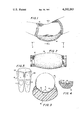
- FIGS. 1 and 2 are side and bottom elevations of an embodiment of the invention
- FIG. 3 is a cross-sectional elevation along line 3--3 of FIG. 1;
- FIG. 4 is an enlargement of circled area 4 in FIG. 3;
- FIG. 5 shows athletic trousers including the invention.
- the present invention is based, in one aspect, on the use of hydrokinetic fabric combinations in medical and athletic applications.
- the hydrokinetic principle is not novel per se and, indeed is the principle employed in disposable diapers and some other products.
- a hydrophobic material forms the surface of a fabric that is adapted to be placed next to the moisture source, and a hydrophilic material forms the opposed surface.
- synthetic fibers such as acrylics are preferred, and cotton is typical of the latter.
- the acrylic Being hydrophobic, the acrylic will wick moisture away from the surface by capillary action and into contact with the hydrophilic cotton, where it is absorbed and migrates outwardly, facilitating evaporation and evaporative cooling.
- the integral pad also plays a role in the hydrokinetic action, as described hereinbelow.
- a terry knit tube 10 is provided including Creslan (TM) terry loops 12 on the inner surface and an outer surface 14 of a cotton yarn.
- TM Creslan
- the cotton side include two feeds, one of cotton and one of texturalized nylon.
- sleeve 10 can be produced on a conventional 108 needle 4 inch cylinder machine (Carolina Knitting Machine Knitfast 4 T).
- a conventional 108 needle 4 inch cylinder machine Carolina Knitting Machine Knitfast 4 T.
- Creslan acrylic type 67A (Count 1/22.5) is used; for the first back side feed type 66 texturalized nylon (Count 100/2/34), and for the second back feed cotton (Count 18/1 C.P.) is used.
- a sleeve as described above forms an essential part of the invention for medical purposes.
- such a fabric would be very desireable, for instance, in hockey uniforms, but would be heavier than desired for warm weather sports.
- the integral foam pad 16 forms the second part of the invention.
- the preferred foam material for medical applications, is a hydrophilic polyurethane polymer, though other materials can be used.
- a preferred foam pad formulation is as follows: One feed is the TDI pre-polymer (Hypol 3000, Grace Chemical). The other feed is a water solution, with the following additives:
- the purpose of the surfactant is to optimise cell structure, and an acceptable range is 1-5%. Acceptable range for the catalyst, a tertiary amine, is 0.5 to 1.5%.
- the colorant is of course optional. An increase in the catalyst will speed the reaction.
- the TDI pre-polymer and the aqueous solution are mixed in a ratio of from 5:5 to 5:3. With the lesser proportion of solution (5:4 or 5:3) the reaction is speeded, since water acts as a heat sink. However, certain other properties are also affected. As noted hereinbelow, this ratio also affects mold design, and it is preferred to establish one ratio.
- the 1:1 ratio provides very fast demold times (2 minutes) and has been used.
- density of the foam is primarily a matter of the formulation utilized, it can be varied by a factor of 2 or 3 by merely overpacking the mold. Obviously, metal molds are preferred to prevent flashing and produce a good quality skin.
- Witco FO 538 TDI Witco FO 538 TDI in a ratio of 100:165 with a polyol, but in this instance de-mold time was about 8 minutes.
- foam systems--PVC, rubber latex, polyethylene, polypropylene, styrene or polyester--could be employed, but processing is quite different and properties would also be different.
- pads are produced having the following properties:
- Forming of the pad 16 integrally with the sleeve 10 is carried out in the following manner: Pour molding is used. A mixing head is located above the molding station. [It will be appreciated that, for economic, volume production a machine including a plurality of molds arranged in a carousel is preferred.] A predetermined quantity of the mixed reactants is poured into the female mold.
- temperature control is desireable both in terms of uniformity of product and maximum production rates. In the preferred system set forth above about 115° F. on the prepolymer side and anywhere from room to 90° F. on the solution side should be maintained. The exact temperature is not important, but uniformity of temperature is. It is also desireable to have a mold preheat station ahead of the mold station, where an 80°-85° F. temperature is established.
- the female mold is of the desired shape for heel, elbow or other applications, e.g. generally cup-shaped.
- about 40-50% shrinkage occurs after de-mold (due to water evaporation), so the mold must be appropiately oversized, and shrinkage will vary with the pre-polymer-solution ratio, so this should be kept constant.
- the male mold is hinged behind the female, and has sleeve 10 stretched thereover. Hooks on the male mold can be used to hold sleeve 10 at the desired taughtness. Since the degree of tautness will also affect penetration, in any particular system some experimentation is required to optimise this factor. It is desired to have the backing material embedded in and integral with the pad, but the terry loops free-standing (FIG. 4).
- the mold After pouring and the (optional) delay noted hereinabove, the mold is closed and the molds are indexed to the next station. De-mold proceeds after the prescribed interval.
- foams of the type described are themselves very hydrophilic; indeed they are sponge-like. They thus assist greatly in drawing moisture away from the skin and through sleeve 10. With an average pad 16 thickness of about one inch, absorbing capacity of the pad 16 is great. It will also be noted that a single layer sleeve is essential to proper hydrokinetic functioning, which contrasts with prior art devices where a double layer is either necessary or desired.
- a further aspect of the invention is the method of pour molding to obtain the integrally bonded product.
- the manufacturer (“Hypol-Laboratory Procedures and Foam Formulations") it should be possible to coat or impregnate a fabric with the prepolymer, and then immerse it in water or steam for in situ foaming, something said to be not possible with other urethanes. It is thus considered surprising that an integrally bonded product can be produced by pour molding with pre-mixed ingredients.
- FIG. 5 shows a pair of football trousers 18 having integrally molded hip pads 20 and thigh pads 22.
Abstract
For both orthopedic and sports uses, a foamed plastic pad is integrally molded to a fabric. More particularly, a knitted sleeve is constructed having a terry loop on the interior surface of a hydrophobic yarn (e.g. acrylic) and an exterior surface of a hydrophilic yarn (e.g. cotton), whereby moisture is wicked away from the surface in a hydrokinetic fashion. A soft, hydrophilic polyurethane foam pad, which acts as a sponge, absorbs the moisture, is molded integrally with the sleeve, leaving the terry loops free for skin contact. For sports uses, knitted or woven fabrics may be employed, and stiffer, polyurethane foams are preferred.
Description
This is a division, of application Ser. No. 774,377, filed Mar. 4, 1977 now U.S. Pat. No. 4,193,134 issued Mar. 18, 1980.
The present invention relates generally to human protective devices. In one aspect, it relates to pads that may be applied to the heels or elbows of bed-ridden patients for either the prevention or treatment of decubitus ulcers, e.g. bed sores. In another aspect, the invention relates to sports medicine, including integrally molded protective padding of controllable density and stiffness.
Bed sores are caused by friction of the heel or elbows on the bed sheet, in the presence of (body) heat and moisture, e.g. perspiration. While products are known for treatment of this painful condition, it is not believed that there has heretofore been a product effective in its prevention. What is needed is a medium that removes excess moisture from the area, allows for air circulation for removal of heat, and minimizes pressure. Of course, after an ulcer has formed the same conditions are needed for treatment, but in this case the problem of moisture removal is much more severe, because in addition to perspiration there are the inflammatory-response fluids: blood, puss, serous fluids, etc.
As pointed out in detail hereinbelow, a feature of the present invention is the direct molding of a pad to a fabric with the production of an integral product. With proper selection of materials, this product is not only washable but can also be autoclaved. With this in mind, attention was directed to sports padding.
In football, for instance, shoulder pads are separate, bulky devices of considerable weight, and discrete hip and thigh pads are inserted in special pockets in trousers. All of this adds to the weight and adds very substantially to the expense of such outfits. Because pads in accordance with the present invention are washable and of controlled properties, it is now possible to produce a jersey with integral, washable shoulder pads and trousers with similar hip and thigh pads, eliminating the special pockets, much weight and much expense, while at the same time carrying out the protective function as well or even better than conventional devices (pads of this type can not be left on the locker room floor).
In U.S. Pat. No. 3,322,118 there is disclosed a protective heel or elbow sleeve including a knitted double-layered sleeve having a generally circular, cup-shaped foam pad therebetween and cemented to the inside of the outer layer. The pad reduces pressure and the inner layer can move with the patient, reducing friction.
A commerical product on the market is much simpler. Under the trademark "Heelbo", it includes an Acrilan (TM) sleeve with an inner, bar-tacked pad shaped in the same manner as a brassiere pad and, indeed, resembling same.
By virtue of their shaped pads, these devices are improvements over earlier cushion protectors, such as is disclosed in U.S. Pat. No. 3,189,919, where a flat pad is bent around the desired area.
In U.S. Pat. No. 3,990,440 a method is disclosed involving a shaped foam pad and a separate tubular sleeve, the pad comprising adhesively bonded particles of a polyurethane foam.
U.S. Pat. No. 3,648,291 discloses a foam rubber pad within a sleeve of a hard-surfaced fabric, and including an elasticized cuff. Other devices, with variously shaped pads and securing straps, are disclosed in U.S. Pat. Nos. 3,011,494; 3,693,619; and 3,670,725. A polyvinyl alcohol gel pad is disclosed in U.S. Pat. No. 3,858,379.
A general object of the present invention is to provide an improved process for producing a protective pad for medical and athletic purposes.
Another object of the present invention is to provide an improved process for producing a pad for both prevention and treatment of decubitus ulcers.
A further object of the present invention is to provide an improved process for producing a protective pad including hydrokinetic moisture removal.
A still further object of the present invention is to provide an improved process for producing a protective pad which is less expensive to manufacture than products previously available.
Yet another object of the present invention is to provide an improved process for producing an integral protective pad and fabric combination that is not only washable but that also can be autoclaved.
A still further object of the invention is to provide a process for producing athletic wear having integral padding that is washable, lighter and less expensive than uniform-padding combinations heretofore available.
Various other objects and advantages of the invention will become clear from the following description of embodiments thereof, and the novel feature will be particularly pointed out in connection with the appended claims.
Reference will hereinafter be made to the accompanying drawings, wherein:
FIGS. 1 and 2 are side and bottom elevations of an embodiment of the invention;
FIG. 3 is a cross-sectional elevation along line 3--3 of FIG. 1;
FIG. 4 is an enlargement of circled area 4 in FIG. 3; and
FIG. 5 shows athletic trousers including the invention.
The present invention is based, in one aspect, on the use of hydrokinetic fabric combinations in medical and athletic applications. The hydrokinetic principle is not novel per se and, indeed is the principle employed in disposable diapers and some other products. In general, a hydrophobic material forms the surface of a fabric that is adapted to be placed next to the moisture source, and a hydrophilic material forms the opposed surface. In the former category, synthetic fibers such as acrylics are preferred, and cotton is typical of the latter.
Being hydrophobic, the acrylic will wick moisture away from the surface by capillary action and into contact with the hydrophilic cotton, where it is absorbed and migrates outwardly, facilitating evaporation and evaporative cooling. In the present invention, the integral pad also plays a role in the hydrokinetic action, as described hereinbelow.
The invention will first be described with reference to an orthopedic pad, and attention is directed to the drawings. A terry knit tube 10 is provided including Creslan (TM) terry loops 12 on the inner surface and an outer surface 14 of a cotton yarn. To provide better stretching qualitites to the sleeve, it is preferred that the cotton side include two feeds, one of cotton and one of texturalized nylon.
For example, sleeve 10 can be produced on a conventional 108 needle 4 inch cylinder machine (Carolina Knitting Machine Knitfast 4 T). For the terry loop feed Creslan acrylic type 67A (Count 1/22.5) is used; for the first back side feed type 66 texturalized nylon (Count 100/2/34), and for the second back feed cotton (Count 18/1 C.P.) is used.
It is to be noted that a sleeve as described above, e.g. hydrokinetic, forms an essential part of the invention for medical purposes. In athletic embodiments, such a fabric would be very desireable, for instance, in hockey uniforms, but would be heavier than desired for warm weather sports.
The integral foam pad 16 forms the second part of the invention. The preferred foam material, for medical applications, is a hydrophilic polyurethane polymer, though other materials can be used.
A preferred foam pad formulation is as follows: One feed is the TDI pre-polymer (Hypol 3000, Grace Chemical). The other feed is a water solution, with the following additives:
______________________________________surfactant 2% (Bridge 72, ICI Americana) Catalyst 0.5% (Thancat DD, Jefferson Chemical) colorant 0.5% (Calotone Blue, 50% solids, American Cyanamid) ______________________________________
The purpose of the surfactant is to optimise cell structure, and an acceptable range is 1-5%. Acceptable range for the catalyst, a tertiary amine, is 0.5 to 1.5%. The colorant is of course optional. An increase in the catalyst will speed the reaction.
The TDI pre-polymer and the aqueous solution are mixed in a ratio of from 5:5 to 5:3. With the lesser proportion of solution (5:4 or 5:3) the reaction is speeded, since water acts as a heat sink. However, certain other properties are also affected. As noted hereinbelow, this ratio also affects mold design, and it is preferred to establish one ratio. The 1:1 ratio provides very fast demold times (2 minutes) and has been used.
While density of the foam is primarily a matter of the formulation utilized, it can be varied by a factor of 2 or 3 by merely overpacking the mold. Obviously, metal molds are preferred to prevent flashing and produce a good quality skin.
Good pads have also been produced with Witco FO 538 TDI in a ratio of 100:165 with a polyol, but in this instance de-mold time was about 8 minutes.
Other foam systems--PVC, rubber latex, polyethylene, polypropylene, styrene or polyester--could be employed, but processing is quite different and properties would also be different.
Using the preferred system noted above, pads are produced having the following properties:
______________________________________
Density             6-7 lbs/ft.sup.3
ASTM 1564
Indentation Load Deflection (I.L.D)
25%                 20 lbs/50 in.sup.2
65%                 57 lbs/50 in.sup.2
Sag factor: 2.85
Compression Load Deflection (C.L.D)
25%                  0.2 psi
65%                 0.64 psi
______________________________________
Forming of the pad 16 integrally with the sleeve 10 is carried out in the following manner: Pour molding is used. A mixing head is located above the molding station. [It will be appreciated that, for economic, volume production a machine including a plurality of molds arranged in a carousel is preferred.] A predetermined quantity of the mixed reactants is poured into the female mold.
Those skilled in the art will appreciate that temperature control is desireable both in terms of uniformity of product and maximum production rates. In the preferred system set forth above about 115° F. on the prepolymer side and anywhere from room to 90° F. on the solution side should be maintained. The exact temperature is not important, but uniformity of temperature is. It is also desireable to have a mold preheat station ahead of the mold station, where an 80°-85° F. temperature is established.
The female mold is of the desired shape for heel, elbow or other applications, e.g. generally cup-shaped. In the preferred system, about 40-50% shrinkage occurs after de-mold (due to water evaporation), so the mold must be appropiately oversized, and shrinkage will vary with the pre-polymer-solution ratio, so this should be kept constant.
It has been determined that, after pouring, a delay of a few seconds (less than 5) in closing the mold is useful; it is believed that gel formation commences in this period and assists in obtaining the desired degree of penetration of foam into the fabric.
The male mold is hinged behind the female, and has sleeve 10 stretched thereover. Hooks on the male mold can be used to hold sleeve 10 at the desired taughtness. Since the degree of tautness will also affect penetration, in any particular system some experimentation is required to optimise this factor. It is desired to have the backing material embedded in and integral with the pad, but the terry loops free-standing (FIG. 4).
After pouring and the (optional) delay noted hereinabove, the mold is closed and the molds are indexed to the next station. De-mold proceeds after the prescribed interval.
An important aspect of the present invention is that foams of the type described are themselves very hydrophilic; indeed they are sponge-like. They thus assist greatly in drawing moisture away from the skin and through sleeve 10. With an average pad 16 thickness of about one inch, absorbing capacity of the pad 16 is great. It will also be noted that a single layer sleeve is essential to proper hydrokinetic functioning, which contrasts with prior art devices where a double layer is either necessary or desired.
A further aspect of the invention is the method of pour molding to obtain the integrally bonded product. According to the manufacturer ("Hypol-Laboratory Procedures and Foam Formulations") it should be possible to coat or impregnate a fabric with the prepolymer, and then immerse it in water or steam for in situ foaming, something said to be not possible with other urethanes. It is thus considered surprising that an integrally bonded product can be produced by pour molding with pre-mixed ingredients.
While not wishing to be bound to any particular theory of operation, it is believed that the substantial amount of water in the formulation wets the cotton (hydrophilic) yarn on contact, thus facilitating penetration of the foam and formation of a truly integral product. Wetting is also enhanced, of course, by the surfactant.
In athletic applications, partial penetration of the pad into the material may or may not be desired. With woven fabrics, full penetration is perfectly satisfactory. Since impact absorbing properties are paramount in sports padding, somewhat stiffer pads are desired. Typical of these are an integral skin, medium density, semi-rigid urethane. In certain applications (e.g. shoulder pads) these may be provided with a rigid (pre-molded) core; otherwise, procedures would be as described hereinabove.
FIG. 5 shows a pair of football trousers 18 having integrally molded hip pads 20 and thigh pads 22.
Varous changes in the details, steps materials and arrangements of parts, which have been herein described and illustrated in order to explain the nature of the invention, may be made by those skilled in the art within the principle and scope of the invention as defined in the appended claims.
Claims (4)
1. The method of producing a body-protecting pad comprising:
stretching a hydrokinetic fabric sleeve over a male mold, the tautness of said stretched fabric sleeve being controlled to facilitate wetting and penetration of foam into the exterior of said fabric;
mixing a water-foamable hydrophilic polyurethane prepolymer and water in desired proportions in an open female pad mold of desired shape;
closing said molds; and
demolding the resulting, integrally molded pad and sleeve.
2. The method as claimed in claim 1, wherein said water contains a surfactant and a tertiary amine catalyst.
3. The method as claimed in claim 1, wherein said closing is delayed no more than about 5 seconds after said charging.
4. The method as claimed in claim 1, wherein said sleeve is a knit terry fabric having interior, hydrophobic terry loops and a hydrophilic exterior.
Priority Applications (1)
| Application Number | Priority Date | Filing Date | Title |
|---|---|---|---|
| US06/069,929 US4292263A (en) | 1977-03-04 | 1979-08-27 | Method of producing a foamed polyurethane body-protecting pad |
Applications Claiming Priority (2)
| Application Number | Priority Date | Filing Date | Title |
|---|---|---|---|
| US05/774,377 US4193134A (en) | 1977-03-04 | 1977-03-04 | Protective device with integrally molded pad |
| US06/069,929 US4292263A (en) | 1977-03-04 | 1979-08-27 | Method of producing a foamed polyurethane body-protecting pad |
Related Parent Applications (1)
| Application Number | Title | Priority Date | Filing Date |
|---|---|---|---|
| US05/774,377 Division US4193134A (en) | 1977-03-04 | 1977-03-04 | Protective device with integrally molded pad |
Publications (1)
| Publication Number | Publication Date |
|---|---|
| US4292263A true US4292263A (en) | 1981-09-29 |
Family
ID=26750570
Family Applications (1)
| Application Number | Title | Priority Date | Filing Date |
|---|---|---|---|
| US06/069,929 Expired - Lifetime US4292263A (en) | 1977-03-04 | 1979-08-27 | Method of producing a foamed polyurethane body-protecting pad |
Country Status (1)
| Country | Link |
|---|---|
| US (1) | US4292263A (en) |
Cited By (57)
| Publication number | Priority date | Publication date | Assignee | Title |
|---|---|---|---|---|
| US4484360A (en) * | 1983-10-13 | 1984-11-27 | Spectrum Sports, Inc. | Shin guard and method of making |
| US4484361A (en) * | 1983-10-13 | 1984-11-27 | Spectrum Sports, Inc. | Knee and elbow pad and method of making |
| US4494247A (en) * | 1981-12-28 | 1985-01-22 | Trace Athletic Corporation | Knee/elbow guard treated to increase durability and a process for producing same |
| US4573216A (en) * | 1982-07-10 | 1986-03-04 | Walter Wortberg | Impact dissipator |
| US4910886A (en) * | 1983-02-28 | 1990-03-27 | Sullivan James B | Shock-absorbing innersole |
| US4922929A (en) * | 1989-08-31 | 1990-05-08 | Dejournett Richard L | Padded elbow brace |
| US4926502A (en) * | 1989-01-09 | 1990-05-22 | Wacoal Corp. | Corset for alleviation of lumbago |
| US4987613A (en) * | 1990-02-01 | 1991-01-29 | Loverdi Angela M | All-in-one slider sport pants |
| US5168576A (en) * | 1990-10-03 | 1992-12-08 | Krent Edward D | Body protective device |
| US5304547A (en) * | 1990-01-29 | 1994-04-19 | Roquette Freres | Process of refining mixtures obtained from treatments of fatty media with cyclodextrin and containing complexes of cyclodextrin mainly with lipophilic substances other than fatty acids |
| US5328652A (en) * | 1992-06-19 | 1994-07-12 | Protective Athletic Designs, Inc. | Method for making a foamed goal pad for hockey |
| US5405312A (en) * | 1992-06-22 | 1995-04-11 | Safe-T-Gard Corporation | Custom fit body guards |
| US5545128A (en) * | 1992-11-20 | 1996-08-13 | Beth Israel Hospital | Bone fracture prevention method |
| US5636385A (en) * | 1995-12-06 | 1997-06-10 | Harrison; Don | Clothing article with framed hologram applique |
| US5689836A (en) * | 1994-08-22 | 1997-11-25 | Mcdavid Knee Guard, Inc. | Athletic protective undergarment |
| US5787610A (en) * | 1996-05-29 | 1998-08-04 | Jeffrey S. Brooks, Inc. | Footwear |
| US5876134A (en) * | 1992-02-14 | 1999-03-02 | The Gillette Company | Foam grip |
| US5914082A (en) * | 1995-11-30 | 1999-06-22 | Harrison; Donald G. | Method and apparatus for molding thermosetting polymers onto substrates |
| US5928593A (en) * | 1995-11-30 | 1999-07-27 | Harrison; Donald G. | Method and apparatus for molding thermosetting polymers onto substrates |
| US5939004A (en) * | 1995-11-30 | 1999-08-17 | Harrison; Donald G. | Molding thermosetting polymers onto substrates |
| US6058503A (en) * | 1998-03-20 | 2000-05-09 | Williams; David | Articulated joint protector |
| US6093468A (en) * | 1997-03-14 | 2000-07-25 | The Procter & Gamble Company | Flexible lightweight protective pad with energy absorbing inserts |
| US6139787A (en) * | 1996-10-24 | 2000-10-31 | Ubertech Texas, Inc. | Method for applying molded silicone design elements onto substrates |
| US6193914B1 (en) | 1995-11-30 | 2001-02-27 | Ubertech Texas, Inc. | Molding thermosetting polymers onto substrates |
| US6241930B1 (en) | 1995-11-30 | 2001-06-05 | Ubertech Texas, Inc. | Method of constructing a garment with a graphical design thereon |
| US6273091B1 (en) * | 1999-11-18 | 2001-08-14 | Handle With Care, Inc. | Apparatus and method for safely maintaining a restraining hold on a person |
| US6279160B1 (en) * | 1999-03-15 | 2001-08-28 | Asics Corp | Knee and elbow protector |
| NL1015412C2 (en) * | 2000-06-09 | 2001-12-12 | Lyds Internat B V | Garment able to protect the bones, includes a shock absorbing layer of microcellular polyurethane |
| US6490730B1 (en) | 1989-09-20 | 2002-12-10 | Robert M. Lyden | Shin-guard, helmet, and articles of protective equipment including light cure material |
| US6519782B2 (en) | 2001-05-01 | 2003-02-18 | Hos Development Corporation | Baseball catcher's chest protector |
| US6681403B2 (en) | 2000-03-13 | 2004-01-27 | Robert M. Lyden | Shin-guard, helmet, and articles of protective equipment including light cure material |
| US6687912B2 (en) | 2001-05-01 | 2004-02-10 | Hos Development Corporation | Baseball catcher's shin guard |
| US20040078873A1 (en) * | 2002-10-18 | 2004-04-29 | The Hipsaver Co., Inc. | Washable protective pad |
| FR2848071A1 (en) * | 2002-12-06 | 2004-06-11 | Lee Sara Corp | Knitted sock or stocking has areas of padding made from foam-filled textiles incorporated in sole |
| US20040210178A1 (en) * | 2001-08-08 | 2004-10-21 | Beiersdorf, Inc. | Tennis elbow support comprising tendon pad |
| US6810603B1 (en) | 2001-04-10 | 2004-11-02 | Anthony Cosentino | Toe pad for ballet dancers |
| US6854198B2 (en) | 1996-05-29 | 2005-02-15 | Jeffrey S. Brooks, Inc. | Footwear |
| US20050165338A1 (en) * | 1995-12-28 | 2005-07-28 | Iglesias Joseph M. | Molded orthopaedic devices |
| US20070277282A1 (en) * | 2006-05-17 | 2007-12-06 | Art Sheppell | Support for prevention of decubitus ulcers |
| FR2912879A1 (en) * | 2007-02-22 | 2008-08-29 | Olympia Soc Par Actions Simpli | Collar shaped textile device e.g. sock, for e.g. use during practicing of football, has knitted structure including meshes passed inside pad, and locked by elastic material of pad to form assembly, and pad portion arranged outside structure |
| US20090048550A1 (en) * | 2007-08-18 | 2009-02-19 | Silikids Llc | Knee pads for children and method of manufacture |
| FR2940046A1 (en) * | 2008-12-22 | 2010-06-25 | Thuasne | HEEL PROTECTIVE DEVICE PREVENTING THE HEART SQUARE |
| US20100319096A1 (en) * | 2009-06-22 | 2010-12-23 | Scott Michael A | Methods and devices for reducing elbow pain and arm fatigue for poker players when playing poker |
| US20110023324A1 (en) * | 2009-08-03 | 2011-02-03 | Dananberg Howard J | Footwear sole |
| US20110185467A1 (en) * | 2010-02-04 | 2011-08-04 | Loretta Suarez | Leg Warmers for Crawling Babies |
| EP2394811A1 (en) | 2010-06-08 | 2011-12-14 | Jade Long John Enterprise Co., Ltd | A performance textile having gas permeable and protective function |
| US20120174278A1 (en) * | 2011-01-10 | 2012-07-12 | Allen Spivak | Protective Apparel for Use While Gardening |
| US8555888B1 (en) * | 2007-03-07 | 2013-10-15 | Trauma Technologies, Inc. | Pressure relief gel pads |
| US20150038891A1 (en) * | 2013-08-01 | 2015-02-05 | James Lipton | Protective sheath |
| US20150101097A1 (en) * | 2013-10-11 | 2015-04-16 | Julia M. Clarke | Protective knee band |
| US10390587B2 (en) | 2016-03-01 | 2019-08-27 | Hbn Shoe, Llc | Device for high-heeled shoes and method of constructing a high-heeled shoe |
| US10477915B2 (en) | 2016-03-01 | 2019-11-19 | Hbn Shoe, Llc | Device for high-heeled shoes and method of constructing a high-heeled shoe |
| US10702008B2 (en) | 2018-02-26 | 2020-07-07 | Hbn Shoe, Llc | Device and method of constructing shoes |
| US10806193B2 (en) * | 2014-11-07 | 2020-10-20 | Toscom Co., Ltd. | Supporter and method for manufacturing same |
| US11540588B1 (en) | 2021-11-24 | 2023-01-03 | Hbn Shoe, Llc | Footwear insole |
| US11717038B2 (en) * | 2009-08-11 | 2023-08-08 | Adidas Ag | Pad for a garment, padded garment and method of manufacturing same |
| US11805850B1 (en) | 2023-07-19 | 2023-11-07 | Hbn Shoe, Llc | Cuboid pad |
Citations (20)
| Publication number | Priority date | Publication date | Assignee | Title |
|---|---|---|---|---|
| US2302368A (en) * | 1939-03-21 | 1942-11-17 | Burr A Evans | Shooting jacket |
| US2626394A (en) * | 1948-09-21 | 1953-01-27 | Davis Loraine | Cushion pad |
| US2727278A (en) * | 1952-11-21 | 1955-12-20 | Robert D Thompson | Method of making molded composite article |
| US3011494A (en) * | 1959-04-06 | 1961-12-05 | Florence R Mcgowan | Protective pad for bed patients |
| US3116196A (en) * | 1957-06-11 | 1963-12-31 | Stubnitz Greene Corp | Combination pad and insulator for cushions |
| US3136832A (en) * | 1959-08-22 | 1964-06-09 | Fritz Sandmeier | Method of manufacturing a foamedrubber article |
| US3189919A (en) * | 1963-12-05 | 1965-06-22 | George Frost Company | Cushioned protector |
| US3239584A (en) * | 1964-02-24 | 1966-03-08 | Hoover Ball & Bearing Co | Method of fabricating a seat or cushion of combined springs and resilient pad construction |
| US3246059A (en) * | 1961-09-01 | 1966-04-12 | Collo Rheincollodium Koln G M | Process for the preparation of form pressed parts of light specific gravity from foamed synthetic plastics |
| US3256882A (en) * | 1964-04-28 | 1966-06-21 | Huber Karl | Strapping support |
| US3273179A (en) * | 1963-03-19 | 1966-09-20 | Hoover Ball & Bearing Co | Insulator for foam pads and method of making the same |
| US3322118A (en) * | 1964-07-13 | 1967-05-30 | Sotherlin Lois | Protective sleeve for elbow or heel |
| US3446880A (en) * | 1964-12-31 | 1969-05-27 | James H Enicks | Method of manufacturing a protective athletic pad |
| US3493449A (en) * | 1965-10-12 | 1970-02-03 | Freudenberg Carl | Process for the manufacture of molded foam articles from polyurethanes |
| US3606614A (en) * | 1969-09-15 | 1971-09-21 | Thomas G Dimitroff | Sports glove |
| US3648291A (en) * | 1970-07-06 | 1972-03-14 | William A Braddock | Protective garment for bedridden people |
| US3670725A (en) * | 1969-06-30 | 1972-06-20 | Medical Specialties Inc | Protective pad |
| US3858379A (en) * | 1970-06-09 | 1975-01-07 | Us Army | Process for making a polyvinyl alcohol gel support pad |
| US3990440A (en) * | 1974-07-29 | 1976-11-09 | Medical Specialties, Inc. | Body protecting method |
| US4003113A (en) * | 1971-04-01 | 1977-01-18 | Bulloch Jr Carl Gordon | Method of forming a spring cushion construction |
-
1979
- 1979-08-27 US US06/069,929 patent/US4292263A/en not_active Expired - Lifetime
Patent Citations (20)
| Publication number | Priority date | Publication date | Assignee | Title |
|---|---|---|---|---|
| US2302368A (en) * | 1939-03-21 | 1942-11-17 | Burr A Evans | Shooting jacket |
| US2626394A (en) * | 1948-09-21 | 1953-01-27 | Davis Loraine | Cushion pad |
| US2727278A (en) * | 1952-11-21 | 1955-12-20 | Robert D Thompson | Method of making molded composite article |
| US3116196A (en) * | 1957-06-11 | 1963-12-31 | Stubnitz Greene Corp | Combination pad and insulator for cushions |
| US3011494A (en) * | 1959-04-06 | 1961-12-05 | Florence R Mcgowan | Protective pad for bed patients |
| US3136832A (en) * | 1959-08-22 | 1964-06-09 | Fritz Sandmeier | Method of manufacturing a foamedrubber article |
| US3246059A (en) * | 1961-09-01 | 1966-04-12 | Collo Rheincollodium Koln G M | Process for the preparation of form pressed parts of light specific gravity from foamed synthetic plastics |
| US3273179A (en) * | 1963-03-19 | 1966-09-20 | Hoover Ball & Bearing Co | Insulator for foam pads and method of making the same |
| US3189919A (en) * | 1963-12-05 | 1965-06-22 | George Frost Company | Cushioned protector |
| US3239584A (en) * | 1964-02-24 | 1966-03-08 | Hoover Ball & Bearing Co | Method of fabricating a seat or cushion of combined springs and resilient pad construction |
| US3256882A (en) * | 1964-04-28 | 1966-06-21 | Huber Karl | Strapping support |
| US3322118A (en) * | 1964-07-13 | 1967-05-30 | Sotherlin Lois | Protective sleeve for elbow or heel |
| US3446880A (en) * | 1964-12-31 | 1969-05-27 | James H Enicks | Method of manufacturing a protective athletic pad |
| US3493449A (en) * | 1965-10-12 | 1970-02-03 | Freudenberg Carl | Process for the manufacture of molded foam articles from polyurethanes |
| US3670725A (en) * | 1969-06-30 | 1972-06-20 | Medical Specialties Inc | Protective pad |
| US3606614A (en) * | 1969-09-15 | 1971-09-21 | Thomas G Dimitroff | Sports glove |
| US3858379A (en) * | 1970-06-09 | 1975-01-07 | Us Army | Process for making a polyvinyl alcohol gel support pad |
| US3648291A (en) * | 1970-07-06 | 1972-03-14 | William A Braddock | Protective garment for bedridden people |
| US4003113A (en) * | 1971-04-01 | 1977-01-18 | Bulloch Jr Carl Gordon | Method of forming a spring cushion construction |
| US3990440A (en) * | 1974-07-29 | 1976-11-09 | Medical Specialties, Inc. | Body protecting method |
Cited By (73)
| Publication number | Priority date | Publication date | Assignee | Title |
|---|---|---|---|---|
| US4494247A (en) * | 1981-12-28 | 1985-01-22 | Trace Athletic Corporation | Knee/elbow guard treated to increase durability and a process for producing same |
| US4573216A (en) * | 1982-07-10 | 1986-03-04 | Walter Wortberg | Impact dissipator |
| US4910886A (en) * | 1983-02-28 | 1990-03-27 | Sullivan James B | Shock-absorbing innersole |
| US4484360A (en) * | 1983-10-13 | 1984-11-27 | Spectrum Sports, Inc. | Shin guard and method of making |
| US4484361A (en) * | 1983-10-13 | 1984-11-27 | Spectrum Sports, Inc. | Knee and elbow pad and method of making |
| US4926502A (en) * | 1989-01-09 | 1990-05-22 | Wacoal Corp. | Corset for alleviation of lumbago |
| US4922929A (en) * | 1989-08-31 | 1990-05-08 | Dejournett Richard L | Padded elbow brace |
| US6490730B1 (en) | 1989-09-20 | 2002-12-10 | Robert M. Lyden | Shin-guard, helmet, and articles of protective equipment including light cure material |
| US5304547A (en) * | 1990-01-29 | 1994-04-19 | Roquette Freres | Process of refining mixtures obtained from treatments of fatty media with cyclodextrin and containing complexes of cyclodextrin mainly with lipophilic substances other than fatty acids |
| US4987613A (en) * | 1990-02-01 | 1991-01-29 | Loverdi Angela M | All-in-one slider sport pants |
| US5168576A (en) * | 1990-10-03 | 1992-12-08 | Krent Edward D | Body protective device |
| US5423087A (en) * | 1990-10-03 | 1995-06-13 | Krent; Edward D. | Body protective device |
| US5876134A (en) * | 1992-02-14 | 1999-03-02 | The Gillette Company | Foam grip |
| US5328652A (en) * | 1992-06-19 | 1994-07-12 | Protective Athletic Designs, Inc. | Method for making a foamed goal pad for hockey |
| US5405312A (en) * | 1992-06-22 | 1995-04-11 | Safe-T-Gard Corporation | Custom fit body guards |
| US5599290A (en) * | 1992-11-20 | 1997-02-04 | Beth Israel Hospital | Bone fracture prevention garment and method |
| US5545128A (en) * | 1992-11-20 | 1996-08-13 | Beth Israel Hospital | Bone fracture prevention method |
| US5689836A (en) * | 1994-08-22 | 1997-11-25 | Mcdavid Knee Guard, Inc. | Athletic protective undergarment |
| US6193914B1 (en) | 1995-11-30 | 2001-02-27 | Ubertech Texas, Inc. | Molding thermosetting polymers onto substrates |
| US5914082A (en) * | 1995-11-30 | 1999-06-22 | Harrison; Donald G. | Method and apparatus for molding thermosetting polymers onto substrates |
| US5928593A (en) * | 1995-11-30 | 1999-07-27 | Harrison; Donald G. | Method and apparatus for molding thermosetting polymers onto substrates |
| US5939004A (en) * | 1995-11-30 | 1999-08-17 | Harrison; Donald G. | Molding thermosetting polymers onto substrates |
| US6241930B1 (en) | 1995-11-30 | 2001-06-05 | Ubertech Texas, Inc. | Method of constructing a garment with a graphical design thereon |
| US5636385A (en) * | 1995-12-06 | 1997-06-10 | Harrison; Don | Clothing article with framed hologram applique |
| US7311686B1 (en) | 1995-12-28 | 2007-12-25 | Ossur Hf | Molded orthopaedic devices |
| US20050165338A1 (en) * | 1995-12-28 | 2005-07-28 | Iglesias Joseph M. | Molded orthopaedic devices |
| US7867182B2 (en) | 1995-12-28 | 2011-01-11 | Ossur Hf | Molded orthopaedic devices |
| US6854198B2 (en) | 1996-05-29 | 2005-02-15 | Jeffrey S. Brooks, Inc. | Footwear |
| US5787610A (en) * | 1996-05-29 | 1998-08-04 | Jeffrey S. Brooks, Inc. | Footwear |
| US6139787A (en) * | 1996-10-24 | 2000-10-31 | Ubertech Texas, Inc. | Method for applying molded silicone design elements onto substrates |
| US6093468A (en) * | 1997-03-14 | 2000-07-25 | The Procter & Gamble Company | Flexible lightweight protective pad with energy absorbing inserts |
| US6058503A (en) * | 1998-03-20 | 2000-05-09 | Williams; David | Articulated joint protector |
| US6279160B1 (en) * | 1999-03-15 | 2001-08-28 | Asics Corp | Knee and elbow protector |
| US6273091B1 (en) * | 1999-11-18 | 2001-08-14 | Handle With Care, Inc. | Apparatus and method for safely maintaining a restraining hold on a person |
| US6681403B2 (en) | 2000-03-13 | 2004-01-27 | Robert M. Lyden | Shin-guard, helmet, and articles of protective equipment including light cure material |
| US7003803B1 (en) | 2000-03-13 | 2006-02-28 | Lyden Robert M | Shin-guard, helmet, and articles of protective equipment including light cure material |
| NL1015412C2 (en) * | 2000-06-09 | 2001-12-12 | Lyds Internat B V | Garment able to protect the bones, includes a shock absorbing layer of microcellular polyurethane |
| US6810603B1 (en) | 2001-04-10 | 2004-11-02 | Anthony Cosentino | Toe pad for ballet dancers |
| US6519782B2 (en) | 2001-05-01 | 2003-02-18 | Hos Development Corporation | Baseball catcher's chest protector |
| US6687912B2 (en) | 2001-05-01 | 2004-02-10 | Hos Development Corporation | Baseball catcher's shin guard |
| US20040210178A1 (en) * | 2001-08-08 | 2004-10-21 | Beiersdorf, Inc. | Tennis elbow support comprising tendon pad |
| US7527602B2 (en) | 2001-08-08 | 2009-05-05 | 3M Innovative Properties Company | Tennis elbow support comprising tendon pad |
| US20060122549A1 (en) * | 2001-08-08 | 2006-06-08 | Beiersdorf, Inc. | Tennis elbow support comprising tendon pad |
| US20060122550A1 (en) * | 2001-08-08 | 2006-06-08 | Beiersdorf, Inc. | Tennis elbow support comprising tendon pad |
| US7172566B2 (en) | 2001-08-08 | 2007-02-06 | Beiersdorf, Inc. | Tennis elbow support comprising tendon pad |
| US7229426B2 (en) | 2001-08-08 | 2007-06-12 | Beiersdorf, Inc. | Tennis elbow support comprising tendon pad |
| US20040168245A1 (en) * | 2002-10-18 | 2004-09-02 | Goodwin Edward L. | Washable, protective hip pad construction |
| US20040078873A1 (en) * | 2002-10-18 | 2004-04-29 | The Hipsaver Co., Inc. | Washable protective pad |
| FR2848071A1 (en) * | 2002-12-06 | 2004-06-11 | Lee Sara Corp | Knitted sock or stocking has areas of padding made from foam-filled textiles incorporated in sole |
| US20070277282A1 (en) * | 2006-05-17 | 2007-12-06 | Art Sheppell | Support for prevention of decubitus ulcers |
| FR2912879A1 (en) * | 2007-02-22 | 2008-08-29 | Olympia Soc Par Actions Simpli | Collar shaped textile device e.g. sock, for e.g. use during practicing of football, has knitted structure including meshes passed inside pad, and locked by elastic material of pad to form assembly, and pad portion arranged outside structure |
| WO2008104662A1 (en) * | 2007-02-22 | 2008-09-04 | Olympia | Textile device for body protection |
| US20100031706A1 (en) * | 2007-02-22 | 2010-02-11 | Olympia | Textile device for body protection |
| US8555888B1 (en) * | 2007-03-07 | 2013-10-15 | Trauma Technologies, Inc. | Pressure relief gel pads |
| US20090048550A1 (en) * | 2007-08-18 | 2009-02-19 | Silikids Llc | Knee pads for children and method of manufacture |
| WO2010072957A1 (en) * | 2008-12-22 | 2010-07-01 | Thuasne | Heel protection device for preventing a heel eschar |
| FR2940046A1 (en) * | 2008-12-22 | 2010-06-25 | Thuasne | HEEL PROTECTIVE DEVICE PREVENTING THE HEART SQUARE |
| US20100319096A1 (en) * | 2009-06-22 | 2010-12-23 | Scott Michael A | Methods and devices for reducing elbow pain and arm fatigue for poker players when playing poker |
| US20110023324A1 (en) * | 2009-08-03 | 2011-02-03 | Dananberg Howard J | Footwear sole |
| US8166674B2 (en) | 2009-08-03 | 2012-05-01 | Hbn Shoe, Llc | Footwear sole |
| US11717038B2 (en) * | 2009-08-11 | 2023-08-08 | Adidas Ag | Pad for a garment, padded garment and method of manufacturing same |
| US20110185467A1 (en) * | 2010-02-04 | 2011-08-04 | Loretta Suarez | Leg Warmers for Crawling Babies |
| EP2394811A1 (en) | 2010-06-08 | 2011-12-14 | Jade Long John Enterprise Co., Ltd | A performance textile having gas permeable and protective function |
| US20120174278A1 (en) * | 2011-01-10 | 2012-07-12 | Allen Spivak | Protective Apparel for Use While Gardening |
| US20150038891A1 (en) * | 2013-08-01 | 2015-02-05 | James Lipton | Protective sheath |
| US20150101097A1 (en) * | 2013-10-11 | 2015-04-16 | Julia M. Clarke | Protective knee band |
| US10806193B2 (en) * | 2014-11-07 | 2020-10-20 | Toscom Co., Ltd. | Supporter and method for manufacturing same |
| US10390587B2 (en) | 2016-03-01 | 2019-08-27 | Hbn Shoe, Llc | Device for high-heeled shoes and method of constructing a high-heeled shoe |
| US10477915B2 (en) | 2016-03-01 | 2019-11-19 | Hbn Shoe, Llc | Device for high-heeled shoes and method of constructing a high-heeled shoe |
| US10729205B2 (en) | 2016-03-01 | 2020-08-04 | Hbn Shoe, Llc | Device for high-heeled shoes and method of constructing a high-heeled shoe |
| US10702008B2 (en) | 2018-02-26 | 2020-07-07 | Hbn Shoe, Llc | Device and method of constructing shoes |
| US11540588B1 (en) | 2021-11-24 | 2023-01-03 | Hbn Shoe, Llc | Footwear insole |
| US11805850B1 (en) | 2023-07-19 | 2023-11-07 | Hbn Shoe, Llc | Cuboid pad |
Similar Documents
| Publication | Publication Date | Title |
|---|---|---|
| US4292263A (en) | Method of producing a foamed polyurethane body-protecting pad | |
| US4193134A (en) | Protective device with integrally molded pad | |
| US3295529A (en) | Strap material for garments | |
| US3424633A (en) | Method of making strap material | |
| US3374785A (en) | Cervical collar | |
| US3356090A (en) | Absorbent breast pad | |
| US5728169A (en) | Lining material for use with prosthetics and similar devices and method for making and using same | |
| US4469740A (en) | Foam plastic material with moisture removing properties | |
| US6499485B1 (en) | Therapeutic device for treating foot pathologies | |
| US3446880A (en) | Method of manufacturing a protective athletic pad | |
| JP2019517904A (en) | Absorbent Aliphatic Polyurethane Foam Products | |
| US6267743B1 (en) | Anatomically shaped medical bandages | |
| JPH08512212A (en) | Therapeutic moist heat pack | |
| WO2013001083A1 (en) | Thermoplastic sheet material provided with a support layer and use thereof | |
| US7354424B2 (en) | Protective garment | |
| CN107136644A (en) | A kind of rapid traverse movement protection shoe-pad | |
| KR20140137749A (en) | The functional panty for the male | |
| JPH06142126A (en) | Lumbago band | |
| CN107319686A (en) | A kind of moulding body therapeutic massage sport shoe-pad | |
| CN108685267A (en) | A kind of badminton insole | |
| CN206213302U (en) | A kind of Novel cup structure and brassiere | |
| CN211021022U (en) | Molded cup | |
| JP2897953B2 (en) | bag | |
| DE202015104919U1 (en) | padding device | |
| CA2507822C (en) | Protective garment |
Legal Events
| Date | Code | Title | Description |
|---|---|---|---|
| STCF | Information on status: patent grant |
Free format text: PATENTED CASE |